The interest tax shield is the reduction in a borrower's cash taxes from deducting interest. Its value is the present value of those savings. In an adjusted present value valuation, it is a financing benefit added to the value of the unlevered business. If the tax benefit already enters through the after-tax cost of debt in a weighted average cost of capital valuation, adding it separately would count it twice. Damodaran, The Adjusted Present Value Approach
The debt schedule sets the interest base
A fictional company borrows USD 100 million at a fixed 6% annual coupon. It pays interest at each year-end and repays all principal with the fifth coupon. Assume the company can deduct all the interest and use the deduction to reduce cash taxes that same year at a constant 25% marginal rate. Each year it pays USD 6 million of interest and saves million in cash taxes. The principal repayment itself generates no interest deduction. The SelfMadeQuant bond lesson shows how to split a payment schedule into coupons and principal. Zero-Coupon and Coupon Bonds, full lesson for members
Assume the tax savings arrive at the same year-ends and discount them at a stipulated 6% annual effective rate. The five-year shield is worth, in USD millions,
Now suppose the company repays USD 20 million of principal after each year's interest payment. Interest accrues on the opening balance, which falls from USD 100 million in year one to USD 20 million in year five. The first shield is the same, but the later ones shrink. At the same discount rate, the full shield stream is worth USD 3.94 million.
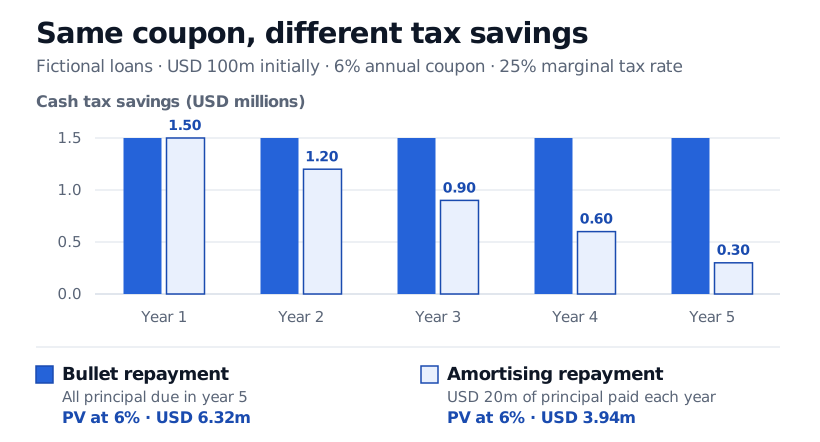
Paying principal earlier reduces later interest and the cash tax savings it generates.
If the company instead keeps USD 100 million of debt outstanding forever, with the same coupon, deduction capacity, tax rate and discount rate, the level perpetuity is worth million. The shortcut of multiplying debt by the tax rate works here because the coupon rate and shield discount rate are equal. Using the cost of debt to discount the shield assumes it bears comparable risk. A fixed coupon determines the interest bill, while future taxable income and deduction rules determine when the cash tax saving arrives. Modigliani and Miller, §II and notes 5 and 9 · Damodaran, Expected Tax Benefit from Borrowing
Forecast when cash taxes actually fall
Keep the operating forecast fixed and calculate cash taxes with and without the borrowing in each period. Discount the differences using assumptions consistent with their timing and risk. Tax losses or a deduction limit can delay the benefit. For example, U.S. federal section 163(j) can limit the current business interest deduction where the rule applies, and a carryforward may still face a limit in the next year. Include a saving in the period the forecast shows it can reduce cash taxes. See capital structure and taxation for the broader borrowing decision. IRS FS-2026-14, Topics A and C