Capital structure is the mix of debt and equity that finances a company. Taxation changes what each source of funding costs. Eligible interest can reduce corporate taxable income, while ordinary dividends generally come out of after-tax profits. The Modigliani–Miller capital-structure theorem gives the no-tax benchmark. Once interest reduces corporate cash taxes, two firms with the same operations can have different values because they finance those operations differently. Modigliani and Miller, 1963, §§I–II · Damodaran, Capital Structure
How much cash does the next loan save?
A fictional company replaces 100 million of equity with 100 million of debt. It pays 6% fixed annual interest on the full balance and earns enough taxable income to use the entire deduction as it arises. At a marginal corporate tax rate of 25%, the annual interest is million and the current interest tax shield is million. The lender still receives the full 6 million. The saving comes from the lower corporate tax bill.
If the company can deduct and use only 2 million this year, its current saving falls to 0.5 million. If the rules let the firm carry forward the other 4 million of interest, the deduction may reduce future cash taxes when the firm has capacity to use it. To estimate the shield's present value, compare cash taxes with and without the extra borrowing in each forecast period. Discount the resulting savings at a rate consistent with their risk. A schedule of deductions can differ from a schedule of cash savings when a company has tax losses or competing deductions. Modigliani and Miller, 1963, note 5 and §II
The U.S. federal limit in 26 U.S.C. § 163(j) illustrates the timing issue. Where the rule applies, the general ceiling combines business interest income, 30% of adjusted taxable income (with that component floored at zero), and qualifying floor plan financing interest. Disallowed interest can generally carry forward and may still face a limit in the following year. Exemptions and separate rules for some entities affect the calculation. 26 U.S.C. § 163(j)(1)–(4) · IRS FS-2026-14, August 2026
Who pays the tax?
Bondholders and shareholders can face different tax rates. In Miller's model, investors who pay more tax on interest than on equity income can demand a higher pretax bond yield. That can offset the issuer's benefit from deducting interest. The size of the offset depends on the investors whose demand sets the market price, since investors in different tax brackets can prefer different claims. Miller, 1977, §§III–IV
Take one dollar of pretax corporate income and assume either fully deductible interest or an ordinary dividend paid out after corporate tax. Use fictional tax rates of 25% at the company, 40% on the bondholder's interest and 20% on the shareholder's dividend. The bondholder keeps dollars. The shareholder keeps dollars. These rates exactly offset the corporate tax advantage in Miller's simplified model.
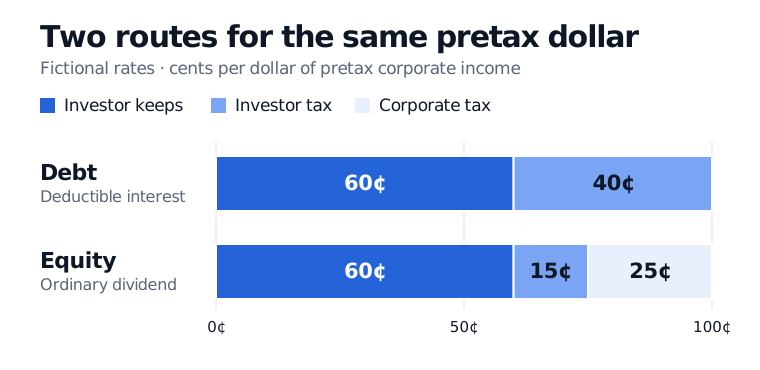
Both investors keep 60 cents per pretax dollar, even though the corporation deducts the interest payment.
Compare financing plans in the same downside case
A refinancing forecast can show tax savings shrinking just as debt service becomes harder to meet. In a weak operating year, the firm may lose current use of some deductions while still owing interest and principal. Extra borrowing can also tie up capacity the firm needs for investment or expose it to financial distress costs. Section 2.4 of the SelfMadeQuant lesson explains how a shortfall of internal cash can put profitable investment at risk when outside funding is costly. Why Manage Financial Risk? Full lesson for members
In a valuation, the weighted average cost of capital can reflect usable tax savings through the after-tax cost of debt. An adjusted present value approach starts with the value of the business without debt and values the savings separately, along with any other material financing effects. This separation makes the timing easier to see when debt amortises or deductions carry forward. Count each saving once. Damodaran, Applied Corporate Finance, Chapter 8
Sources
- Modigliani and Miller (1963), Corporate Income Taxes and the Cost of Capital: A Correction
- Miller (1977), Debt and Taxes
- Office of the Law Revision Counsel, 26 U.S.C. § 163
- IRS FS-2026-14, Questions and Answers on the Business Interest Expense Limitation
- Aswath Damodaran, NYU Stern, Capital Structure
- Aswath Damodaran, Applied Corporate Finance, Chapter 8