Start with the business, then price the financing
- Value the operations. Forecast free cash flow to the firm after operating taxes and reinvestment, before interest and principal flows. Compute taxes for this baseline without the interest deduction. Discount at the unlevered cost of capital, which reflects the risk of the operating cash flows. For a new project, deduct the initial investment to get the unlevered net present value. Jenter, slides 23–25
- Value the tax savings. Use the planned debt balances and interest payments to forecast the interest tax shield when it actually reduces cash taxes. Discount it for its own risk. A predetermined debt schedule with reliable deductions can make that saving relatively predictable. If the firm resets debt to a share of market value, future interest deductions also move with the business. Myers, 1974, §V
- Value the other financing effects. Subtract incremental issuance fees and any expected financial distress costs that the operating forecast has yet to capture. For example, if a funding shortfall forces a firm to abandon a profitable investment, the lost value belongs in the comparison of financing plans. Value uncertain costs in the states and periods where they arise. Damodaran, Estimating Expected Bankruptcy Costs and Net Effect · Why Manage Financial Risk? §2.4, full lesson for members
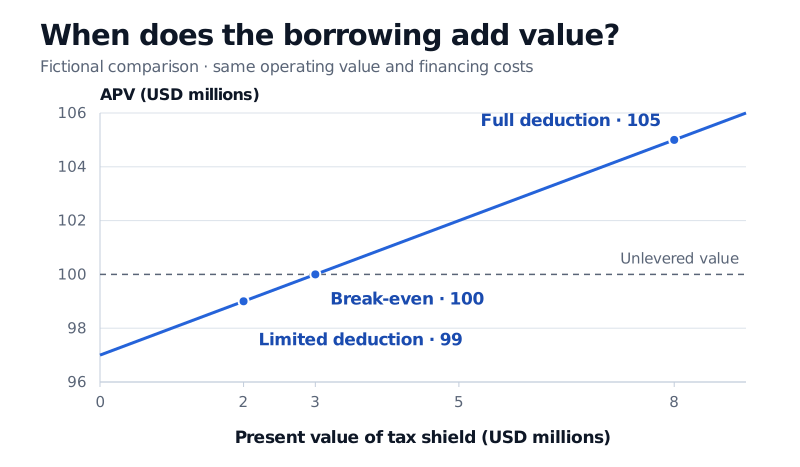
When does the borrowing add value?
A fictional company has an unlevered operating value of USD 100 million. It plans to hold USD 32 million of debt outstanding indefinitely, with interest of 5% paid at each year-end and a net upfront issuance cost of USD 3 million. Assume the company uses the full interest deduction to reduce cash taxes at each year-end at a 25% marginal rate, and the resulting annual saving of USD 0.40 million is discounted at a stipulated 5% annual effective rate. The level saving is worth USD 8 million today. Assume the issuance fee is the only other financing effect. All three values are in USD millions at the valuation date.
Now suppose the company can use only a quarter of each year's deduction, with no later recovery. Holding the other inputs fixed, the shield is worth USD 2 million and APV is USD 99 million. The break-even tax shield is worth exactly enough to cover the issuance fee.