Capital cash flow valuation (CCF) is a discounted cash flow method that adds the interest tax shield to free cash flow to the firm (FCFF) and discounts the combined stream to value the business for debt and equity investors together. FCFF starts with operating cash flows after reinvestment and taxes calculated as if the business had no interest deduction. The shield is the cash tax saving from that deduction. Use the shield once. If the forecast uses cash taxes after the interest deduction, the saving is already in the cash flow. Ruback, §2.1
One year left to run
An analyst values a fictional project with one year remaining. At year-end, the project is expected to generate USD 110 million in FCFF and save USD 10 million in cash taxes from interest deductions. Assume there are no subsequent cash flows or other financing effects. The annual effective cost of operating assets is stipulated at 20%, and the tax savings carry the same systematic risk as the operations. The expected capital cash flow is USD 120 million. Its present value, in USD millions, is
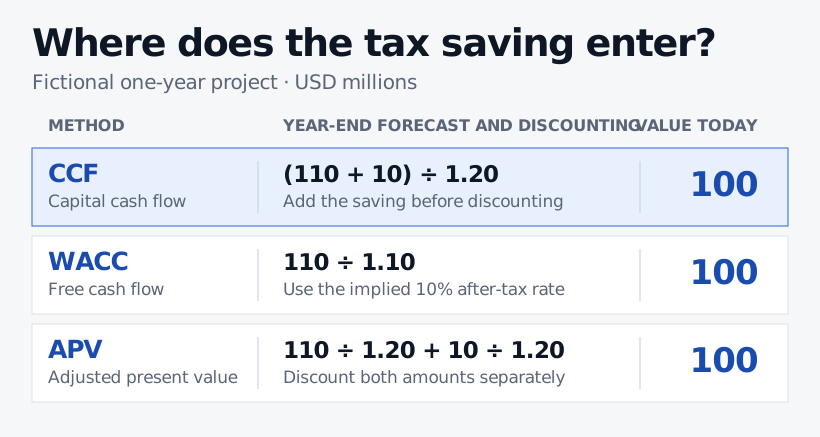
The same tax saving enters through the cash flow in CCF, the rate in WACC, and a separate present value in APV.
With the same operating forecast, debt policy and risk assumptions, the after-tax weighted average cost of capital (WACC) method gives the same value by discounting FCFF alone. The WACC implied by this example is . Discounting the USD 120 million at that after-tax rate would count the shield twice. Adjusted present value (APV) discounts the operating cash flow and tax saving separately. Here both use 20%, so the two present values still add to USD 100 million. Ruback, §§3–4 · Jenter, WACC and APV, slides 4 and 23–29
When does the common rate fit?
In Ruback’s model, debt adjusts with business value and usable tax savings inherit the systematic risk of the operating assets. That supports discounting both streams at the unlevered cost of capital. When the debt balance changes, CCF makes the changing tax savings visible in each period’s cash flow. The rate still needs to reflect the risk of the combined stream. A forecast of dated loan balances tells you how much interest to expect. The financing policy tells you whether those balances would change if the business performed better or worse than forecast. Ruback, §§2.2 and 4.2–4.3
If loan balances are fixed independently of business value and deductions are reliably usable, the shield may have different risk from the operations. APV lets the two components use different rates. If a deduction only reduces cash taxes in a later period, put the saving in that later period’s cash flow. Ruback, §4 · Jenter, WACC and APV, slides 26–28
Sources
- Richard S. Ruback, Capital Cash Flows: A Simple Approach to Valuing Risky Cash Flows. Author’s working-paper version of the 2002 article.
- Dirk Jenter, MIT OpenCourseWare, WACC and APV.