Discounted cash flow valuation (DCF) estimates what an asset or business is worth today by adding up the present values of its expected future cash flows. Each forecast is discounted from its payment date at a rate that reflects its risk. For an equity analyst, DCF translates a view about operations and reinvestment into a value estimate and shows how much of it rests on cash flows far in the future. Aswath Damodaran, NYU Stern, Approaches to Valuation
Match the cash flows to the rate
| What you forecast | Rate for those cash flows | What the discounted sum values |
|---|---|---|
| Free cash flow to the firm (FCFF), the operating cash left after operating taxes and reinvestment, before debt payments | After-tax weighted average cost of capital (WACC) | Operations, or enterprise value in this example |
| Free cash flow to equity (FCFE), the cash available to common shareholders after reinvestment and net debt cash flows | Cost of equity | Common equity directly, with any needed adjustments for assets or claims outside the forecast |
The discount rate must also match the forecast currency and inflation basis. Discount nominal USD forecasts with a nominal USD rate and real USD forecasts with a real USD rate. An annual effective rate applies once per year in the example below. Damodaran, Discounted Cash Flow Valuation, slide 149
Year two is the valuation date for the remaining cash flows
Let be expected FCFF at the end of year , with an explicit forecast through year and a constant annual effective WACC . The terminal value puts the cash flows from year onward in year- terms. Today’s enterprise value is
Suppose a fictional company generates FCFF of 10 at the end of year one and 12 at the end of year two, all in nominal USD millions. Stipulate an operating terminal value of 126 at the end of year two and a constant WACC of 10%.
| Cash flow or value | Date | Amount at that date (USD millions) | Value today (USD millions) |
|---|---|---|---|
| Year-one FCFF | End of year 1 | 10.00 | 9.09 |
| Year-two FCFF | End of year 2 | 12.00 | 9.92 |
| Terminal value for years 3 onward | End of year 2 | 126.00 | 104.13 |
| Enterprise value | Today | 123.14 |
Discount both the year-two cash flow and the terminal value over two years. The year-two cash flow appears once. If the company has 5 of excess cash outside the operating forecasts and debt with a current market value of 30, with no other assets or claims to adjust for, common equity is worth million in this scenario. Using net debt of 25 gives the same result. A direct FCFE valuation already accounts for debt cash flows, so subtracting debt again would double-count the debt claim. Damodaran, Getting to Equity Value per Share
What would support a terminal value of 126?
One possible assumption is FCFF of 12.60 million at the end of year three and the same amount every year thereafter. More generally, if FCFF grows at a constant rate from the first post-forecast payment onward, the Gordon growth model gives
Here at the end of year two. The numerator uses the first cash flow after the explicit forecast. With positive gross growth and discount factors, ensures the series converges. Both rates are annual and nominal in this example. Damodaran, Closure in Valuation, slides 136–139
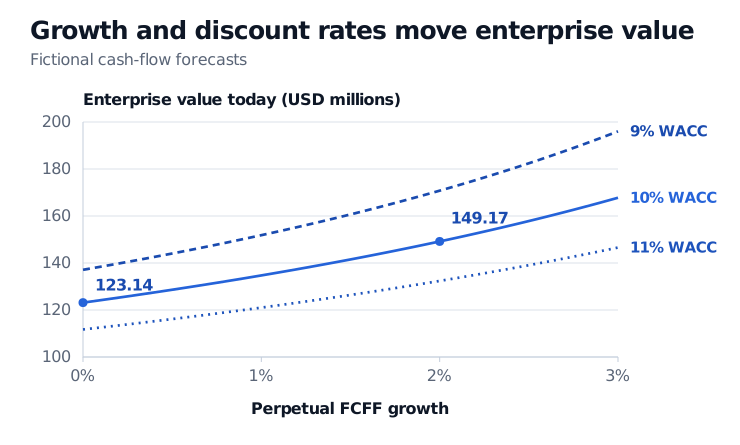
The chart holds the first three cash flows fixed at USD 10, 12 and 12.60 million. Growth affects cash flows from year four onward.
In the base case, the terminal component makes up about 85% of enterprise value. With WACC still at 10%, raising perpetual growth from 0% to 2% while holding year-three cash flow fixed raises enterprise value to 149.17 million. The higher estimate comes entirely from years four onward. In a business forecast, sustaining faster growth can require more reinvestment, which can reduce free cash flow. The chart isolates the effect of the growth assumption. Damodaran, Going Concern or Terminal Value
For the same timing logic from the shareholder’s side, the SelfMadeQuant lesson works through the dividend discount model for a share with constant dividend growth. See the Gordon growth formula and its single-stage sensitivity example. The page is a public preview, with the full lesson available to members. Equity Valuation — Dividend Discount and DCF Models
Sources
- Aswath Damodaran, NYU Stern, Approaches to Valuation and Discounted Cash Flow Valuation, slides 136–139 and 149–153.
- Aswath Damodaran, NYU Stern, Going Concern or Terminal Value and Getting to Equity Value per Share.