The dividend discount model (DDM) estimates the value of a common share as the present value of its expected future cash dividends. It turns a forecast of what shareholders will receive into an equity value per share that an analyst can compare with the market price. The discount rate is the cost of equity, the return investors require for bearing the risk of holding the stock. CFA Institute, Discounted Dividend Valuation
Keep the final dividend and the share separate
With a constant annual cost of equity , let be the expected dividend per share at the end of year . Forecast dividends explicitly through year and let be the terminal value per share at the end of that year, after the year- dividend. Then today's estimated value is
An investor who sells at the forecast boundary receives the final dividend and the ex-dividend sale price. In the DDM, that price represents the dividends the next owner expects from year onward. You can forecast all dividends directly in principle. The terminal price lets you group the later ones at the boundary and discount that value back to today. CFA Institute, Discounted Dividend Valuation, Andrew W. Lo, Equities, slide 7
Suppose a fictional company is expected to pay USD 2.00 per share at the end of year one and USD 2.10 at the end of year two. Assume the share is worth USD 20.00 immediately after the second dividend, with an annual effective cost of equity of 10%. The model values the share today at
Both year-two amounts are discounted for two years. The USD 2.10 is cash the seller receives, and the USD 20.00 is what the buyer pays for the remaining claim. If the sale price still included the right to the year-two dividend, adding the dividend separately would count it twice.
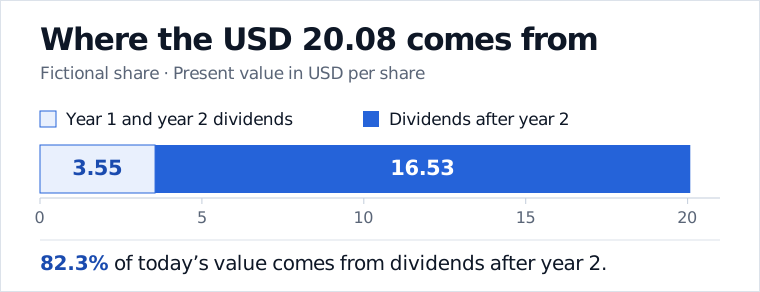
More than four fifths of the share value comes from dividends beyond the two-year forecast.
What would support the later payouts?
The example takes the USD 20.00 terminal price as given. To estimate it from dividends, an analyst can forecast each payout while the company is changing and use a Gordon growth model once dividends can grow at a sustainable constant rate below the mature cost of equity. The first dividend in that stable phase belongs to the terminal forecast. It can reflect a change in dividend policy as well as a change in earnings growth. CFA Institute, Discounted Dividend Valuation
A company can pay zero dividends today and still have a positive DDM value if it is expected to distribute cash as dividends later. For example, a company funding its expansion with retained profits might begin paying dividends once its reinvestment needs fall. The estimate then depends heavily on when payouts start and how much the mature business can afford. A dividends-only forecast is easier to ground when the company has an established payout policy. When share buybacks are the main route for returning cash, a broader payout model can account for them. Aswath Damodaran, Investment Valuation, Chapter 14 questions, CFA Institute, Discounted Dividend Valuation
Section 1 of the SelfMadeQuant lesson derives the one-year case by discounting the dividend and resale price together. The preview is public, and the full lesson requires membership. Equity Valuation: Dividend Discount and DCF Models
Sources
- CFA Institute. Discounted Dividend Valuation, 2026 refresher reading.
- Andrew W. Lo, MIT OpenCourseWare. Finance Theory I, Lecture 7: Equities, slides 7–8 and 12.
- Aswath Damodaran, NYU Stern. Investment Valuation, 4th edition, Chapter 14 questions.