The rate used to turn a future cash flow into present value, with a fixed 110 USD example and clear distinctions between valuation rates, bill discount yields and central-bank lending rates.
Discount rate
A discount rate is the rate used to convert a future cash flow into a value at an earlier date within a specified valuation framework. It determines how much a future payment contributes to a bond price, project value or other asset valuation. The choice includes an economic assumption as well as a numerical quote: which currency, payment date and risks does this rate describe?
Discounting is the operation; the rate is one input; the discount factor is the multiplier applied to the cash flow.
Keep the receipt fixed
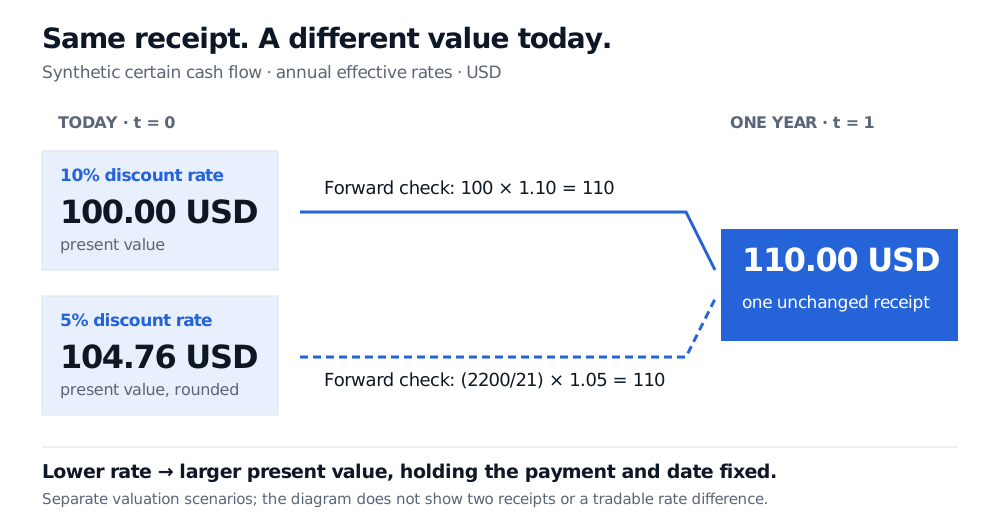
Consider a certain 110 USD receipt in exactly one year, with no fees, taxes or default risk. Stipulate an annual effective discount rate of 10%. This is a synthetic valuation scenario, not a market quote.
The forward check explains the denominator: 100 USD today plus 10 USD of interest becomes 110 USD in one year. The rate measures interest relative to the amount invested today.
Now change only the rate to 5% annual effective:
PV=1.05110=212200≈104.76 USD.
The exact initial amount earns 110/21 USD of interest and still produces 110 USD. At a lower rate, more money must be set aside today to fund the same future receipt. Present value rises by approximately 4.76 USD; the payment remains 110 USD.
Two separate valuations of one certain 110 USD receipt in one year: the present value is 100 USD at 10% annual effective and approximately 104.76 USD at 5%. Both initial amounts accumulate to the same 110 USD receipt under their respective rates.
Synthetic comparison with the payment, horizon and certainty held fixed. The lower rate raises present value; the two scenarios do not create two receipts.
This relationship needs its conditions. For a fixed positive receipt at a positive horizon, a higher rate lowers present value under the same convention. A zero rate leaves the amounts equal. A negative interest rate can make today's value exceed the future receipt; the annual effective formula requires r>−1.
A rate needs a horizon and a convention
For one known payment C due in T years, an annual effective spot rate rT gives
PV=(1+rT)TC.
The subscript matters: the rate belongs to that maturity. A yield curve supplies rates across maturities, so a stream of payments generally uses a discount factor for each date. A single rate used for every payment is an additional modelling choice. A coupon bond's yield to maturity is a single rate that reproduces its price from promised payments; it need not equal every spot rate on the curve. The Bank of England's terminology guide distinguishes these objects.
The same numerical quote also means different things under different compounding conventions. With a constant continuously compounded rate rc, the factor is e−rcT. To describe the same growth as an annual effective rate, use rc=log(1+rT) for the relevant horizon. Calendar-based calculations additionally need a day-count convention.
The Time Value of Money lesson develops accumulation, equivalent rate quotations and dated cash-flow sums. The public page offers a preview; the full lesson requires membership.
Match the economic assumptions
A discount rate is not a universal central-bank policy number. Match its currency and maturity to the payment, then specify the valuation's treatment of risk. Government-bond curves, collateral-based derivative frameworks and the required return on risky equity answer different valuation questions. A government rate applied to a company's promised payment does not remove default risk.
Cash flows and rates must describe the same risk framework. Discounting expected cash flows at a risk-adjusted required return differs from discounting certainty-equivalent cash flows, adjusted for risk before discounting, at a risk-free rate. Do not apply the same risk adjustment twice. In particular, a credit spread calibrated against promised payments cannot automatically be reused unchanged after those payments have been reduced for expected defaults.
Damodaran's valuation notes stress consistency between cash-flow type and discount rate. That includes inflation: discount nominal cash flows with nominal rates, and inflation-adjusted real cash flows with corresponding real rates. Using a real rate on unchanged nominal receipts alters the valuation rather than merely changing its units.
Two other meanings of “discount rate”
Bank-discount yield. Some instruments quote the discount relative to face value rather than the purchase price. In the 10% scenario above, the difference is 10 USD: 10/100=10% on the investment, but 10/110≈9.0909% of the future receipt. These are different denominators. Simply taking 10% off 110 gives 99 USD, which is not the present value in that scenario.
For U.S. Treasury bills, TreasuryDirect gives the bank-discount pricing convention
P=F(1−d360n),
where F is face value, d the annualised discount quote and n the number of days to maturity. The fraction removed from face value is dn/360; it is not an annual effective return on P. The denominator comparison above is an unannualised one-period comparison, not a bill quote with an unstated day count.
Central-bank lending terminology. In U.S. monetary-policy usage, discount rates also refer to rates on Federal Reserve discount-window credit. The Federal Reserve's overview describes collateralised lending to eligible institutions through distinct programmes. Those facility rates are not automatically the appropriate discount rates for arbitrary assets or maturities.
Sources
Bruce Tuckman, Fixed Income Securities: Tools for Today's Markets, 2nd ed., Wiley, 2002, Chapter 1, pp. 6–9: discount factors, inverse accumulation and the conditions behind comparable cash flows.
Aswath Damodaran, NYU Stern, Estimating Inputs for Valuation: matching cash-flow risk and type, and nominal versus real consistency. Historical numerical examples are not current market inputs.
Aswath Damodaran, Risk Adjusting the Cash Flows, 30 April 2011: expected cash flows versus certainty-equivalent cash flows.