Convert future cash flows into comparable present values, with a checked 1,050 USD example, discount factors, rate conventions and curve selection.
Discounting
Discounting is the process of converting a future cash flow into a value at an earlier date using a specified valuation framework. It makes payments on different dates comparable: a bond coupon due next year cannot simply be added to cash available today. The result is a present value; the contractual payment itself stays unchanged.
Run the cash forward to check the value backward
Suppose a certain payment of 1,050 USD arrives in exactly one year. Use a stipulated 5% annual effective rate, with no fees, taxes or default risk. This is a synthetic example, not a market quote.
At that rate, 1,000 USD today grows to the promised amount:
1,000+0.05×1,000=1,050 USD.
Discounting reverses that accumulation:
PV=1.051,050=1,000 USD,D(0,1)=1.051=2120.
The discount factorD(0,1) converts the year-one amount into its time-zero value. It is dimensionless, so USD multiplied by a discount factor remains USD, now valued at the comparison date.
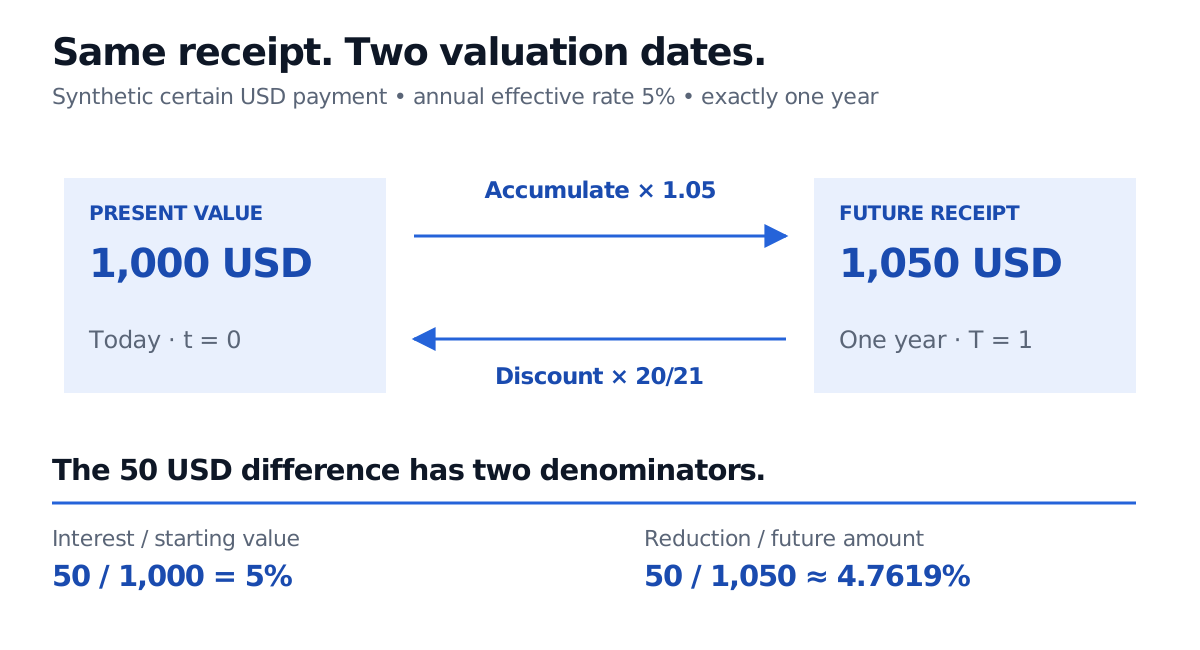
A certain 1,050 USD receipt in one year has present value 1,000 USD at 5% annual effective. The forward arrow multiplies by 1.05 and the backward arrow by 20/21. The 50 USD difference is 5% of 1,000 but approximately 4.7619% of 1,050.
Original synthetic timeline. Both arrows describe the same dated receipt under the stated rate; they do not represent two payments.
The 50 USD difference is interest on 1,000 USD. Taking 5% off 1,050 USD would instead give 997.50 USD, which fails the forward check. The reduction from the future amount is 50/1,050, approximately 4.7619%. The denominator matters.
Discount the date, then add the values
For known receipts and payments Ci at dates Ti, their combined value at time zero is
PV=i∑CiD(0,Ti).
Use positive signs for receipts and negative signs for payments from the chosen party's perspective. Each cash flow needs the factor for its own payment date. A yield curve supplies maturity-specific information; a flat rate applied to every date is a simplifying assumption.
For a constant annual effective rate r, the factor is (1+r)−T, where T is measured in years under the stated timing convention. For a constant continuously compounded raterc, it is e−rcT. These quoted rates must be converted to describe the same growth: rc=log(1+r). Substituting the same numerical quote into both formulas generally changes the value. For actual calendar dates, the day-count convention also matters.
The Time Value of Money lesson develops simple, periodic and continuous accumulation alongside present-value sums. Its public page provides a preview; the full lesson requires membership.
Which curve belongs to the cash flow?
The arithmetic does not choose the economic assumptions. Match the payment's currency, maturity and risk treatment to the valuation framework. A risky promise needs a consistent treatment of default and risk; mechanically discounting its promised face amount at a government rate does not make the promise certain. Expected losses and risk adjustments must be handled coherently rather than counted twice.
There is no universal discount rate for all claims. The Bank of England, for example, publishes distinct government-bond and overnight-index-swap curves. Its terminology guide distinguishes a maturity's zero-coupon spot rate from a coupon bond's single yield to maturity. In derivatives valuation, collateral and funding terms can also affect the applicable framework.
Even the label discount rate needs context. The U.S. Treasury's bill pricing convention calculates a discount from face value using a day-based quote. That quote is different from the annual effective investment rate used above.
For a positive receipt, a higher annual effective rate lowers present value when time and all other assumptions stay fixed. Zero interest makes present and future amounts equal; a negative interest rate can make present value exceed the later amount. Discounting also does not automatically remove inflation: nominal cash flows and inflation-adjusted cash flows require corresponding nominal and real assumptions.
Sources
Bruce Tuckman, Fixed Income Securities: Tools for Today's Markets, 2nd ed., Wiley, 2002, Chapter 1, pp. 6–9: discount factors, inverse accumulation, dated cash-flow sums and the assumptions behind comparable cash flows.
Bank of England, Yield curve terminology and concepts, especially “Nominal zero coupon yields (spot interest rates)” and footnote 3; and Yield curves: distinct curve families and quotation context.