A day count convention is a rule for turning dates into the time fraction used in an interest calculation. Two contracts with the same principal, annual interest rate and payment dates can owe different amounts because their day count rules differ. A pricing or funding model therefore needs the convention alongside the rate.
The rule specifies how days are counted and what reference denominator is used. “Six months” alone is insufficient: calendar months have unequal lengths, and a contractual year need not mean 365 days.
The same dates, two interest bills
Take a synthetic loan of USD1,000,000, at 4% simple annual interest, from 15 January to 15 July 2026. Hold the rate and principal constant, with no interim interest payments, fees or taxes. Use the dates as stated, without business-day adjustments. For the actual-day ledger, exclude the first date and include the last.
The actual-day count is . Compare two stipulated conventions:
| Convention | Year fraction | Interest due | Principal plus interest |
|---|---|---|---|
| ACT/360 | USD20,111.11 | USD1,020,111.11 | |
| 30E/360, ordinary rule below | USD20,000.00 | USD1,020,000.00 |
The exact ACT/360 interest is dollars. The difference is dollars, or USD111.11 after rounding to cents. The extra amount comes entirely from the time convention; neither loan compounds interest. These are alternative contractual calculations, not two interchangeable labels for an identical cash flow.
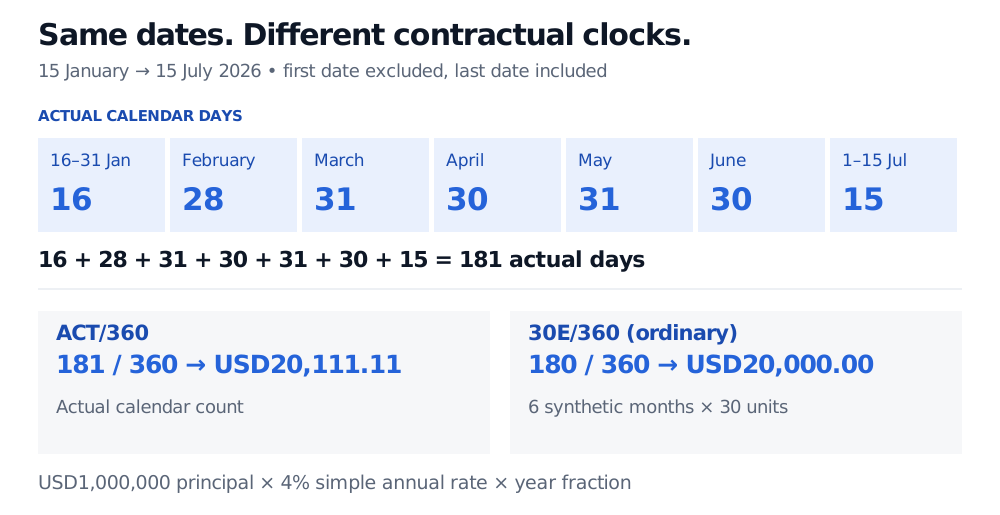
Original synthetic example. The top ledger enumerates actual calendar days; the lower comparison applies two stipulated day counts to the same USD1,000,000 principal and 4% simple annual rate. Cash amounts are rounded to cents.
For the ordinary 30E/360 rule used here, replace a day-of-month of 31 by 30 at either endpoint, then calculate
Our endpoints are both the 15th, so the numerator is . This rule is the 30E/360 formulation in §4.16(g) of the 2006 ISDA Definitions. Its specified variant matters: 30E/360 (ISDA) has additional February-end rules, including a termination-date exception; it is not the same algorithm.
Read the full convention name
Some common labels illustrate the choices:
| Label | What determines the year fraction? |
|---|---|
| ACT/360 | Actual elapsed days divided by 360. |
| ACT/365 Fixed | Actual elapsed days divided by 365, including in leap years. |
| Actual/Actual ISDA | Split actual days by calendar year; divide the non-leap-year portion by 365 and the leap-year portion by 366, then add. |
| Actual/Actual ICMA | Use the coupon schedule and frequency; irregular first or last periods need additional reference-period rules. |
| 30/360 family | Apply the named variant's endpoint adjustments before dividing its synthetic count by 360. |
“Actual/Actual” and “30/360” without further detail can conceal different algorithms. Month ends, leap days and irregular coupon periods are useful test cases when reconciling systems. OpenGamma's day-count documentation makes these variants and schedule dependencies explicit. No single convention applies to every bond, loan, currency or market; use the instrument's governing terms.
A year fraction is not a coupon fraction
When calculating accrued interest on a conventional fixed coupon, the relevant fraction may be the portion of one coupon period already elapsed. Suppose a regular coupon period contains actual days, of them have accrued, and the cash coupon for that period is . A proportional in-period calculation gives
Here is a fraction of one coupon, not necessarily a fraction of a year. For a regular Actual/Actual ICMA period with coupons per year, the corresponding annual year fraction is . Multiplying an annual coupon amount by would omit the frequency adjustment. Stub periods require the applicable schedule rules rather than blindly extending this regular-period expression.
Keep three other instructions separate:
- Coupon frequency tells you when contractual coupons are scheduled.
- Compounding tells you how interest enters the earning base.
- Business day convention tells you how a relevant date moves when it is not a business day. Whether the accrual boundaries also move depends on the terms; a delayed payment does not automatically earn extra interest.
For a backtest application, Financing, Borrow and Transaction Costs shows how a declared day fraction enters funding and stock-borrow charges. Its public preview introduces the lesson; full teaching requires membership.
Sources
- John C. Hull, Options, Futures, and Other Derivatives, Ninth Edition, Global Edition, Pearson Education Limited, 2018, §6.1, pp. 154–155: day counts and the reference-period approach to accrued interest.
- ISDA, 2006 Definitions, §§4.9–4.13 and 4.16, pp. 8–13: payment versus calculation dates and named day-count fractions. This is a specific definitions edition, not a claim that every current contract incorporates it.
- OpenGamma Strata, Day Counts: implementer documentation for Actual/Actual variants, 30/360 variants and schedule information.