Compare annual, semiannual and quarterly coupon schedules, price their dated payments on the same discount curve, and separate payment frequency from compounding.
Coupon frequency
Coupon frequency is the number of scheduled coupon payments a bond makes in a regular year. Annual means once a year, semiannual twice, and quarterly four times. Frequency tells a cash manager when interest becomes available; it also determines the payment dates a pricing model must discount.
A higher frequency does not, by itself, mean a higher coupon rate or more promised interest over the year. It divides the annual coupon into payments that arrive sooner.
Same annual amount, different cash dates
Consider three fictional fixed-rate bullet bonds, each with 1,000 USD face value, a 6% annual coupon rate and one regular year remaining. Each repays its full principal at year-end. Valuation is immediately after a coupon date, with no accrued interest. Assume all promised payments occur, with no tax or transaction costs.
For unchanged face value F, annual coupon rate c and m equal regular payments per year, each coupon is
C=mFc.
Here Fc=1,000(0.06)=60 USD. The payment schedules are:
Frequency
Payments per year
Coupon dates after valuation
Each coupon
Year's coupon total
Annual
1
Month 12
60 USD
60 USD
Semiannual
2
Months 6 and 12
30 USD
60 USD
Quarterly
4
Months 3, 6, 9 and 12
15 USD
60 USD
The final receipt includes the last coupon plus 1,000 USD principal. Principal repayment is separate from coupon income.
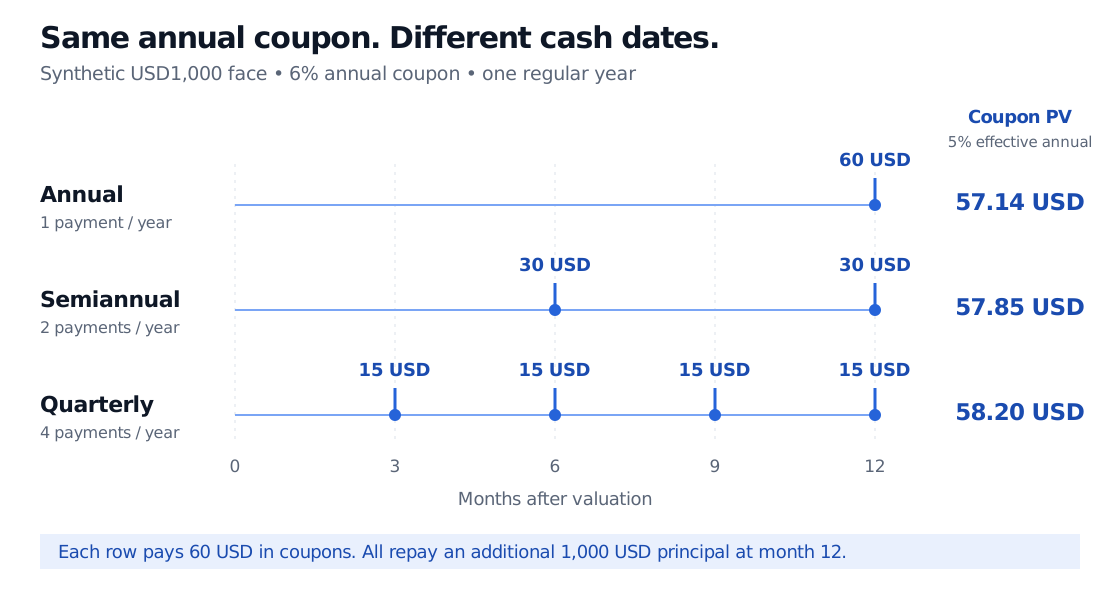
Annual coupons pay 60 USD at month 12; semiannual coupons pay 30 USD at months 6 and 12; quarterly coupons pay 15 USD at months 3, 6, 9 and 12. At a common 5% effective annual discount rate, the coupon present values are 57.14, 57.85 and 58.20 USD. Each bond also repays 1,000 USD principal at month 12.
Original synthetic schedules: the months represent equal quarter-year fractions. Coupon present values exclude the common principal repayment; this is a timing comparison, not market data.
Price depends on present value, so the dates matter as well as the amounts. Use the same flat 5% effective annual discount rate for all three synthetic bonds. A payment at time t, measured in years, has discount factor
D(0,t)=(1.05)−t.
For the semiannual schedule, the coupon-only value is
1.050.530+1.0530≈57.85 USD.
Add the present value of the 1,000 USD principal to obtain each full bond value:
Schedule
Coupon present value
Full bond present value
Annual
57.14 USD
1,009.52 USD
Semiannual
57.85 USD
1,010.23 USD
Quarterly
58.20 USD
1,010.58 USD
The more frequent schedules have higher values under this common positive-rate curve because some interest arrives earlier. At a zero discount rate, all three coupon values would be 60 USD. The table does not establish a universal ranking across bonds with different credit risks, coupon terms or discount curves.
These are model values, not stipulated equal purchase prices. If each bond is bought at its own unrounded model value and every receipt can be reinvested at the same 5% effective annual rate, each investment earns 5% over the year. Earlier coupons command a higher initial price in this comparison; they are not a free increase in return.
SelfMadeQuant's Bonds and Yields lesson develops the dated-payment pricing equation and distinguishes coupons from yield. The public page is a preview; the full lesson requires membership.
Payment frequency is not a compounding instruction
Coupon frequency describes cash paid out. Compounding describes how interest accumulates, or how a quoted rate represents that accumulation. A coupon sent to the investor does not automatically earn interest inside the bond. Reinvestment is a separate decision at whatever rates are available.
In this example, the 5% discount rate is an effective annual rate. Its equivalent half-year growth rate is
1.051/2−1≈2.4695%,
rather than 2.5%. Using 5% divided by two would instead treat 5% as a nominal annual rate compounded semiannually, changing the discount curve. Choosing semiannual coupon dates does not authorise that change of rate convention.
To see the reinvestment distinction directly, hold all received coupons as zero-interest cash until year-end. Each schedule then leaves 1,060 USD, including principal. If every coupon can instead be reinvested at the stipulated 5% effective annual rate, year-end wealth becomes 1,060.00 USD annually, 1,060.74 USD semiannually and 1,061.11 USD quarterly. Earlier coupons have more time to accumulate. These wealth amounts use different initial model prices and are not evidence that the quarterly bond offers the best return.
A frequency label is only the start of a schedule
The simple division Fc/m assumes equal regular coupon periods and unchanged principal. A short or long first or last period—a stub—needs the contract's calculation. Actual accrual fractions may depend on the day-count convention; calendar dates and business-day adjustments also come from the instrument's terms. A three-month label should not be silently replaced by a fixed number of days.
A zero-coupon bond has no periodic coupon payments. It can still have a positive yield: payment frequency and investment return answer different questions.
Sources
Frank J. Fabozzi, Bond Markets, Analysis, and Strategies, 9th ed. (Pearson, 2016), Chapter 1, p. 4, “Principal and Coupon Rate”; Chapter 2, pp. 20–21, payment timing and bond pricing.