Understand how unpaid coupon interest enters a bond settlement invoice, with a checked cash ledger and a clear separation between USD amounts and per-100 quotes.
Accrued interest
Accrued interest is interest that has accumulated under an instrument's terms but has not yet been paid. For a conventional coupon bond sold between payment dates, it helps reconcile the quoted price with the cash that changes hands at settlement. A buyer may pay for the bond plus the coupon interest accrued before settlement, even though the next coupon has not arrived yet.
The distinction matters in a pricing system: comparing a model's full bond value with a quote that excludes accrued interest creates a price discrepancy before any market mispricing has been found.
Follow one coupon through the sale
Consider a synthetic fixed-rate bond with USD1,000 face value and a 6% annual coupon rate, paid in two equal regular payments each year. Annual coupon interest is USD60, so each coupon is USD30. Assume ordinary trading in which the buyer receives the next coupon, no ex-coupon treatment, no embedded options, and no fees or taxes.
Stipulate a coupon period with 180 accrual units and settlement after 60 units. These are teaching inputs, not a claim about the number of calendar days between actual coupon dates. Under the proportional coupon-period rule used here,
Accrued interest=Cα=30×18060=10 USD,
where C is the cash coupon for this period and α is the elapsed fraction of that coupon period. It is not an annual year fraction: using the whole USD60 annual coupon with the same fraction would count twice as much interest.
Suppose the agreed cash price excluding accrual is USD1,005. The settlement ledger is:
The buyer pays the seller USD1,015, excluding the costs omitted here. The per-100 quote is a scale, not a separate currency amount for the whole trade: there are ten lots of 100 face in this position. Add accrued interest only when starting from a clean price; a dirty price already includes it.
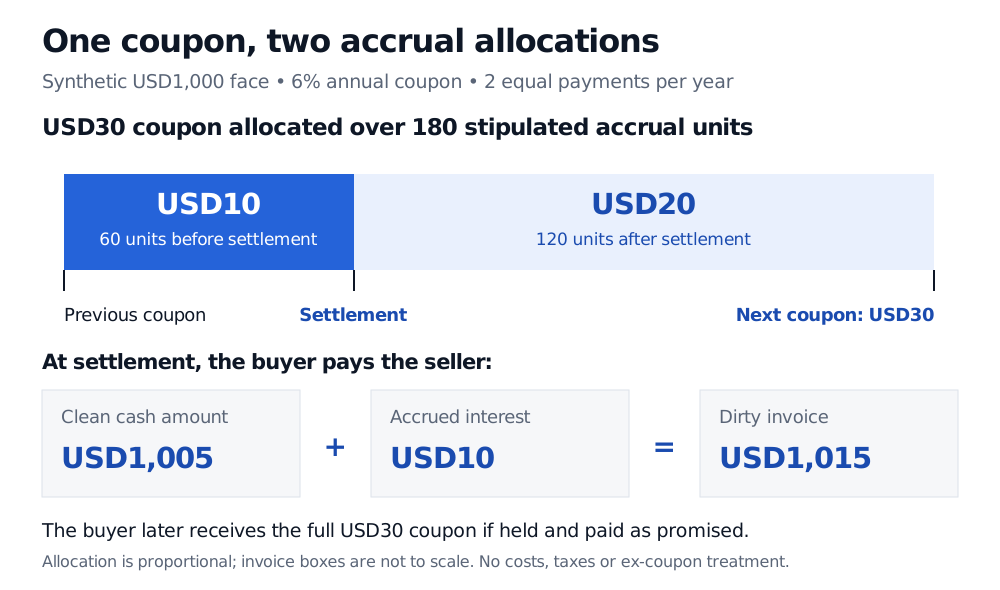
A synthetic USD1,000 face bond pays USD30 per coupon. Sixty of 180 accrual units allocate USD10 before settlement, while the remaining 120 allocate USD20. At settlement, USD1,005 clean plus USD10 accrued equals the USD1,015 dirty invoice.
Original synthetic coupon-allocation ledger. The stipulated accrual period has 180 units, with settlement after 60; no real calendar dates are asserted. Timeline widths show the allocation; invoice boxes are not to scale.
If the buyer holds through the next payment and the issuer pays as promised, the buyer receives all USD30. Of that coupon, USD10 offsets the accrued-interest amount paid to the seller at settlement; the remaining USD20 corresponds to the rest of this stipulated accrual period. This allocation is not a total-return calculation: purchase price, sale or redemption value, financing and the timing of cash still matter. The seller's USD10 allocation covers the period since the previous coupon; it does not establish how long this particular seller owned the bond.
The convention determines the fraction
A day-count convention specifies how dates enter the accrual calculation. For a regular coupon-period calculation, actual days elapsed divided by actual days in the period is one possible rule. Other instruments use annual bases or adjusted 30-day months. A coupon-period fraction and a year fraction must be paired with the matching coupon or annual-rate formula.
For a concrete market-specific rule, MSRB Rule G-33 defines municipal-security accrual from the previous interest date, or dated date for a first coupon, up to but excluding settlement; its day-count provisions specify a 30-day month and 360-day year with stated exceptions and date adjustments. That rule should not be substituted for every bond's terms.
Use the settlement date required by the transaction, not automatically the trade date or today's date. Verify the schedule, coupon entitlement, day-count variant, first or final irregular period, and rounding rule for the actual security. Payment frequency varies too: US Treasury notes and bonds pay interest every six months, while other instruments can have different schedules. Floating rates or changing principal can require a different accrual calculation.
For the ordinary clean-quote convention, dirty price equals clean price plus accrued interest, with all three quantities on the same face-value basis. A model that discounts the remaining entitled coupon and principal payments produces a full value. Subtracting accrual translates that value to a clean basis; adding it again would double count it.
As a coupon payment is made, the payment leaves the remaining cash-flow schedule and accrued interest ordinarily resets for the new period. A fall in the full bond price around that payment is not, by itself, an investment loss: the holder has also received cash. Clean-price movements alone likewise do not measure total return, and a clean price is not guaranteed to remain constant between coupon dates.
Frank J. Fabozzi and Francesco A. Fabozzi, Bond Markets, Analysis, and Strategies, 10th ed., MIT Press, 2021, Chapter 2, “Accrued Interest”, “Calculating Accrued Interest” and “Day Count Conventions” (PDF sequence pages 70–72).
MSRB Rule G-33: Calculations, sections (a), (d) and (e): municipal-security accrual timing, precision and day-count rules.