A year fraction is the numerical length assigned to a date interval under a specified financial convention, expressed in units of a year. It connects an annual interest rate to the interest for a particular period. Two systems can agree on the dates and the quoted rate, yet disagree on the cash flow because they use different year fractions.
The day-count convention is the rule; the year fraction is its output. It is often written , or . The symbol alone does not identify the rule.
Follow the units into the cash flow
For a loan with constant principal , simple annual rate and year fraction , interest is
Enter a 6% rate as . The product is the return for this accrual period; multiplying by the principal gives a money amount. This simple-interest formula does not reinvest interest during the period.
Consider a synthetic USD100,000 loan at 6% simple annual interest over 30 stipulated actual elapsed days, with no fees, taxes or interim payments. Dates need not be invented to isolate the effect of the annual basis:
| Convention | Year fraction | Period return | Interest |
|---|---|---|---|
| ACT/360 | 0.5% | USD500.00 | |
| ACT/365 Fixed | Approximately 0.493151% | USD493.15 |
The ACT/365 Fixed amount is exactly dollars before rounding. The difference is dollars, or USD6.85 rounded to cents. Both calculations count the same 30 actual days. Dividing by 360 is a contractual scaling rule, not a claim that a calendar year contains 360 days. ACT/365 Fixed always uses 365 as its denominator, even when the interval includes a leap day. These definitions appear in §4.16(d)–(e) of the 2006 ISDA Definitions.
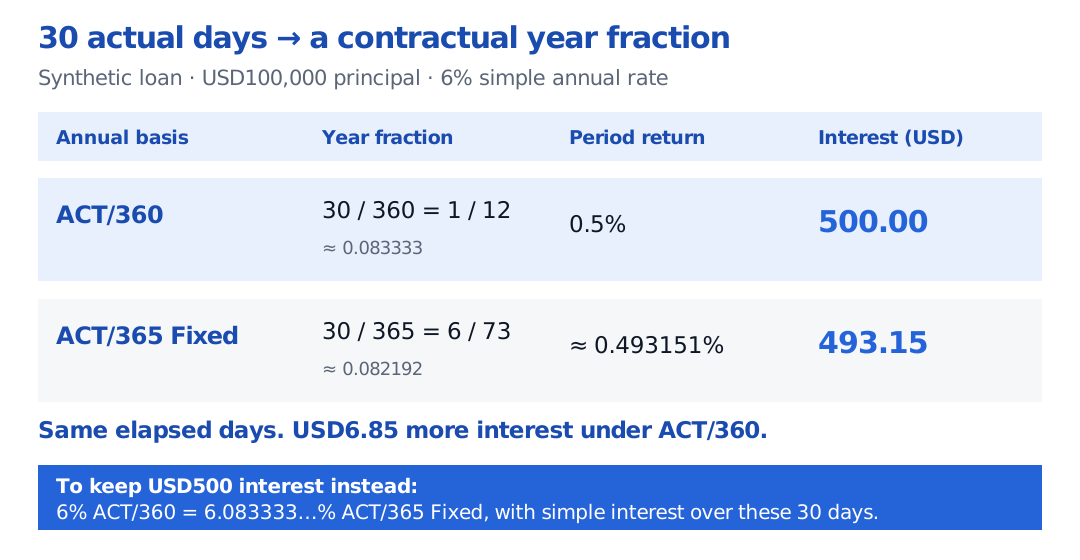
Original synthetic convention ledger. The principal, elapsed days and simple annual quote are held fixed in the first two rows. Interest is rounded to cents; the bottom line instead holds the cash flow fixed and changes the quote.
There is a second way to compare the bases: keep the interest amount fixed. To reproduce the ACT/360 loan's USD500 using ACT/365 Fixed, the equivalent simple annual quote is
or 6.083333…%. Then . This rebases the annual quote; it does not add compounding or change the elapsed days. A rate and its time basis belong together.
Four time quantities that should stay distinct
- Calendar-day count is the actual elapsed count between the accrual boundaries, with the applicable endpoint treatment. It is an input to ACT/360 and ACT/365 Fixed, not itself a year fraction.
- Coupon-period fraction measures the elapsed share of one coupon. For a regular Actual/Actual ICMA coupon period, let be accrued actual days, the actual days in that full period and the number of regular coupons per year. The coupon-period fraction is ; the annual year fraction is . Multiply the first by the cash coupon for one period, or the second by the annual coupon cash amount. Irregular periods need the named convention's schedule rules. Strata's documentation specifies the frequency and schedule dependencies.
- A business-day convention adjusts a relevant date when it falls on a non-business day. A payment-date roll changes the accrual fraction only if the governing terms also change the accrual boundaries. Payment dates and calculation periods are separate instructions in §§4.9–4.13 of the 2006 ISDA Definitions.
- Model time is the year-based coordinate used by a pricing model or curve. It may use a different basis from a particular coupon's contractual accrual fraction. Keep each rate, volatility and time input consistent with its own convention; do not replace a coupon's accrual factor merely because a model uses another clock.
This distinction is especially useful when checking accrued interest: a fraction of a coupon and a fraction of a year can both be correct, provided each multiplies the matching amount.
SelfMadeQuant's Instrument Data Conventions extends the calculation into compounding, clean and dirty prices, and the contract data needed before pricing. The linked page is a public preview; the full lesson requires membership.
Sources
- John C. Hull, Options, Futures, and Other Derivatives, Ninth Edition, Global Edition, Pearson Education Limited, 2018, §6.1, pp. 154–155: day counts and the reference-period approach to interest accrual.
- ISDA, 2006 Definitions, §§4.9–4.13, 4.16(d)–(e) and 5.1, pp. 8–14: date adjustments, calculation periods, named annual bases and fixed-amount calculation. This is a specified definitions edition; actual contracts may incorporate different terms.
- OpenGamma Strata, Day Counts: primary implementation documentation for named day counts, including regular coupon frequency and irregular-period schedule handling for Actual/Actual ICMA.