Compounding updates the earning base each period. Follow a three-year interest ledger, compare simple interest, and distinguish rate conventions from uncertain market returns.
Compounding
Compounding means applying each period’s return to the value carried forward from the previous period. The earning base changes as gains or losses accumulate. It is how a quant turns a sequence of period returns into a terminal account value, and why adding those returns can give the wrong answer.
With compound interest, credited interest stays in the account and itself earns interest. This is a particular form of compounding. The same multiplication also describes a portfolio whose gains and losses remain invested, even when it pays no interest.
Follow the interest, one year at a time
Suppose a hypothetical account starts with USD 1,000, earns a fixed 5% annual effective rate, and capitalises all interest at each year-end. There are no additional deposits, withdrawals, fees or taxes. Assume the calculation retains full precision rather than rounding the balance to cents each year.
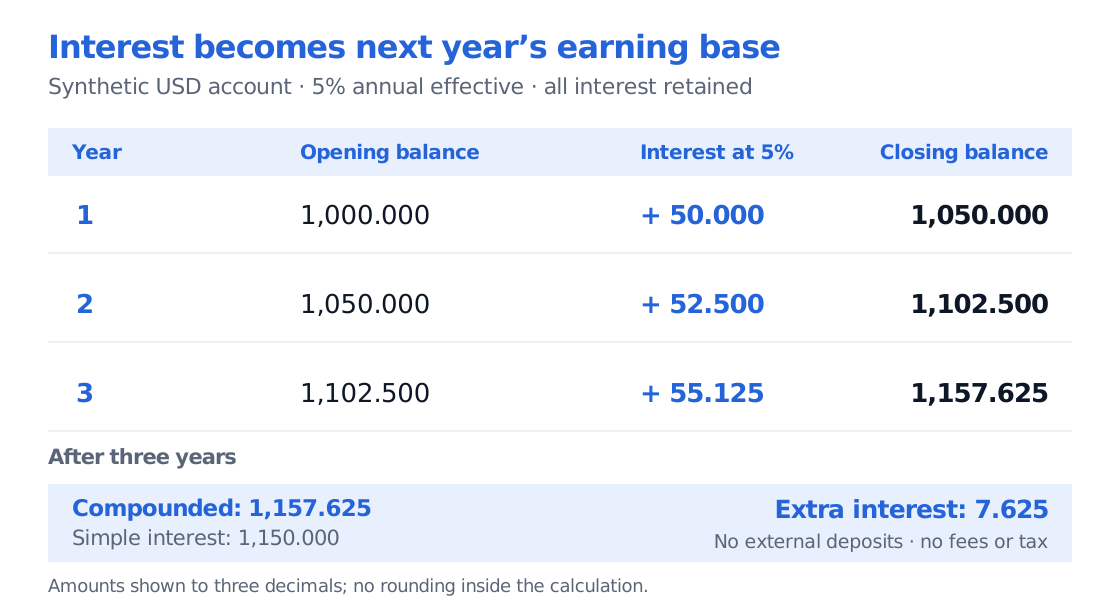
The first year earns USD 50. The second year earns USD 52.50 because its opening balance includes the previous interest. The third earns USD 55.125. Total interest is therefore USD 157.625, giving a future value of USD 1,157.625, or USD 1,157.63 rounded to cents at the end.
USD 1,000 at 5% annual effective interest earns 50, 52.5 and 55.125 dollars in years one to three. Closing balances are 1,050, 1,102.5 and 1,157.625 dollars; simple interest ends at 1,150 dollars.
Synthetic annual account ledger: all interest is capitalised, with no external flows, fees or tax. Amounts are unrounded internally and shown to three decimals.
Under simple interest at the same 5% annual quote, each year earns USD 50 on the original principal. Three years give USD 150 of interest and USD 1,150 in total. Compounding contributes an extra USD 7.625 here: the return earned on previously credited interest.
If the interest is paid out and spent, it is no longer in this account’s earning base. If it is reinvested elsewhere, the combined wealth depends on the rate earned there. A coupon payment from a bond likewise does not automatically earn the bond’s original yield after it is paid.
The formula is a repeated balance update
Let Vt−1 be the opening value and rt the effective return for period t, expressed as a decimal. With no external cash flows,
Vt=Vt−1(1+rt),Vn=V0t=1∏n(1+rt).
A constant rate r reduces this to Vn=V0(1+r)n. The rate period and the number of periods must match: in the account example, r=0.05 and n=3 annual periods.
Compounding does not require a positive return. For a positive starting balance, −1<rt<0 shrinks the balance while keeping it positive. A return of −1 wipes it out. Returns below −1 lie outside this positive-balance accumulation model; leveraged positions can create liabilities that require separate treatment.
A frequency is part of the quote
An interest rate described only as “5% per year” is ambiguous. A 5% effective annual rate already means a one-year growth factor of 1.05. A 5% nominal annual rate compounded semiannually instead applies 2.5% twice:
(1+0.05/2)2−1=0.050625=5.0625%.
Increasing frequency while holding the nominal quote fixed changes the effective return. Converting to an equivalent quote preserves the growth factor. Continuous compounding is another rate convention; it does not create extra economic return when rates are converted consistently.
The Time Value of Money lesson develops these conventions and their connection to discounting. A public preview is available; the full lesson requires membership.
Market returns compound; they are not promised
For two successive periods, a 10% gain followed by a 10% loss produces
1.10×0.90−1=−0.01=−1%.
The loss acts on the larger value left by the gain. The arithmetic sum is zero, but the compounded return is negative. A total return series must also account for distributions consistently, including any assumed reinvestment.
The smooth 5% account example is a stated assumption, not a forecast for an investment portfolio. Actual rates, investment returns, reinvestment opportunities and costs can change. For a real account, check when interest is credited and whether it remains invested: even U.S. Regulation DD does not prescribe a single compounding or crediting frequency.
Sources
John C. Hull, Options, Futures, and Other Derivatives, Ninth Edition, Global Edition (Pearson Education Limited, 2018), Chapter 4, §4.2, pp. 102–103: periodic accumulation, frequency and continuous-rate conversion.