“Simple” describes the calculation basis. It does not establish whether a loan is cheap, safe or certain to be repaid.
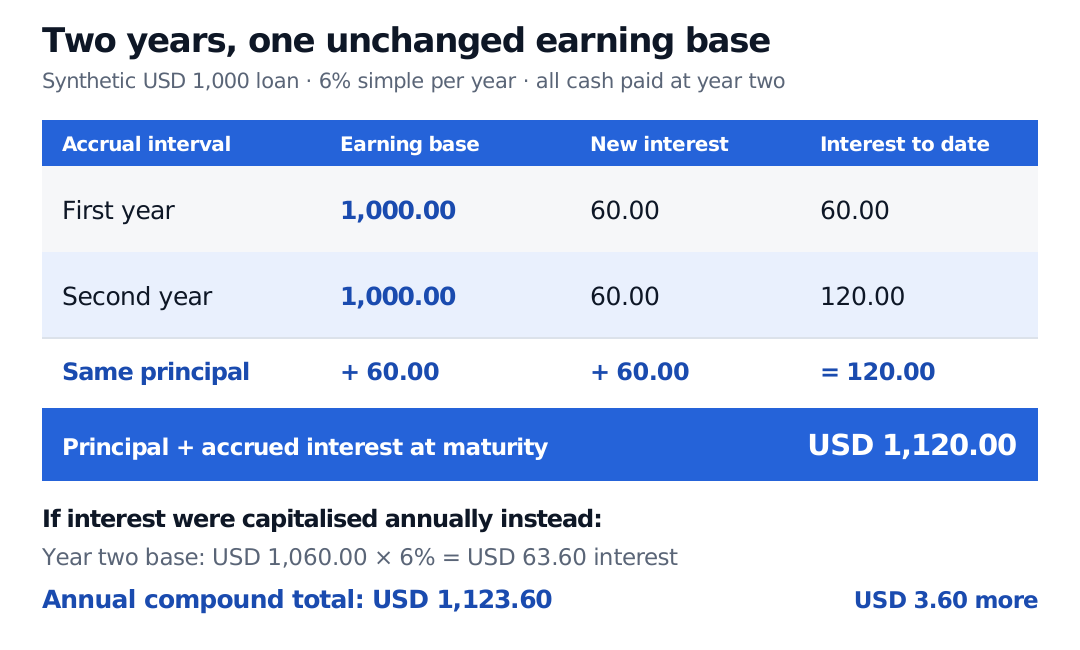
The principal stays at USD 1,000
The first year adds USD 60. The second year adds another USD 60, because its earning base is still USD 1,000. Recording interest as it accrues does not itself make that interest earn interest.
| Accrual interval | Principal used to calculate interest | New interest | Total interest accrued |
|---|---|---|---|
| First year | USD 1,000 | USD 60 | USD 60 |
| Second year | USD 1,000 | USD 60 | USD 120 |
Rate × time × principal
For constant principal , a simple annual rate written as a decimal, and contractual year fraction ,
Here is the interest and is the total due when everything is paid at the end. For the loan above, . A separate loan with the same principal and quote over an explicitly specified half-year fraction would accrue . Its period interest is 3% of principal, despite the 6% annual quote.
- On Actual/360, , so interest is USD 15.00.
- On Actual/365 Fixed, , so interest is USD 14.79, rounded to cents.
Where the shortcut stops
Simple interest is useful for a single accrual interval, including many short-term funding quotes. It is not a rule that every instrument with a short maturity must use simple interest.
If principal is repaid partway through, calculate each interval on its applicable outstanding principal. If interest is paid and then reinvested elsewhere, that reinvestment has its own cash flows and rate. Rolling over successive simple-interest deposits can produce compounding when each new deposit includes earlier interest; the original two-year simple contract does not do that.
The formula also permits a negative : interest is then negative for positive principal and positive time. An ordinary positive repayment amount requires . Do not extrapolate a negative simple rate indefinitely past that boundary. Nor does a positive quoted rate guarantee a realised investment return: payment failure, fees and other contractual terms can change what the lender receives.
Sources
- U.S. TreasuryDirect, Savings Bonds glossary, entries “Interest (simple)” and “Interest (compound)”: distinguishes an initial earning base from capitalised interest.
- Doug Williamson, Association of Corporate Treasurers, How to effectively calculate interest rates: simple annual quotes, period interest and cash flows.
- John C. Hull, Options, Futures, and Other Derivatives, Ninth Edition, Global Edition, Pearson Education Limited, 2018, §4.2, pp. 102–103, and §6.1, pp. 154–155: compounding bases and day-count fractions. The scenarios and figure here are original calculations.