The maturity date is the contractual date on which a debt instrument’s outstanding principal becomes due for repayment. For an ordinary fixed-principal bond, it anchors the final promised cash flow. A quant needs that date to build the payment schedule, value the claim and plan when cash should be available.
The date describes an obligation, not a guarantee of receipt. The SEC’s bond guide explains both the promise to repay principal and the risk that an issuer fails to pay.
Put the final payment on a calendar
Consider a synthetic bond issued on 15 January 2026, with USD 1,000 face value, a 5% annual coupon rate and a scheduled maturity of 15 January 2028. It pays annually, with two regular full-year coupon periods. Assume no default or early redemption.
Each annual coupon is
| Scheduled date, before any business-day adjustment | Promised amount | What it represents |
|---|---|---|
| 15 January 2027 | USD 50 | First annual coupon |
| 15 January 2028 | USD 1,050 | USD 1,000 principal plus USD 50 final coupon |
The first coupon date is not the maturity date: interest is paid while principal remains outstanding. The final receipt is larger because it combines two obligations. Maturity does not mean that the issuer repays the investor’s purchase price; in this example it owes the contractual USD 1,000 principal, whether an investor bought the bond above or below that amount.
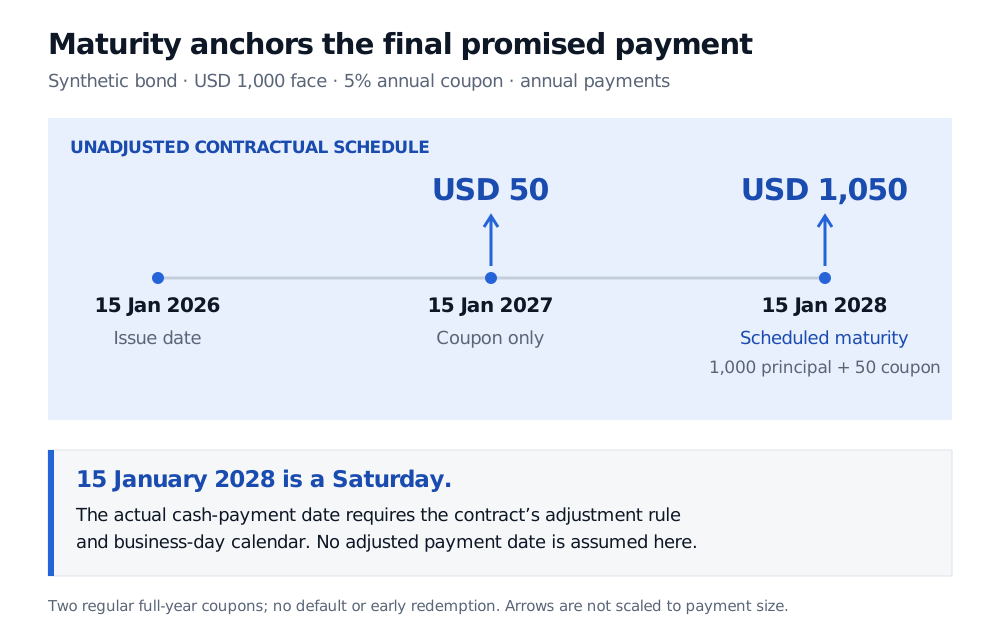
Original synthetic schedule: 5% annual coupon, two regular full-year coupon periods, no default or early redemption. Dates shown are unadjusted; the final cash-payment date is not specified.
There is a calendar catch: 15 January 2028 is a Saturday. That establishes the weekday, but does not tell us when this synthetic bond actually pays. We still need its payment-adjustment provision and the calendar defining a business day. The terms also determine whether an adjustment changes interest accrual or the amount due. We cannot simply announce “Monday” or assume extra interest.
A concrete, instrument-specific example is 31 CFR 356.30(a): for the Treasury securities it covers, a principal or interest date on a Saturday, Sunday or day when the Federal Reserve System is closed leads to payment on the next business day, without additional interest. That is a rule for those securities, not a universal rule for bonds denominated in USD. It does not fill in the missing terms of our synthetic bond.
A date stays fixed; the remaining time shrinks
The example has an original term of two years. On 15 January 2027, it has one calendar year remaining to scheduled maturity. Buying it on that later date does not give the buyer a fresh two-year term.
In pricing notation, the maturity date is often , the valuation date is , and time to maturity is written . Turning those dates into a numerical year fraction requires a day-count convention. The valuation must also use the actual contractual payment schedule, including applicable adjustments, rather than infer every payment from one headline maturity date.
SelfMadeQuant’s Bonds and Yields lesson takes that next step: discount each promised payment and distinguish the coupon from yield to maturity. The public page is a preview; the full lesson requires membership.
Dates that answer different questions
- Trade settlement date: when a buyer’s cash and a seller’s securities are transferred to complete their transaction. It concerns a trade; the bond’s maturity concerns repayment by its issuer. The SEC’s settlement explanation makes the transfer meaning explicit.
- Option expiry date: the end of an option’s contractual life, rather than a promise to repay borrowed principal. Exercise, last trading and subsequent settlement follow the product’s own rules. CME’s options-on-futures examples show that option expiry can precede the underlying futures settlement.
- Early redemption date: a callable bond may repay before stated maturity under its terms. Conversely, credit risk can cause missed payments or restructuring. A stated maturity alone does not determine the actual payment path.
For cash planning, ask for the scheduled maturity, applicable payment adjustment, outstanding principal and final coupon. Those details turn a date on a factsheet into a usable cash-flow forecast.
Practice
A different synthetic fixed-principal bond has USD 2,500 face value and a 6% annual coupon rate, paid in two equal semiannual instalments. There are no stub periods, no early redemption and no default; its final coupon and all principal are paid together at maturity. What is the final promised receipt?
Answer. Each semiannual coupon is USD 75: half of the USD 150 annual coupon. The final receipt is USD 2,575, comprising USD 2,500 principal plus USD 75. USD 2,650 would incorrectly add a full year’s coupon at the final semiannual payment date.
Sources
- Bruce Tuckman, Fixed Income Securities: Tools for Today’s Markets, 2nd ed., Wiley, 2002, Chapter 1, pp. 4–5: coupon, face value and maturity determine the illustrated bond cash-flow schedule.
- SEC Investor.gov, Bonds — FAQs: principal repayment, default risk and call risk.
- eCFR, 31 CFR 356.30(a): the specific Treasury payment adjustment and additional-interest rule; current text checked 25 October 2026.
- SEC Investor.gov, New “T+1” Settlement Cycle — What Investors Need to Know, “What Is Settlement?”: cash and securities transfer on a trade.
- CME Group, What Is Expiration Date (Expiry)?: option life and the separate settlement of underlying futures.