A dirty price is a bond’s full price, including accrued coupon interest. Also called the full price or invoice price, it is the price basis used to calculate the cash exchanged for the bond at settlement. For a trading desk, confusing it with a clean price creates an immediate cash shortfall or a false valuation difference.
What actually changes hands?
Take a synthetic coupon bond with a clean quote of 98.50 per 100 face. Its stipulated accrued interest at the settlement date is 1.20 per 100 face. The buyer is entitled to the next coupon. This example excludes fees, taxes, principal adjustments and ex-coupon complications.
On the same quotation basis,
For USD100,000 face value, the cash invoice is
The buyer transfers USD99,700 and receives the bond position; the seller receives that cash and transfers the position. The invoice comprises USD98,500 from the clean quote and USD1,200 of accrued interest. The latter compensates the seller for the portion of the coupon period before settlement under the assumed convention; it is not an extra coupon paid by the issuer.
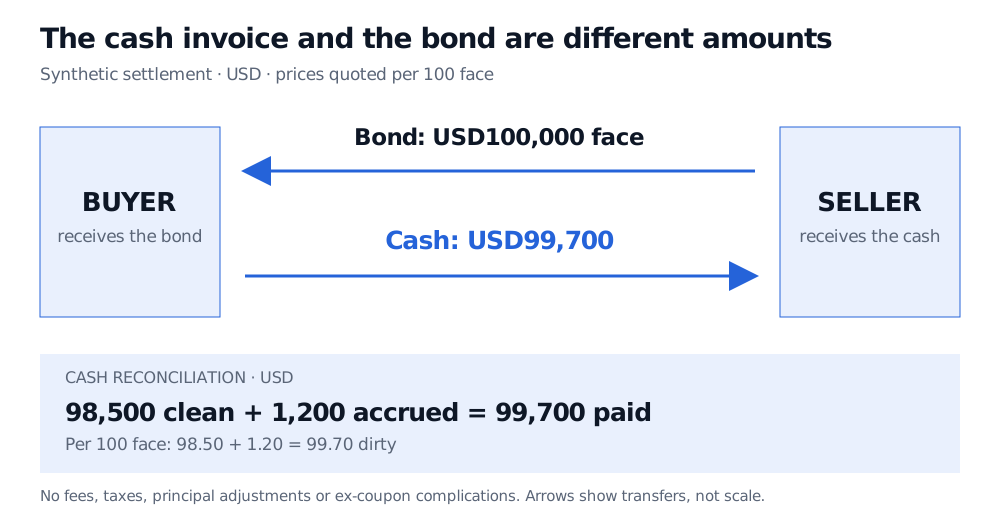
Original synthetic settlement diagram. Face value describes the bond position; dirty price determines the cash amount under the stipulated terms. Transfers are not drawn to scale; fees, taxes and special coupon-entitlement rules are excluded.
A dirty quote of 99.70 means 99.70% of face, not USD99.70 for the whole position and not a yield of 99.70%. FINRA’s pricing guide explains the percentage-of-par point scale and the accrued-interest addition in ordinary secondary-market transactions.
The model value must use the same basis
For a plain fixed-coupon bond, discounting the remaining coupon and principal payments to settlement produces a full value, using discount factors appropriate to the valuation assumptions and the payments the buyer is entitled to receive. Compare that value with a dirty price. To compare it with a clean quote, subtract the corresponding accrual first.
Accrued interest is therefore a bridge between quotation bases, not another future cash flow to add to a model that already values the full bond. ICE’s accrued-interest documentation states the reverse conversion: dirty price less accrued interest equals clean price. Adding accrual twice overstates value.
SelfMadeQuant’s Bonds and Yields lesson develops the discounting of coupon and principal payments before interpreting yield. It has a public preview; the full lesson requires membership.
“Full” has a specific meaning
Dirty price includes accrued interest; it does not automatically include every transaction cost. A dealer’s markup may already be embedded in an execution price, while an agency commission may be charged separately. Read the confirmation before treating a quoted full price as the complete cash debit. FINRA describes both compensation arrangements.
Nor is a change in dirty price a total return. Coupons can leave the bond as cash during the holding period. A return calculation must reconcile the purchase cash, subsequent receipts, ending value or sale proceeds, and relevant costs; coupon reinvestment matters when measuring a compounded return.
Finally, use the security’s actual coupon-entitlement rules and day-count convention. Ex-coupon trading, defaulted bonds trading flat and principal-adjusted instruments require their own treatment. The positive accrual in this example is a stipulated ordinary case, not a rule for every bond.
Sources
- Frank J. Fabozzi and Francesco A. Fabozzi, Bond Markets, Analysis, and Strategies, 10th ed., MIT Press, 2021, Chapter 2, “Pricing of Bonds,” “Accrued Interest” and “Calculating Accrued Interest”: cash-flow valuation, clean/full prices and settlement conventions.
- FINRA: Bonds, “Selling Before the Maturity Date,” “Bond Pricing” and “Brokerage Firm Role and Compensation”: accrual, quotation units and compensation arrangements.
- ICE: Dirty Price: settlement-price meaning and the possibility of a market quoting dirty prices directly.
- ICE: Accrued or Accrued Interest: the relationship between dirty price, accrued interest and clean price.