A clean price is a bond price that excludes accrued coupon interest. It separates the traded price from the coupon interest accumulated before settlement. For a quant comparing a model valuation with a market quote, this is a units-and-conventions check: the model's full value and a clean quote are different price bases.
The distinction concerns a coupon bond, not the cleanliness of its data or its credit quality. A low-risk bond can have either a clean quote or a full price, and a clean price can rise or fall with market conditions.
Start with the quote, finish with the cash
Consider a synthetic ordinary bond settlement. The agreed clean quote is 98.50 per 100 face value, and accrued interest at settlement is 1.20 on the same basis. The buyer receives the next coupon under the assumed convention. There are no fees, taxes, principal adjustments or ex-coupon complications in this example.
The dirty price, also called the full price, is
These are per-100 quotes, not the dollar invoice for an entire position. For USD100,000 face, multiply each quoted component by :
| Component | Quote per 100 face | USD for this position |
|---|---|---|
| Clean price | 98.50 | 98,500 |
| Accrued interest | 1.20 | 1,200 |
| Dirty price / settlement invoice | 99.70 | 99,700 |
The clean quote is 98.50% of face. The buyer pays USD99,700 under the stipulated terms; budgeting only USD98,500 leaves out the accrued-interest component. FINRA's bond-pricing explanation describes the percentage-of-par point scale and explains adding accrued interest to the contract price in an ordinary secondary-market sale.
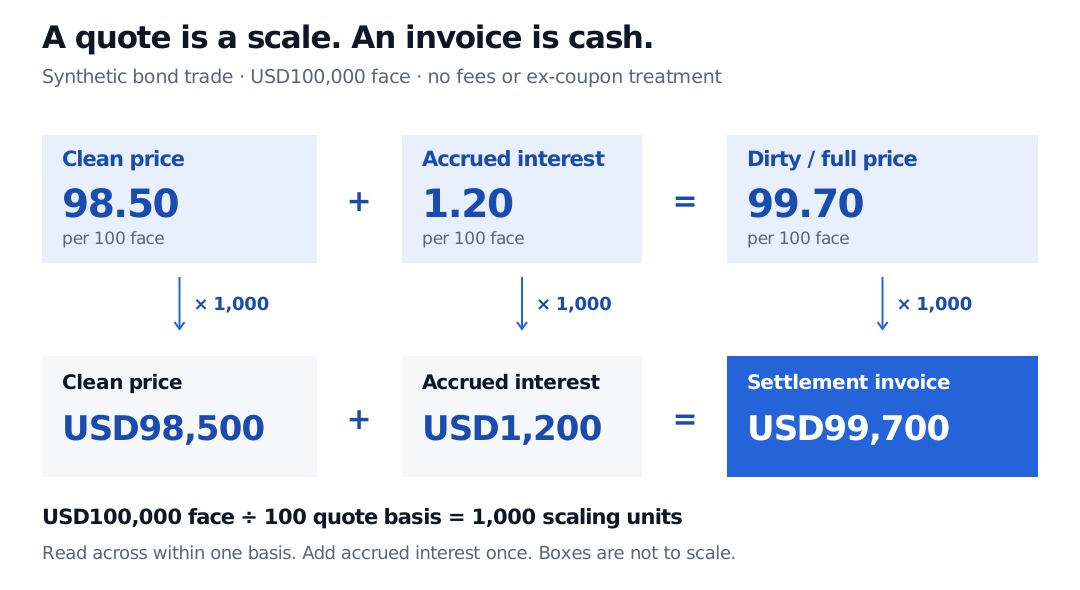
Original synthetic quote-to-invoice ledger. Each column is scaled by the same face-value factor; boxes are not to scale. Fees and special coupon-entitlement rules are excluded.
What has been removed?
The clean-price convention removes the separately calculated coupon accrual from the full price:
It does not remove the value of future coupons. Discounting the bond's remaining entitled coupon and principal payments gives a full value; subtract accrued interest to compare that value with a clean quote. ICE's pricing documentation makes this same full-to-clean distinction. Adding accrual to a model value that already includes it would count the component twice.
Stripping out accrual helps keep the mechanical coupon cycle separate from quoted-price movements. It does not make the clean price constant between coupon dates, and a change in the clean price alone is not the bondholder's total return: coupons received and the cash paid or received at each settlement matter too.
For the underlying valuation step, SelfMadeQuant's Bonds and Yields lesson explains discounting coupon and principal payments and distinguishes coupon rate from yield. The link opens a public preview; the full lesson requires membership.
Before using an actual quote, confirm its basis, currency, face amount and settlement date, then apply the security's coupon-entitlement and day-count convention. The simple positive-accrual example above is not a universal rule for every distressed, ex-coupon or principal-adjusted security.
Sources
- Frank J. Fabozzi and Francesco A. Fabozzi, Bond Markets, Analysis, and Strategies, 10th ed., MIT Press, 2021, Chapter 2, “Accrued Interest” and “Calculating Accrued Interest”: clean/full price distinction, coupon entitlement and settlement conventions.
- FINRA: Bonds, “Selling Before the Maturity Date” and “Bond Pricing”: accrued interest and the percentage-of-par quotation scale.
- ICE: Accrued or Accrued Interest: subtracting accrued interest from a bond's dirty price to obtain its clean price.