Convert nominal interest quotes into one-year growth, follow a semiannual interest ledger and distinguish equivalent rate conversions from APR and realised returns.
Effective annual rate
The effective annual rate (EAR) is the percentage increase in a balance over one year after allowing for compounding. It puts different interest-rate quotations on a common one-year growth basis: a nominal annual quote of 6% compounded semiannually produces a 6.09% EAR when all interest remains invested.
Here EAR describes fee-free interest accumulation under a stated convention. It does not by itself measure an investment's market risk, purchasing-power growth or total borrowing cost.
Follow the balance
Consider a synthetic USD 1,000 deposit with a fixed nominal annual rate of 6%, compounded in two equal half-year periods. The rate per half-year is 0.06/2=0.03, or 3%. There are no fees, taxes, additional deposits or withdrawals.
Date
Interest for the period
Balance after interest
Today
—
USD 1,000.00
End of first half-year
USD 30.00
USD 1,030.00
End of year
USD 30.90
USD 1,060.90
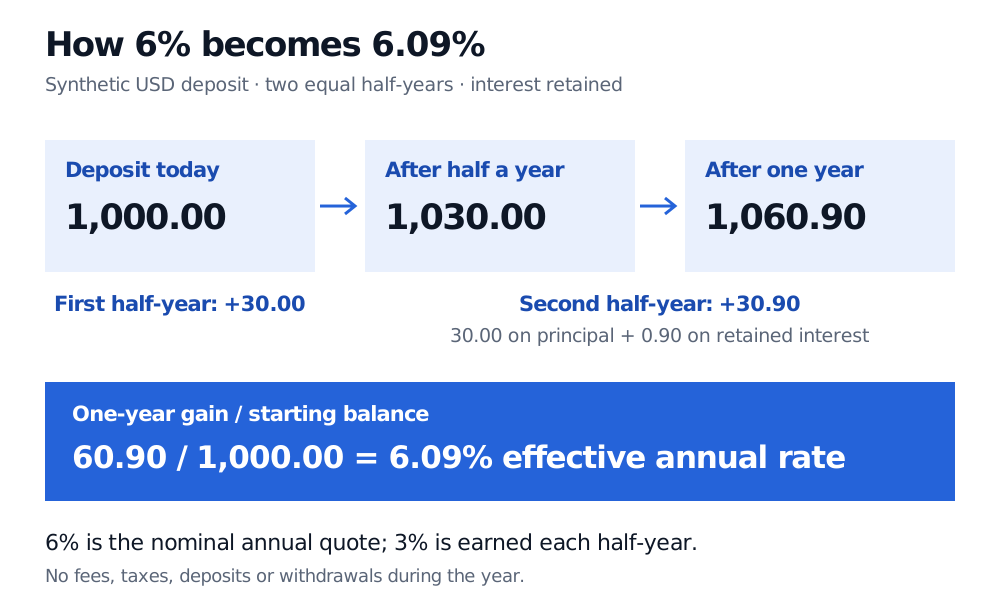
The second interest credit is 3% of USD 1,030, so it includes USD 0.90 earned on the first period's USD 30 interest. This is compounding. The year's gain is USD 60.90 on the original USD 1,000:
i=1,0001,060.90−1=0.0609=6.09%.
USD 1,000 grows to USD 1,030 after one half-year and USD 1,060.90 after one year. The second half-year's USD 30.90 interest includes USD 0.90 earned on retained interest.
Original synthetic ledger: 6% nominal annually with semiannual compounding means two 3% periods. All interest is retained; no fees, taxes or intermediate cash flows.
Convert the quote, preserve the growth
For a nominal annual quote j compounded m equal times per year, with a constant periodic rate j/m,
i=(1+mj)m−1.
Here m is a positive integer and the accumulation base 1+j/m must be positive. With annual compounding (m=1), the nominal annual quote and EAR coincide. The formula also permits negative rates within its domain; “effective” does not mean positive or guaranteed.
Going the other way, the equivalent rate per month is
q=(1+i)1/12−1.
For the same 6.09% EAR, this gives approximately 0.49386220% per month, or a 5.92634644% nominal annual quote compounded monthly, obtained as 12q. Using the unrounded monthly rate for twelve periods reproduces USD 1,060.90. Dividing the EAR by twelve fails to preserve that growth because the monthly interest itself compounds.
Changing compounding frequency while holding the nominal quote fixed changes the one-year accumulation. Converting to an equivalent quote changes the quoted number and preserves it. This distinction matters when a pricing model and a quoted funding rate use different conventions.
The Time Value of Money lesson extends these conversions to present value and discount factors. The public page offers a preview; the full lesson requires membership.
Read the terms behind the rate
An EAR conversion needs a defined year and accumulation rule. Actual contracts can specify day counts, variable rates, crediting schedules and treatment of partial periods; an equal-month mathematical conversion does not establish those terms.
Finally, converting a quoted rate is arithmetic under assumptions. A realised market return depends on what actually happens to prices and cash flows. Reinvesting a security's payments at the quoted rate may be impossible; converting its quote does not guarantee that return.
Sources
John C. Hull, Options, Futures, and Other Derivatives, 9th edition, Global Edition, Pearson, 2018, §4.2, pp. 101–104: accumulation conventions and equivalent rate quotations.