APR expresses borrowing cost on an annual basis. Understand nominal APR, effective annual growth and why consumer-credit disclosures depend on product and jurisdiction.
Annual percentage rate
An annual percentage rate (APR) expresses the cost of credit as a yearly percentage. It helps put borrowing quotes on a common time scale, but its meaning depends on the product and the rules used to calculate it. For a quant modelling financing costs, treating every APR as an effective annual growth rate can produce the wrong cash flows.
Two uses need to be kept separate. In rate-conversion exercises, nominal APR commonly means a periodic interest rate multiplied by the number of periods in a year. A legally disclosed consumer APR is a defined borrowing-cost measure: its included charges, cash-flow assumptions and annualisation rules depend on the jurisdiction and credit product. It is not safe to apply one textbook formula to every disclosure.
The 12% quote that compounds to 12.6825%
Take a synthetic, fee-free contract quoted at 12% nominal per year, convertible monthly. There are twelve equal monthly periods, and the periodic rate is
im=120.12=0.01=1%.
On a constant USD 1,000 principal, one month's interest is USD 10. If principal and interest are repaid at that month-end, the repayment is USD 1,010. The 12% annual quote does not mean that one month costs 12%.
Now consider a different payment pattern under the same periodic rate: leave the initial USD 1,000 outstanding for twelve months, capitalising interest each month, with no payments or fees. The accumulated balance is
The nominal quote remains 12%; the effective rate is higher because interest itself accrues interest. More generally, if j is a nominal annual rate with m equally spaced compounding periods per year,
ieff=(1+mj)m−1.
This is a fee-free compounding conversion, not a universal legal APR formula. It assumes the stated periodic rate remains fixed and the interest is capitalised. Actual repayment schedules and balance calculation rules determine actual financing cash flows.
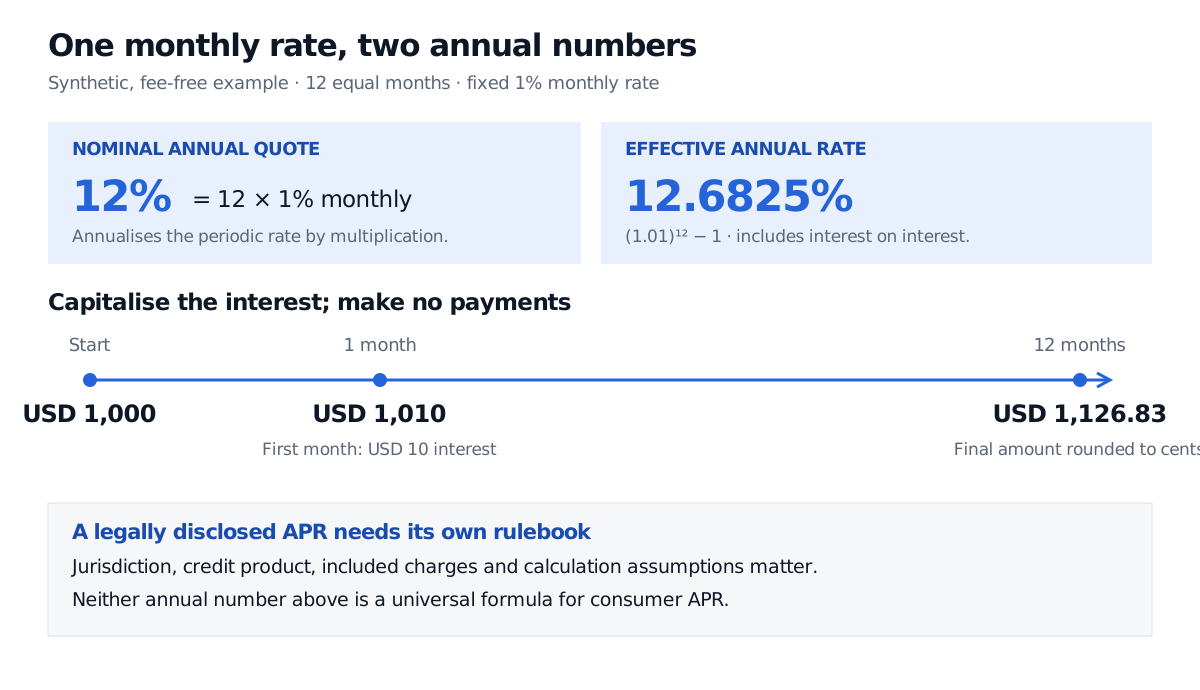
A 12% nominal annual quote gives 1% per month. With no fees or payments and unrounded monthly compounding, USD 1,000 grows to USD 1,010 in one month and USD 1,126.83 in twelve months: an effective annual rate of 12.6825%. Legal APR rules depend on jurisdiction and product.
Synthetic fixed-rate example, twelve equal months and no fees. Interest is capitalised without monthly cent rounding; the final amount is displayed to cents. The legal APR warning is separate from this rate conversion.
The Time Value of Money lesson develops equivalent rate quotes and discount factors. Its preview is public; the full lesson requires membership.
What a consumer APR includes depends on the rule
For US mortgages, the Consumer Financial Protection Bureau describes APR as a broader cost measure incorporating the interest rate, points, mortgage broker fees and certain other charges. It says APR is usually higher than the interest rate. “Always higher” would be too strong: a fee-free loan can have matching nominal note-rate and APR figures under applicable regular-payment conventions. Nor should “includes fees” be read as “includes every possible cost.” CFPB mortgage explanation.
Even within the US, the rules differ by credit type. Regulation Z §1026.14(b) computes the corresponding APR for specified open-end disclosures by multiplying a periodic rate by the number of periods in a year. That number does not incorporate a particular account balance or finance charge. Closed-end credit instead has the calculation framework in §1026.22 and Appendix J. The word “APR” therefore does not establish that a displayed rate compounds annually. Open-end rule, closed-end rule.
For UK credit agreements within FCA CONC App 1.2, the APR calculation equates the annual present values of drawdowns with repayments and payments of charges. The same section prescribes included and excluded costs, timing conventions and assumptions. Its annual cash-flow equation is a different convention from simply multiplying a monthly rate by twelve. The scope matters: this section is not a universal rule for every UK mortgage or credit product. FCA CONC App 1.2.
Translate the label into a cash-flow model
Before using an APR in a funding model, establish which measure the data field contains:
Nominal periodic quote: identify the period and compounding frequency before converting it.
Effective annual rate: identify the one-year accumulation factor it represents and the assumptions behind that factor.
Consumer APR disclosure: retain the jurisdiction, credit type, included costs and prescribed repayment assumptions alongside the number.
A single annual percentage also compresses a repayment schedule. It does not by itself reveal monthly payments, total currency cost, future changes in a variable rate or the cost of a different repayment path. APR is useful for comparison within a consistent disclosure framework; the underlying cash flows remain necessary for valuation and financing analysis.
John C. Hull, Options, Futures, and Other Derivatives, 9th Global Edition, Pearson, 2018, §4.2, pp. 101–103: periodic compounding and equivalent interest-rate conventions.