Compounding frequency is the number of times interest is added to the interest-bearing balance in a year. Annual compounding has one period; monthly compounding has twelve. For a quant comparing funding costs or converting a yield quote, the frequency tells you how to turn the quoted annual interest rate into a growth factor.
The crucial question is which rate stays fixed. Holding a positive nominal annual rate fixed while compounding more often increases the year's growth. Holding the effective annual rate fixed preserves that growth; only the quotation changes.
Four ways to quote 8%
Consider a synthetic USD 1,000 deposit for one full year. The nominal annual rate is fixed at 8%, interest stays in the account, and there are no deposits, withdrawals, fees or taxes. Each year is divided into equal compounding periods. The rate per period is .
If is the starting principal and the nominal annual rate as a decimal, the one-year balance and effective annual rate are
| Compounding | Periods per year | Rate per period | Effective annual rate | Year-end balance |
|---|---|---|---|---|
| Annual | 1 | 8% | 8.000000% | USD 1,080.00 |
| Semiannual | 2 | 4% | 8.160000% | USD 1,081.60 |
| Quarterly | 4 | 2% | 8.243216% | USD 1,082.43 |
| Monthly | 12 | 8.299951% | USD 1,083.00 |
Balances are rounded to cents only at the end, and effective rates to six decimal places. The unrounded quarterly balance is USD 1,082.43216; the monthly balance is approximately USD 1,082.99950680751. Actual account rounding rules can differ. This periodic accumulation formula is described in OpenStax's compound-interest chapter.
The semiannual cash ledger makes the extra growth visible. After the first half-year, interest is , leaving USD 1,040. In the second half-year, interest is . Total interest is USD 81.60. The extra USD 1.60 comes from earning 4% on the first USD 40 of interest. That is compounding at work.
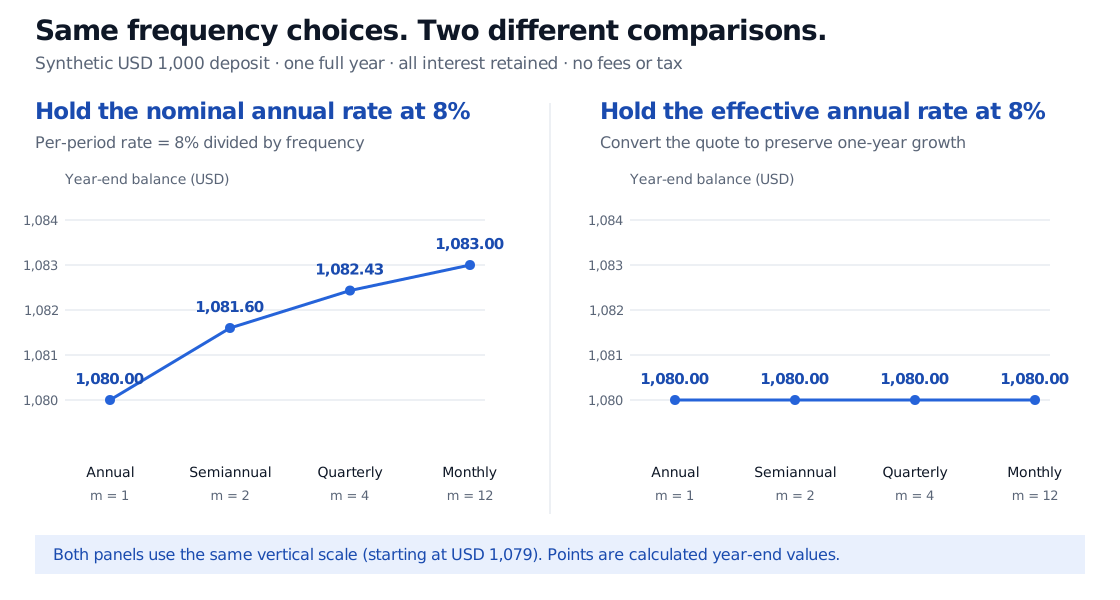
Original synthetic comparison on USD 1,000 for one year. Both panels use the same balance scale; points show calculated year-end amounts, with all interest retained.
The same return in different units
Now specify an effective annual rate of 8%. The year-end balance must be USD 1,080, whichever frequency is used to express the rate. For an equivalent nominal quote ,
Its per-period rate is , so
Dividing the effective 8% by twelve would miss this conversion: that division belongs to a nominal annual quote convertible monthly. The right-hand panel changes the nominal quote as the frequency changes. It does not manufacture extra wealth by relabelling the same return.
For accumulation, equivalent quotations and the reverse calculation of present value, continue with Time Value of Money. Its public page is a preview; the full lesson requires membership.
Compounding dates and payment dates answer different questions
Coupon frequency describes when a bond pays cash. Compounding frequency describes an accumulation or rate-quotation convention. A coupon paid out of a bond is not automatically reinvested in that bond at its quoted yield. Its contribution to future wealth depends on what happens to the cash after payment.
Likewise, an account can calculate interest, compound it and credit it on schedules that need to be read separately. For example, US deposit-account disclosure rules explicitly require the frequencies of compounding and crediting to be disclosed in Regulation DD §1030.4(b)(2). The contract's calculation rules, payment terms and any day count convention determine the actual amounts; the simple equal-period example above does not replace them.
Finally, increasing without changing the nominal 8% has the mathematical limit
The limiting effective annual rate is about 8.328707%, giving USD 1,083.29 after one year on USD 1,000. Continuous compounding is useful in pricing mathematics. This limit is a statement about the stipulated accumulation model, not a promise that an investment can deliver the return or that a provider offers infinitely frequent compounding.
Sources
- John C. Hull, Options, Futures, and Other Derivatives, 9th edition, Global Edition, Pearson, 2018, §4.2, pp. 101–104: periodic accumulation, equivalent rate quotations and the continuous limit.
- OpenStax, Contemporary Mathematics, §6.4: Compound Interest: compound accumulation and effective annual yield.
- Consumer Financial Protection Bureau, Regulation DD §1030.4, current text checked 26 October 2026: US deposit-account compounding and crediting disclosures.