Dividend policy is how a company decides how much and how often to pay dividends to shareholders. For an equity analyst forecasting cash flows, a key distinction is whether a higher payment changes the expected stream of future dividends or simply moves cash out of the company sooner.
A regular dividend is a recurring payment the company aims to maintain. A special dividend is an additional distribution outside that schedule. In their survey and interviews, Brav and co-authors found that financial executives were reluctant to cut regular dividends and preferred to raise them when they expected higher earnings to last. That helps explain why a regular increase can carry information about management’s outlook. Brav et al., Payout Policy in the 21st Century
Same earnings, different payout ratios
The dividend payout ratio compares cash dividends declared on common shares with net income attributable to common shareholders over the same period.
This example uses declarations for the earnings comparison. A paid-dividend series can differ when declaration and payment fall in different periods. With zero earnings the ratio is undefined, and with a loss it loses its interpretation as a share of profit. Damodaran, Financial Measures and Ratios
A fictional company earns USD 100 for common shareholders. It declares and pays USD 30 in regular dividends that year. With a further USD 30 special dividend, the payout ratio is 60% and USD 40 is added to retained earnings. With the regular dividend alone, the ratio is 30% and USD 70 is added to retained earnings. Assume no other entries to retained earnings.
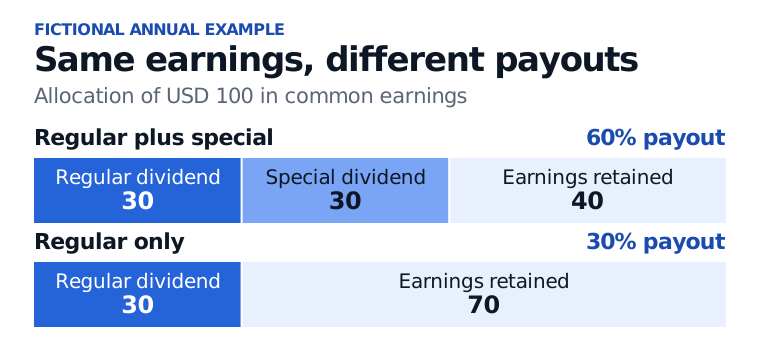
The regular dividend is identical in both cases. The one-off distribution accounts for the entire difference in the annual payout ratio.
Costco’s fiscal 2025 filing shows how this distinction changes a year-to-year comparison. Dividends declared fell from USD 19.36 per share in fiscal 2024 to USD 4.92 in fiscal 2025. Fiscal 2024 included a USD 15.00 special dividend. Excluding it, regular dividends declared increased from USD 4.36 to USD 4.92 per share. Costco, fiscal 2025 Form 10-K, Item 7
Cash available and cash returned
Retained earnings are an accounting balance. To assess whether recurring payouts can be funded, compare them with cash available after reinvestment and debt cash flows, and check existing cash balances. For instance, collecting receivables slowly can leave a profitable company short of cash in the current period. Damodaran, Financial Measures and Ratios
A share buyback pays shareholders who sell their shares. Dividends pay eligible holders per share. A company-level measure of net cash payout adds actual dividends and buybacks paid, then subtracts cash proceeds from share issuance over the same period. This captures cash moving both ways between the company and its equity investors. Damodaran, Dividends and FCFE by Sector
What changes in a valuation?
In Miller and Modigliani’s frictionless-market model, a company can change its dividend while keeping its investment plan fixed, leaving the value of existing shareholders’ claims before the payout unchanged. If the company issues equity to finance a larger dividend, existing shareholders receive more cash today and own a smaller share of future cash flows. When a payout change affects planned investment, funding costs or what investors expect the business to earn, those effects belong in the valuation. Miller and Modigliani, Dividend Policy, Growth, and the Valuation of Shares, sections I and V
In a dividend discount model, put an expected special dividend at its expected payment date and forecast the regular stream separately. The opening derivation in the SelfMadeQuant lesson shows how a dated dividend enters a share valuation. The full lesson requires membership. Equity Valuation: Dividend Discount and DCF Models
Sources
- Brav, Graham, Harvey and Michaely (2003). Payout Policy in the 21st Century.
- Costco Wholesale Corporation. Fiscal 2025 Form 10-K.
- Damodaran, NYU Stern. Financial Measures and Ratios and Dividends and FCFE by Sector (US).
- Miller and Modigliani (1961). Dividend Policy, Growth, and the Valuation of Shares.