EBITDA stands for earnings before interest, income taxes, depreciation and amortisation. It starts with net income and reverses those expenses. Adjusted EBITDA makes further changes under a stated definition. Adjusted earnings can instead refer to an adjusted bottom-line figure, such as adjusted net income or adjusted earnings per share. The distinction matters in a peer screen. Adding back more expenses raises the EBITDA denominator and can make the same company look cheaper at the same enterprise value. SEC staff, Non-GAAP Financial Measures, Q103.01–103.02, Damodaran, Financial Measures and Ratios
From net income of 50 to adjusted EBITDA of 103
A fictional U.S. manufacturer reports 50 million USD of net income for the year. Its results include 10 of income tax expense, 15 of net interest expense and 20 of depreciation and amortisation (D&A). Assume there are no other adjustments to those lines. For a separate comparison of ongoing production costs, management shows an adjusted figure that adds back 8 of severance paid for a specific plant closure. The expense is already in net income and remains in EBITDA.
Suppose management also reports adjusted net income using the same severance exclusion. If the exclusion raises the hypothetical income tax expense by 2, that reconciliation adds the 8 separately and deducts the 2, producing . This measure keeps interest and D&A in earnings. MasterBrand’s Q2 2026 investor presentation shows separate bridges from GAAP net income to adjusted EBITDA and to adjusted net income, with tax effects shown separately in the latter. MasterBrand, Q2 2026 Investor Presentation, slides 18–19, SEC staff, Q102.11
Why the cash figure is 40
The same manufacturer ends the year with 30 more in receivables because it has yet to collect some of the sales it recorded. It paid the severance, interest, taxes and other operating costs recognised in the year. With no other timing differences or non-cash items, the indirect bridge adds back 20 of D&A to net income and subtracts the 30 increase in receivables. Operating cash flow is . If it also spent 25 in cash on equipment, that purchase is an investing outflow and leaves 15 of operating cash flow after capital spending. SEC, Beginners’ Guide to Financial Statements, Cash Flow Statements
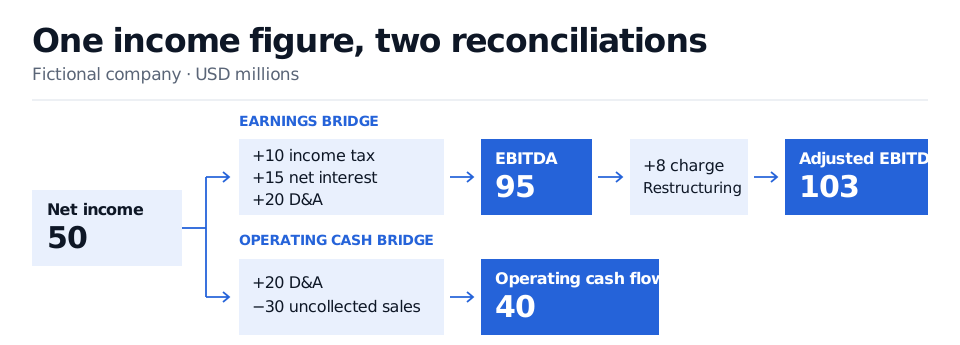
The cash bridge keeps the paid restructuring charge, interest and income tax in the result. It also removes the sales still waiting to be collected.
Two firms can report the same EBITDA and collect customer invoices at different speeds or need different amounts of cash to replace equipment. EBITDA can put peers with different interest costs or depreciation charges on a more comparable footing. A comparable company analysis still needs a consistent earnings window, adjustment policy and operating scope. The SelfMadeQuant capstone shows how a filing screen uses net income and operating cash flow together to measure accruals. Damodaran, Financial Measures and Ratios, Financial Filing Change and Deterioration Monitor (full report for members)
Read the add-backs and the agreement
Check whether similar costs recur under new labels and whether comparable gains come out as well as losses. A plant closure can be a distinct event while restructuring remains a recurring cost for the business as a whole. For U.S. registrants, SEC staff guidance flags potentially misleading exclusions of ordinary recurring cash expenses, changes in treatment across periods and exclusions that remove charges while retaining similar gains. SEC staff, Q100.01–100.05
Under U.S. Regulation G, covered public disclosures of material information containing a non-GAAP measure generally need the most directly comparable GAAP figure and a quantitative reconciliation for historical measures. The overall presentation must also avoid misleading investors. For SEC filings and earnings releases furnished under Form 8-K Item 2.02, Item 10(e)(1)(i) also requires the comparable GAAP measure to have at least equal prominence and management to explain why it believes the measure is useful to investors. SEC staff identifies GAAP net income as the comparator for EBITDA presented as a performance measure and calls for a distinct label when the calculation makes additional adjustments. The staff interpretations page lists 13 December 2022 as its latest update. Regulation G, § 244.100, Regulation S-K, § 229.10(e), Form 8-K, Item 2.02, Instruction 2, SEC staff, Q102.10 and Q103.01–103.02
A debt covenant can define its own EBITDA for a leverage test. Use the signed agreement and amendments for the debt definition, test period and permitted adjustments. For example, the September 2026 Bloomin’ Brands agreement allows certain projected cost savings in its contract measure, subject to conditions and a cap. For fixed net debt and positive EBITDA, a permitted add-back lowers the contractual leverage ratio without changing cash on hand. SEC staff also explains when disclosure of a material covenant measure may be required in management’s discussion of liquidity. Bloomin’ Brands credit agreement, §§ 1.01, 1.11 and 7.10, SEC staff, Q102.09
Sources
- SEC Division of Corporation Finance, Non-GAAP Financial Measures
- eCFR, Regulation G, 17 CFR § 244.100
- eCFR, Regulation S-K, 17 CFR § 229.10(e)
- SEC, Form 8-K
- SEC, Beginners’ Guide to Financial Statements
- Aswath Damodaran, Financial Measures and Ratios
- MasterBrand, Q2 2026 Investor Presentation
- Bloomin’ Brands and OSI Restaurant Partners, Fourth Amended and Restated Credit Agreement