Earnings per share (EPS) measures how much of a period’s profit or loss is attributable to one ordinary share. Basic EPS uses the time-weighted count of ordinary shares treated as outstanding. Diluted EPS also reflects potential ordinary shares that pass a dilution test, with an adjustment to earnings when the assumed exercise or conversion changes them. The distinction matters when comparing earnings growth or price-to-earnings ratios. EPS can rise after a share buyback even if profit stays flat. IAS 33, paragraphs 9–24 and 30–44.
Start with the profit and the shares that earned it
The basic numerator is the parent company’s profit or loss attributable to ordinary shareholders. In consolidated accounts, exclude the share of profit belonging to non-controlling interests and make any required adjustments for equity-classified preferred shares. For example, the period’s required cumulative preference dividend reduces ordinary earnings even if it has yet to be declared. The basic denominator weights share counts by the fraction of the period for which those shares were outstanding. A late buyback has less effect on this period’s average than an early one. Stock splits require a retrospective adjustment to the share counts so that the per-share figures use comparable units. IAS 33, paragraphs 12–20 and 64 and Appendix A1.
Reconcile basic and diluted EPS
A fictional company earns 100 currency units (CU) attributable to ordinary shareholders, all from continuing operations. It has 60 shares for the first half of the reporting period and 40 for the equally long second half after buying back 20. Its weighted-average share count is therefore 50.
Ten simple equity-classified warrants are outstanding throughout. Each lets the holder buy one share for 6 CU and the share price averages 12 CU over the period. The assumed exercise issues 10 shares and brings in 60 CU, the amount that would buy 5 shares at the average market price. Only the 5-share difference counts for diluted EPS. These warrants leave the earnings numerator unchanged. IAS 33, paragraphs 36–38 and 45–47.
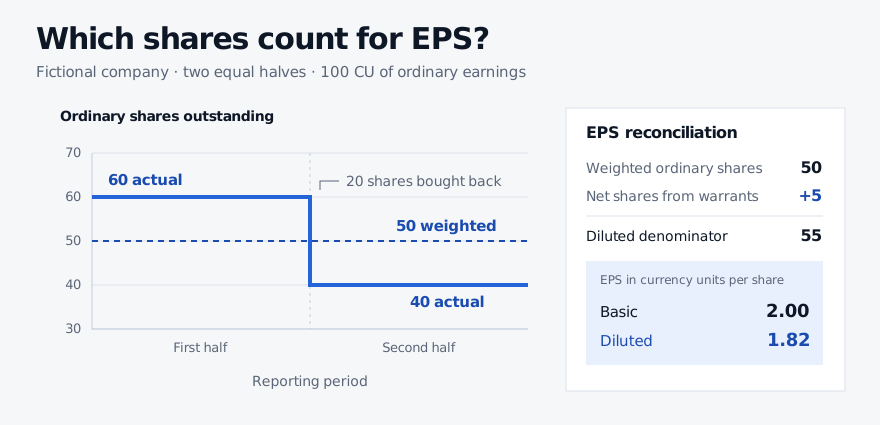
The buyback changes how many actual shares count over the period. The warrant adjustment changes only the diluted denominator in this example.
A convertible bond can change both sides. For a simple bond convertible entirely into shares, assume conversion at the start of the period, or at issue if later. Add the time-weighted conversion shares to the denominator and restore to earnings the after-tax interest expense that would have been avoided, accounting for any other income or expense changes from conversion. The extra earnings can offset the effect of spreading them across more shares. IAS 33, paragraphs 33–39 and 49–50.
What gets left out of diluted EPS?
Under IAS 33, an instrument enters the diluted calculation only if its assumed exercise or conversion lowers EPS from continuing operations, which means making a loss per share more negative in a loss period. Test instruments separately from most dilutive to least dilutive, comparing each addition against the result so far. In the same fictional company, a continuing-operations loss of 100 CU would produce basic EPS of . Including the five warrant shares would bring it to about , a smaller loss per share. The warrants are anti-dilutive in that case, so diluted EPS stays at if they are the only potential shares. If the company instead earns a continuing-operations profit and reports an overall loss because of a discontinued operation, shares that pass the continuing-operations test still enter the overall diluted figure. IAS 33, paragraphs 41–44 and Appendix A3.
To explain a change in EPS, start with the earnings and share-count reconciliations in the EPS note. It also identifies instruments excluded as anti-dilutive that could affect EPS in a later period. For a valuation multiple screen, use the same earnings basis and period across companies, such as trailing reported diluted EPS. The SelfMadeQuant lesson works through the separate task of relating a forward P/E to forecasts of earnings, payout and growth. IAS 33, paragraph 70, Equity Valuation: Dividend Discount and DCF Models (public preview, full lesson for members).