A net operating loss (NOL) carryforward is the unused portion of a tax loss from an earlier year that tax law allows a business to deduct against taxable income in later years. The loss is computed under tax rules, so a loss on the income statement can differ from the amount available to carry forward. For a free cash flow forecast, the amount that can actually be used in each year determines when the tax saving arrives. IRS, Form 1120 instructions, lines 29a and 30
How a loss of 100 can leave tax due
A fictional company starts the year with USD 100 of unused losses and earns USD 80 of taxable income before the NOL deduction. Its fictional tax regime permits only USD 50 of the carryforward to be used this year. The tax rate is 25%, and there are no other adjustments, credits or expiries.
The same deduction reduces this year’s taxable income to and leaves of losses for later years. Current tax is , down from USD 20 without the deduction. The USD 12.50 saving is this year’s tax benefit.
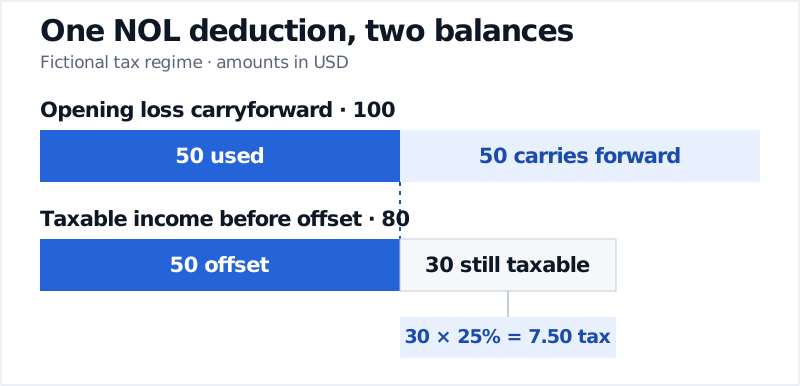
The same USD 50 comes out of the loss balance and the taxable income base. The remaining taxable income is what generates current tax.
Why the tax year and owner matter
Under U.S. federal law, for tax years beginning after 2020, § 172 generally caps the use of losses from tax years beginning in 2018 or later at 80% of the specified taxable-income base left after eligible older losses. The base is computed before deductions under §§ 172, 199A and 250. Older losses generally have a 20-year carryforward, while newer losses generally carry forward indefinitely. Non-life insurers have a separate rule with a 20-year carryforward and no 80% cap. 26 U.S.C. § 172(a), (b) and (f), IRS, Form 1120 instructions, line 30
A separate U.S. limit under § 382 can restrict how much pre-change loss a corporation uses each year after a qualifying ownership change. In an acquisition model, forecast how much of the target’s loss can be used after the deal under the applicable rules. 26 U.S.C. § 382(a), (b) and (g)
From the tax note to the cash flow forecast
The carryforward measures deductions still available. A deferred tax asset (DTA) measures the future tax benefit recognised in the accounts. Under IAS 12, the company recognises the benefit to the extent that sufficient taxable profit is probable. Under U.S. GAAP, a valuation allowance reduces the gross DTA for the portion that fails the more-likely-than-not realisation test. An allowance release can increase the reported DTA before the company claims any of the losses. IAS 12, paragraphs 34–36, FFIEC, September 2026 reporting instructions, Income Taxes glossary
Start with the income tax note and track losses by jurisdiction and year of origin. Forecast eligible taxable income, apply any expiry and annual-use restrictions, and carry the unused balance forward. The economic benefit depends on the present value of the tax savings the company expects to realise. If the cash flow forecast already includes those savings, adding the DTA to the valuation counts the same benefit twice. Aswath Damodaran, The Effect of Net Operating Losses
Sources
- Office of the Law Revision Counsel, 26 U.S.C. § 172, Net operating loss deduction
- Office of the Law Revision Counsel, 26 U.S.C. § 382, Loss limitations following ownership change
- IRS, Instructions for Form 1120 (2025)
- IFRS Foundation, IAS 12 Income Taxes
- FFIEC, September 2026 reporting instructions, Income Taxes glossary
- Aswath Damodaran, More on Effective Tax Rates