The effective tax rate (ETR) divides income tax expense in the income statement by pretax book profit. The cash tax rate, as defined here, divides income taxes paid net of cash refunds by the same pretax book profit. The ETR measures the tax charge or benefit in reported earnings. The cash rate shows how much cash went to tax authorities relative to the period’s profit. The difference matters when forecasting free cash flow from earnings. IAS 12, paragraphs 5 and 86, IAS 7, paragraphs 35–36
Where the two rates diverge
Income tax expense in profit or loss combines current tax expense and deferred tax expense, with benefits entering as negative amounts. Current tax reflects tax accrued on taxable results and can include revisions to prior-period tax. Deferred tax reflects accounting for future tax consequences, such as changes in deferred tax assets and liabilities recognised through earnings. A second gap can arise between current tax accrued and cash paid. For example, a company can finish the year with an unpaid tax balance or settle a prior year’s tax bill. IAS 12, paragraphs 5, 12, 58 and 79–80
Two companies, the same 10-percentage-point gap
Both fictional companies earn USD 120 million before tax, record USD 30 million of income tax expense and pay USD 18 million of income taxes. Their ETR is and their cash tax rate is . That leaves a USD 12 million gap between tax expense and cash paid.
Assume the only movements in current tax payable are the current tax charge and the payment. Then cash paid equals current tax expense less the increase in current tax payable. A rise in that balance means current tax accrued faster than cash went out. IAS 12, paragraph 12
- Company A records USD 24 million of current tax expense and USD 6 million of deferred tax expense. Its current tax payable rises from USD 5 million to USD 11 million, leaving USD 18 million paid ().
- Company B records USD 18 million of current tax expense and USD 12 million of deferred tax expense. Its current tax payable stays at USD 5 million, so cash paid equals current tax expense.
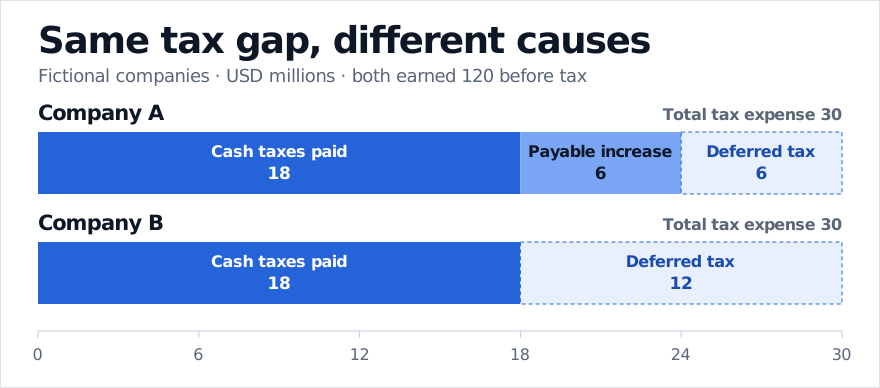
The two companies have identical tax rates, but only Company A increased its unpaid current tax balance.
Read the note and the cash flow statement together
Look for the current and deferred split in the tax note and the cash amount in the cash flow statement or supplemental disclosures. IAS 7 generally puts income tax payments in operating cash flow, with exceptions when the payments can be specifically tied to investing or financing activities. US GAAP Topic 740 requires annual disclosure of income taxes paid net of refunds, broken down by jurisdiction category. A real payable bridge may also need changes in current tax receivables and adjustments for acquisitions, currency translation or taxes recognised outside earnings. IAS 12, paragraphs 12, 58 and 61A, IAS 7, paragraphs 35–36, FASB ASU 2023-09, Topic 740 disclosure amendments
The tax note’s statutory-rate reconciliation answers a separate question. It explains why reported tax expense differs from the amount implied by a benchmark tax rate, for example when a company earns income in jurisdictions with different rates. IAS 12, paragraphs 81(c) and 84–86
Match the fiscal window and reporting scope before comparing rates. For example, tax expense from continuing operations belongs with pretax profit from continuing operations. Cash taxes may cover a broader group of activities and may settle past years even when the reporting periods line up. Both ratios are undefined at zero pretax profit and can swing sharply near zero. A net cash payment in a loss period produces a negative cash tax rate, even though cash left the company. In those cases, the underlying cash amounts and the payments they reflect give a clearer basis for comparison. IAS 7, paragraphs 35–36, FASB ASU 2023-09, Topic 740 disclosure amendments and BC68–BC73