Under IFRS, the equity method records a qualifying stake in another business as an investment and includes the investor’s share of that business’s profit or loss in its own earnings. Full consolidation combines a parent and the businesses it controls line by line, then shows how much of group profit belongs to outside shareholders. The distinction changes which sales, debt and cash flows appear in the reported totals, even when the investor’s share of profit is the same. IAS 28, paragraphs 3, 10 and 16 · IFRS 10, paragraphs 19–22 and B86–B94
Start with who can make the decisions
- Control. The investor can direct the activities that most affect the business’s returns, is exposed to variable returns from its involvement and can use its power to affect those returns. Substantive rights in a contract can confer that power even below a majority of the votes. The controlled business is a subsidiary. IFRS 10 generally requires consolidation from the date control begins, with a fair-value exception for certain subsidiaries of investment entities. IFRS 10, paragraphs 5–14, 20, 31–32 and B35–B41
- Significant influence. The investor can participate in financial and operating policy decisions without controlling those decisions alone or jointly. The business is an associate. IAS 28 generally requires the equity method for associates and joint ventures. It presumes significant influence at 20% or more of the voting power unless clear evidence shows otherwise. Board representation and participation in policy decisions are among the evidence to assess. IAS 28, paragraphs 3, 5–6 and 16–19
Check whether the statements cover the group or the parent alone. IAS 27 permits a parent to use the equity method for subsidiaries in its separate financial statements. IAS 27, paragraphs 4 and 10
Follow a 30% stake through the statements
A fictional investor holds a 30% ordinary equity interest in Birch throughout the year. It has significant influence but neither control nor joint control. Its opening investment carrying amount is USD 100 million. Birch earns USD 40 million after tax and pays USD 10 million in pro rata cash dividends. Assume no acquisition-date basis differences, impairment, other comprehensive income or transactions between the two companies apart from the dividend.
- Profit or loss. Recognise million of equity-method income. Birch’s revenue and expenses stay outside the investor’s corresponding lines.
- Balance sheet. The profit share raises the investment by 12 million. The cash dividend of million reduces it because the distribution transfers value from the investment to cash. The closing carrying amount is million.
- Cash flow statement. The investor reports the 3 million cash receipt. Birch’s own cash flows stay outside the investor’s statement. IAS 28, paragraphs 10–11 and 32 · IAS 7, paragraphs 37–38
Keep the stake fixed and change the rights
In a separate scenario, the investor still holds 30% of Birch’s ordinary equity, but a substantive contract gives it control for the whole year. Assume the same profit, distribution and measurement facts. Birch’s USD 150 million of revenue and USD 110 million of expenses now enter the group totals in full. Of Birch’s USD 40 million contribution to group profit, USD 12 million is attributable to the parent’s owners and USD 28 million to non-controlling interests. IFRS 10, paragraphs 7, B38–B40 and B94
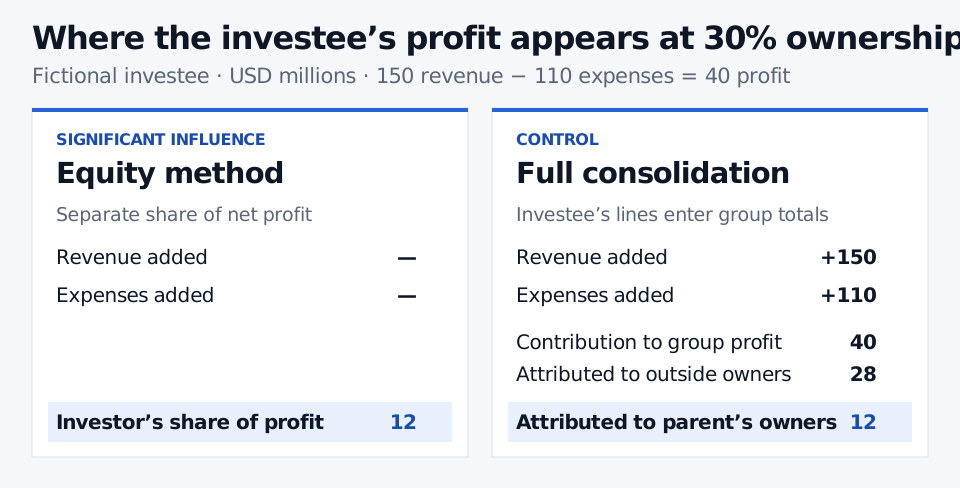
Both fictional scenarios attribute USD 12 million of Birch’s profit to the reporting company’s shareholders, while the reported revenue and expense lines differ.
The consolidated balance sheet includes Birch’s assets and liabilities. It eliminates the parent’s investment against its share of Birch’s equity and presents non-controlling interests separately within group equity. The group cash flow statement includes Birch’s cash flows and eliminates internal transfers, including the USD 3 million dividend to the parent. The USD 7 million paid to outside shareholders leaves the group. IFRS 10, paragraph 22 and B86
Match the multiple to the companies it covers
Reported revenue can jump when an investor obtains control even if the newly consolidated business’s own sales are flat. Check the notes for significant judgments about control and influence and for financial information on material associates. IFRS 12, paragraphs 7–9, 21 and B12–B14
If the denominator of an enterprise-value multiple includes all of a subsidiary’s EBITDA, include the value of the outside equity claim in the numerator as well. If an associate’s EBITDA is outside that denominator, strip the value of the associate stake out of the numerator. These adjustments put the operating earnings and the assets being valued on the same basis. Aswath Damodaran, NYU Stern, Dealing with Cross Holdings