Capitalised software and R&D costs are qualifying development costs recorded as an asset on the balance sheet. Costs charged to expense reduce profit as they are incurred. Capitalised costs generally reach profit later through amortisation or a write-down. That timing affects reported margins and book assets, so two companies spending similar amounts on development can look different in an earnings or profitability screen. The recognition threshold depends on the reporting framework and the kind of project. IAS 38, paragraphs 51–67 and 97, FASB, software accounting background
When does development become an asset?
IFRS, for an internally generated intangible asset under IAS 38. Expense research as incurred. If the research and development phases cannot be distinguished, treat the spending as research. Capitalise eligible, directly attributable development costs from the date the recognition criteria are met. For development, the company must demonstrate that it can technically complete the asset, that it intends to complete and use or sell it, that it is able to use or sell it, that it can show probable future economic benefits, that it has the resources to finish and use or sell it, and that it can reliably measure the development costs attributable to the asset. For internal software, its usefulness can help demonstrate future benefits. Previously expensed costs stay expensed. IAS 38, paragraphs 21–22, 51–57, 65–67 and 71
US GAAP, for R&D within ASC 730-10. Expense the R&D costs covered by that subtopic as they are incurred. Software has its own scope and thresholds. FASB ASU 2010-07, amendment 51
- Software for sale, lease or marketing under ASC 985-20. Expense development costs incurred to establish technological feasibility as R&D. Once feasibility is established, capitalise eligible production costs until the product is available for general release. Feasibility requires evidence that the software can meet its design specifications, supported by a detailed program design or, when the development process omits one, a completed working model. FASB, software accounting background, FASB ASU 2025-06, BC72–BC75
- Internal-use software under ASC 350-40 before adoption of ASU 2025-06. Expense preliminary project costs. Capitalise eligible application-development costs once the preliminary stage is complete, management has authorised and committed funding, and completion and intended use are probable. Capitalisation stops no later than when the software is substantially complete and ready for its intended use. Expense ordinary maintenance as incurred. FASB ASU 2025-06, pre-amendment text of ASC 350-40-25
- Internal-use software under ASC 350-40 after adoption of ASU 2025-06. FASB issued the update on 18 September 2025. It removes the project-stage test. Capitalisation of eligible costs starts when management has authorised and committed funding and it is probable that the project will be completed and the software used as intended. Significant development uncertainty must be resolved before that probability threshold is met. The amendments apply to annual periods beginning after 15 December 2027 and interim periods within them. Early adoption is permitted if the financial statements for the period have yet to be issued or made available for issuance. Adoption takes effect from the start of the annual reporting period. FASB ASU 2025-06, ASC 350-40-25-12 through 25-12A and 350-40-65-4
For a US software vendor, customers' ability to take possession matters. A vendor that hosts the software for customers generally uses ASC 350-40. A hosted arrangement falls under ASC 985-20 if the customer has the contractual right to take possession at any time during the hosting period without significant penalty and can feasibly run the software itself or use an unrelated host. FASB ASU 2025-06, BC13
One IFRS project from research to maintenance
A fictional company builds an internal tool that reconciles invoices. All amounts are in USD thousands. During the build period it pays 30 to evaluate alternative designs before the IAS 38 criteria are met. After it meets the criteria, it pays 70 for qualifying development. The tool becomes available for use at the start of Year 1, and later that year the company pays 20 for ordinary maintenance that keeps it working as intended. The company capitalises 70 and charges 50 of the spending directly to expense as incurred, split between research and maintenance. IAS 38, paragraphs 20, 54, 57 and 65–66
Assume a two-year useful life, zero residual value, straight-line amortisation to profit or loss, and no impairments, taxes or costs beyond those listed. The annual amortisation from the date the tool is available is . Year 1 expense is , and the software closes that year at . In Year 2, the final 35 of amortisation takes the carrying amount to zero. IAS 38, paragraphs 74, 97–100
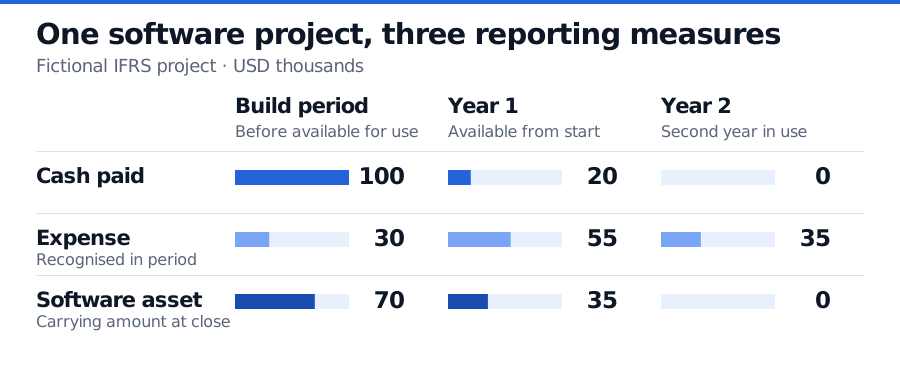
The build period creates a USD 70,000 software asset. In Year 2, amortisation reduces profit and the asset balance even though the project pays out no cash.
What to pull from the filing
Start with the software accounting policy and the reporting period. Then separate the R&D expensed this period, additions from internal development, and amortisation of previously capitalised costs. IAS 38 requires disclosure of R&D recognised as expense and a reconciliation of intangible carrying amounts by class that distinguishes internally developed additions from purchases and business combinations. The R&D expense disclosure covers an aggregate, so match its scope to the additions before using the two measures together. IAS 38, paragraphs 118 and 126–127
When comparing firms, check how much current development spending went into assets and how much reduced current profit. For a free cash flow model, trace cash paid as well as book additions. Cash can be paid in a different period from the addition, and the later amortisation is a noncash charge.