A 409A valuation estimates the fair market value (FMV) per share of a private company's stock, typically common stock, for purposes of U.S. Internal Revenue Code Section 409A. When a company grants nonstatutory stock options, that estimate helps it set the exercise price. The stock-option exclusion requires that the terms never permit a strike below grant-date FMV for the underlying stock, measured disregarding lapse restrictions. The option must also cover a fixed number of eligible shares set at grant, be subject to Section 83 on transfer or exercise, and have no additional deferral feature beyond the recognition timing the rule permits. Treasury regulation § 1.409A-1(b)(5)(i)(A) and (iii)
Two dollars per share at grant
Suppose a private company's common-share FMV is USD 2 on the grant date. It issues an option with a strike of USD 2 per share. An immediate-exercise comparison gives a grant-date intrinsic spread of USD per share. The award is at the money and the two prices satisfy the strike comparison. The stock valuation addresses that comparison. The option itself may have economic value from potential future appreciation, subject to its vesting and exercise terms. For a nonstatutory option with no readily determinable value at grant, later exercise for substantially vested shares can generate compensation income based on the spread at exercise. IRS Publication 525, Nonstatutory Stock Options
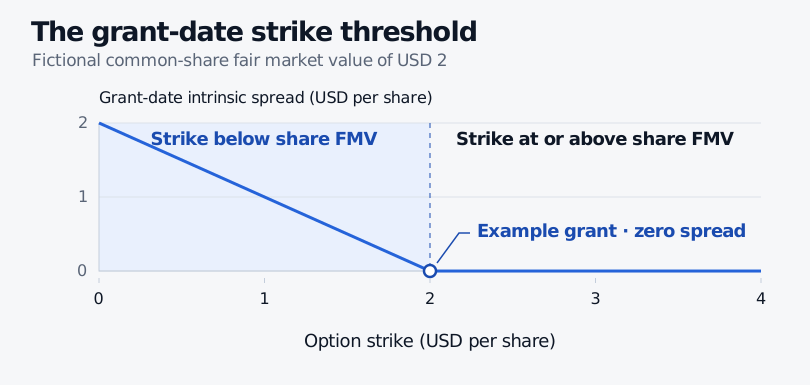
With common-share FMV fixed at USD 2, the spread also stays zero above the threshold. The curve shows the immediate-exercise comparison at grant.
The Finance Primer lesson Options works through the strike, moneyness and immediate-exercise value of a call. The full lesson is available with a free account.
Why the preferred round price can differ
A recent arm's-length funding round can inform the estimate. If investors bought preferred stock, the price they paid reflects the rights attached to that class. For example, a liquidation preference can give preferred holders first claim on part of the exit proceeds, leaving less for common holders in a modest sale. A valuation can use the round as evidence while allocating total equity value across the actual share classes and considering marketability. The size of any common-to-preferred price difference depends on the rights and the assumptions used to value them. Treasury regulation § 1.409A-1(b)(5)(iv)(B)(1)
Two ways to model the allocation are the Option Pricing Method and PWERM. OPM values option-like claims on equity proceeds, with thresholds where the distribution between classes changes. PWERM assigns probabilities to specific scenarios, such as a sale or IPO, and values each class's proceeds across those scenarios. Jade Biosciences described using a combination of the two for its common-share valuations. Aerovate's March 2025 SEC correspondence on Jade's valuations
When a valuation can support a new grant
For stock without a readily tradable market, the regulation calls for a reasonable method applied reasonably to the facts at the valuation date. It recognises three presumptions of reasonableness, often called safe harbours. The IRS Commissioner can rebut one by showing that the method or its application was grossly unreasonable. Treasury regulation § 1.409A-1(b)(5)(iv)(B)(1)–(2)
- Independent appraisal. An appraisal of the share class that meets the Section 401(a)(28)(C) requirements, with a valuation date no more than 12 months before the relevant grant or other transaction.
- Formula tied to transfer restrictions. A qualifying Section 83 formula linked to a permanent transfer restriction, used consistently for covered transfers to the issuer or to holders of more than 10% of total voting power. The rule has exceptions for certain company sales and limits its use when stock obtained on exercise can be transferred outside the restriction.
- Illiquid start-up stock. A reasonable, good-faith valuation documented in a written report by a qualified person. The company and its predecessors must have no material business operated for 10 years or more, the company must have no equity class traded on an established market, and the shares generally cannot carry purchase rights or obligations. Exceptions include a right of first refusal on an unrelated third party's offer and purchase terms that qualify as lapse restrictions. This route is unavailable if the company or option recipient reasonably anticipates a qualifying change in control within 90 days or a public offering within 180 days of the action using the valuation. Treasury regulation § 1.409A-1(b)(5)(iv)(B)(2)
A prior estimate must be no more than 12 months old and can become stale much sooner. If a financing, patent grant or litigation outcome brings information that could materially affect value, a new grant needs a valuation that reflects that information. The regulation looks at the information available when the company relies on the estimate. Treasury regulation § 1.409A-1(b)(5)(iv)(B)(1)
Sources
- U.S. Treasury, current stock-rights and valuation rules. 26 CFR § 1.409A-1(b)(5)
- Internal Revenue Service, nonstatutory options and the timing of income. Publication 525
- Aerovate Therapeutics, historical description of Jade Biosciences' common-stock valuations. SEC correspondence dated 24 March 2025