The Option Pricing Method (OPM) and the Probability-Weighted Expected Return Method (PWERM) estimate how much of a private company's equity value belongs to each share class. OPM prices option-like claims on a range of exit values. PWERM values the class payouts in specific outcomes and weights them by probability. The distinction matters when investors buy preferred stock with rights that common stock lacks. A preferred financing-round price can then be a poor direct estimate of the price of a common share. Jade Biosciences, 2025 Form 10-K, Determination of Fair Value of Common Stock
Who gets the next dollar at exit?
Start with the distribution waterfall, the rules that divide equity proceeds available after claims senior to equity have been settled. In this fictional cap table, the preferred class has a USD 20 million liquidation preference and can instead convert into 25% of all common shares after conversion. It gives up the preference on conversion. If it takes the preference, it has no further participation. Assume two classes and no other equity claims.
- Up to USD 20 million, preferred receives the entire pool. Common receives zero.
- Between USD 20 million and USD 80 million, preferred takes its USD 20 million preference and common receives each additional dollar.
- Above USD 80 million, conversion pays preferred more than the preference because 25% of the pool exceeds USD 20 million. Common receives 75% of the whole pool. At USD 100 million the two classes receive USD 75 million and USD 25 million, respectively.
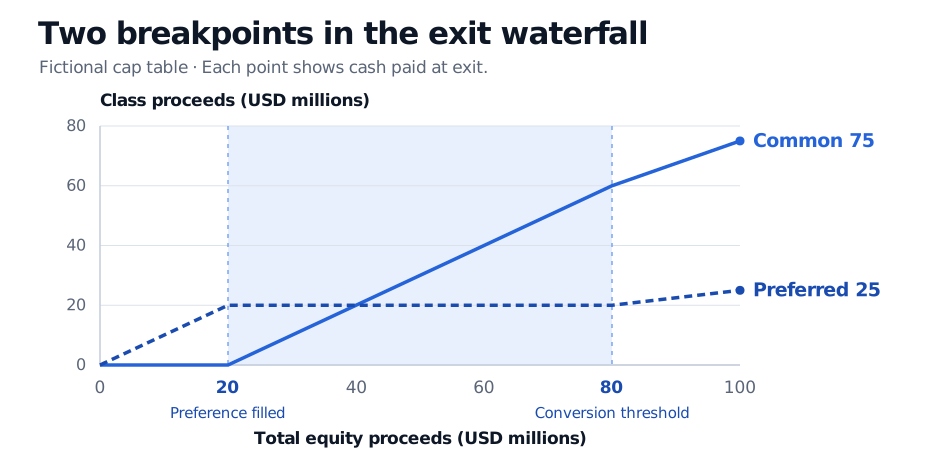
The preference and conversion terms change who receives the next dollar at each breakpoint.
OPM prices the layers of the waterfall
A breakpoint is where the split of the next dollar changes. Use each breakpoint as the strike of a call option on total equity proceeds. Let be today's value of the call struck at , with all strikes and proceeds in USD millions and a common assumed time to exit. Buying the call at 20 and subtracting the call at 80 leaves a payoff that rises only between 20 and 80. Above 80 that spread is capped at 60, and the call at 80 captures the incremental upside. ADC Therapeutics, SEC correspondence, Application of Back Solve method
| Layer of proceeds | Value today | Who receives the layer? |
|---|---|---|
| First USD 20m | 100% preferred | |
| Next USD 60m | 100% common | |
| Above USD 80m | 75% common, 25% preferred |
The common class is therefore worth in this model. Adding both classes' values gives , which equals today's total equity value in this setup if there are no interim payouts. Common can have positive value even if today's total equity is below the preference. It receives proceeds in the modelled exits above USD 20 million.
A Black–Scholes model implementation typically uses valuation-date equity value, an assumed time to liquidity, equity volatility, a risk-free rate, the breakpoints and a dividend assumption if applicable. That version uses a lognormal distribution for terminal equity at a single horizon. The valuation depends on the assumed spread of outcomes and the time available to reach the breakpoints. ADC Therapeutics, SEC correspondence
The SelfMadeQuant lesson on option spreads works through the same capped payoff using a lower-strike call minus a higher-strike call. The full lesson is available to members.
PWERM values named outcomes on their own dates
List distinct outcomes, estimate the equity proceeds and timing for each, then apply the waterfall under each outcome's terms. A sale may preserve a liquidation preference while an IPO may trigger conversion. ADC Therapeutics, SEC correspondence, planned offering conversion
Bring each class's payout back to the same valuation date before combining scenarios. Jade Biosciences, 2025 Form 10-K, Determination of Fair Value of Common Stock
Use the same fictional cap table and assume it has two possible outcomes. Both follow the same waterfall. For the common class, use a 10% annual discount rate solely to illustrate the present-value calculation. Amounts are USD millions.
| Outcome | Probability | Time to payout | Equity at exit | Common at exit | Common today |
|---|---|---|---|---|---|
| Sale | 60% | 1 year | 53 | 33 | 30 |
| Wind-down | 40% | 2 years | 12 | 0 | 0 |
The sale pays common 33 at exit, worth today. In the wind-down the entire USD 12 million goes to preferred. The estimated common class value is million. The inputs 30 and 0 are already on today's basis. Discounting 18 again would count the timing twice. Keep risk assumptions consistent too. A further haircut solely for the same failure already represented in the wind-down scenario would count that risk twice.
When the two methods fit together
PWERM can distinguish outcomes that have different timing or change the rights of a class, when there is enough evidence to estimate each outcome and weight. OPM can model a broad range of proceeds when the cap table terms are known but a particular sale value is hard to pin down. A hybrid can use OPM to allocate equity within one scenario and then combine that scenario's value with others on a common valuation date. For example, Aerovate described a 409A valuation of Jade that modelled an IPO separately and used OPM to allocate equity in the M&A scenario. Aerovate Therapeutics, SEC correspondence, July 24, 2024 Valuation
Sources
- Jade Biosciences describes its pre-merger hybrid method and the treatment of scenario cash flows. 2025 Form 10-K, Determination of Fair Value of Common Stock
- ADC Therapeutics describes breakpoints, the preferred-share waterfall and the inputs to its OPM. SEC correspondence dated 28 April 2020
- Aerovate describes the IPO and M&A assumptions used in Jade's historical 409A valuations. SEC correspondence dated 24 March 2025