Revalue a company’s assets and liabilities, then see how sale deadlines and wind-down costs change what remains for common shareholders.
Asset-based and liquidation valuation
Asset-based valuation estimates equity value by valuing the company’s assets individually and subtracting the value of its liabilities. For common equity, it also accounts for any other claims that rank ahead of common shares. This approach can anchor a valuation when the assets are separable and measurable, as in a property holding company, or when an analyst needs to compare continuing operations with a wind-down. Liquidation valuation uses the same building blocks under a sale premise and estimates the proceeds remaining after realisation costs and claims. CBV Institute, Asset Based Approaches · International Valuation Standards, IVS 200 §70
From book equity to adjusted net assets
Start with the balance sheet and mark both sides on the same date under the same premise. Book equity uses accounting carrying amounts. In an adjusted net asset calculation, an appraisal may put a warehouse above its carrying amount, while evidence on equipment condition and customer collections may bring machinery and receivables down. Review the notes for contingent liabilities, such as a disputed claim that could require payment. Include an evidence-based amount or test alternative settlements if the estimate is uncertain. An identifiable intangible, such as a licence, can have value even if it is absent from the balance sheet. Its value under a sale premise depends in part on whether it can transfer to a buyer. International Valuation Standards, IVS 200 §120
Take a fictional warehouse operator with only common shares. The four columns below are in USD millions as of 30 September 2026. The company has a bank loan of 45 and trade payables of 14. In each valuation scenario, it also faces a claim estimated at 6 that was disclosed in the notes without a recorded liability. Assume the same valuation-date liability amounts in all three estimates, no separately valuable intangibles and no incremental sale taxes in either liquidation. Future receipts and payments are already expressed in valuation-date dollars.
USD millions
Book amounts
Adjusted net assets, continued use
Orderly liquidation
Forced liquidation
Cash
10
10
10
10
Warehouse
60
92
85
65
Equipment
36
23
17
9
Receivables
18
15
14
14
Total assets or gross cash available
124
140
126
98
Liabilities
59
65
65
65
Selling and wind-down costs
—
—
8
5
Common equity residual
65
75
53
28
The continued-use valuation marks the warehouse as an operating asset. The marked assets of 140 less estimated liabilities of 65 give adjusted equity of 75 million USD. Compared with book equity, the asset marks add 16 million and the disputed claim absorbs 6 million.
The sale timetable changes the proceeds
In an orderly liquidation, the seller has a reasonable period to market the assets despite being compelled to sell. A forced liquidation compresses that period, which may shrink the buyer pool or leave less time for due diligence. In the example, assume six months is enough to market the warehouse and equipment. In the forced scenario, the lender withdraws interim funding and the assets must sell within 30 days. The faster sale saves 3 million USD in wind-down costs but reduces gross proceeds by 28 million USD, leaving 25 million USD less for shareholders. International Valuation Standards, IVS 102 Appendix A60, A110–A120
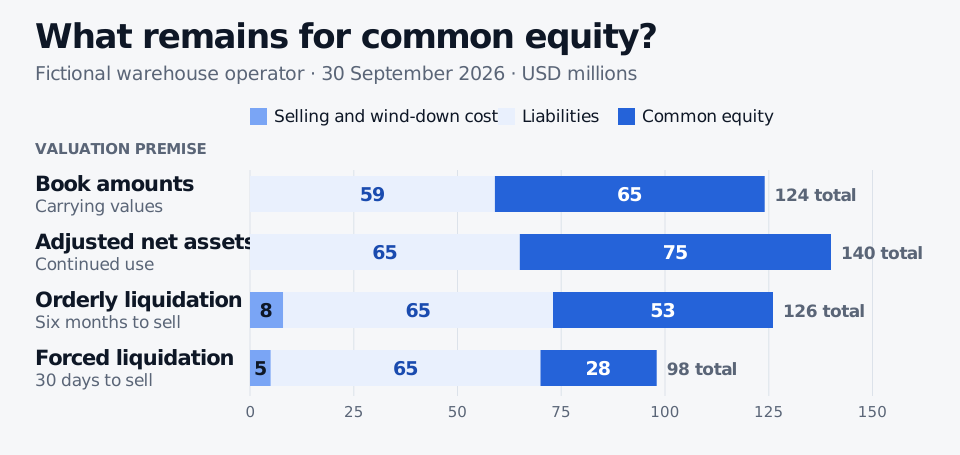
Four stacked bars in USD millions show book assets of 124 less 59 of liabilities leaving 65 of book equity, and adjusted assets of 140 less 65 leaving 75. Orderly liquidation leaves 53 after 65 of liabilities and 8 of costs from 126 gross. Forced liquidation leaves 28 after 65 of liabilities and 5 of costs from 98 gross.
The same company can show higher equity after marking its assets and lower equity when a sale deadline cuts the proceeds.
In the orderly case, 126 million USD of opening cash and gross receipts less 8 million of selling and wind-down costs leaves 118 million to meet claims. After 65 million of liabilities, the common-equity recovery is 53 million USD. The calculation works equally well from net proceeds. If the warehouse estimate already deducts a broker fee, exclude that fee from the separate cost line. Re-estimate liabilities for each premise where needed, such as when a shutdown triggers lease exit payments. In an actual insolvency, distribute the available proceeds according to claim priority. Common shareholders receive zero if higher-ranking claims exhaust the pool. Nine Energy Service’s hypothetical liquidation analysis illustrates this sequence with separate estimates for asset recoveries, wind-down expenses and distributions by claim class. CBV Institute, Asset Based Approaches · Nine Energy Service disclosure statement, Exhibit D
A stake in another company can enter an asset-based estimate at the value of the interest actually owned. Cross-holding valuation handles the ownership arithmetic and avoids counting the same business twice. Fund net asset value uses similar assets-minus-liabilities arithmetic under a fund’s valuation policy, often expressed per share. A corporate liquidation estimate adds an explicit sale timetable, costs and claim recoveries. Damodaran, Holdings in Other Firms · SEC, Invest Wisely: Mutual Funds