Cross-holding valuation estimates a company's equity when it owns shares in another company. An operating valuation that excludes the investee needs a separate value for the stake. A consolidated valuation may already include the entire investee, including the share that belongs to outside owners. The treatment changes with the cash flows and claims already in the model. Aswath Damodaran, Holdings in Other Firms
Start with the cash flows you valued
Suppose fictional Company A owns 20% of Company B, with no reciprocal stake. A's operating enterprise value is 130 million USD, based on a forecast that excludes B's earnings and distributions. A has net debt of 30 million, leaving 100 million of standalone common equity before its stake. B's own operations are worth 65 million and its net debt is 15 million, so B's common equity is worth 50 million. Assume one common share class at each company and no other claims, stake-specific taxes or restrictions.
The 20% applies to B's residual equity after its net debt. If B is listed and its quote is the chosen valuation input, the number of B shares A owns times B's share price gives a market estimate of the stake. For an equity-method investment, the reported carrying amount starts at cost and changes with A's share of B's results and with distributions. Use that figure to understand the accounts and estimate the economic value separately. If the forecast already captures the stake's distributions, adding its full value separately would count the same cash flows twice. Damodaran, Holdings in Other Firms · IFRS Foundation, IAS 28, paragraph 10
Now suppose instead that A owns 80% and controls B. A's consolidated accounts combine its operations with all of B's operations after intragroup eliminations. If the model values those consolidated operations at 195 million USD and consolidated net debt is 45 million, the resulting 150 million of equity covers both A's shareholders and B's outside holders. Deduct the estimated value of the non-controlling interest, here 20% of B's 50 million equity, to get 140 million for A's shareholders. The separate-company method reaches the same 140 million by adding A's 100 million of standalone equity and 40 million for its stake. Adding that 40 million to the consolidated value would count B's operations again. IFRS Foundation, IFRS 10, paragraph 22 and B86 · Damodaran, Holdings in Other Firms
When each firm owns part of the other
Return to the 20% stake and suppose B also owns 10% of A. Hold the standalone equity values at 100 and 50 million USD and assume neither firm controls the other. The 50 million now excludes B's stake in A, so using it as B's full equity would miss part of A's claim. Let and be the values of all common shares in each firm, including its investment in the other. Each firm's total depends on the other, so solve both equations together. Tom Fischer, No-Arbitrage Pricing Under Cross-Ownership, section 2
Substituting the second equation into the first gives . Thus and million USD. The combined total of 173.469 million includes the claims A and B hold on each other. To value the equity held outside the pair, keep the 90% of A and 80% of B held by outside shareholders. Their stakes sum to 150 million USD, equal to the sum of the standalone equity values under these assumptions. Fischer, section 4.3
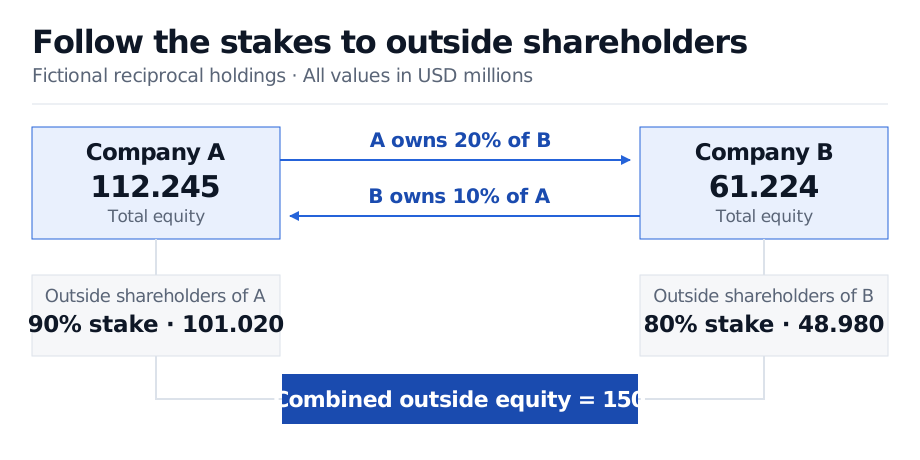
The arrows show who owns each stake. The bottom row counts only shares held outside the two companies.
In a sum-of-the-parts valuation, identify the shareholders whose claims you are adding. A's full equity includes its stake in B. An aggregate for outside owners across both firms removes the internally held claims from both companies' totals. In a filing, check the actual economic rights of the share classes before applying the ownership percentages. The example assumes each common share has the same claim on its company's equity. Damodaran, Holdings in Other Firms · Fischer, sections 2 and 4.3
Sources
- Aswath Damodaran, Holdings in Other Firms, NYU Stern.
- IFRS Foundation, IAS 28, Investments in Associates and Joint Ventures, paragraph 10.
- IFRS Foundation, IFRS 10, Consolidated Financial Statements, paragraphs 20–22 and B86.
- Tom Fischer, No-Arbitrage Pricing Under Cross-Ownership, author preprint, sections 2 and 4.3.