Sum-of-the-parts valuation (SOTP) estimates what a group is worth by valuing its businesses or holdings separately and reconciling them to the value of the parent’s common equity. A regulated utility and a power developer can face different risks and growth prospects even under the same parent. Separate valuations let those differences affect the result. Damodaran, NYU Stern valuation course notes
Value each operation on a common date
Start with the segment disclosures and map what each line covers. Reconcile the segments to the full group so you pick up omitted operations and avoid counting internal sales or financing twice. A discounted cash flow using unlevered cash flows gives an operating enterprise value. A peer EV/EBITDA multiple gives an enterprise value estimate from a different input. In that case, match the peer multiple to a segment EBITDA measured on a comparable basis, including the period and treatment of operating costs. Translate all estimates and bridge adjustments into the same currency as of the same valuation date.
Group headquarters may pay for functions the segment forecasts leave out. If those costs are needed to run the businesses and sit outside the segment values, deduct the present value of the incremental cash outflows. If a forecast already includes its share of headquarters costs, a second deduction for those cash flows would understate value. In the July 2026 NextEra Energy and Dominion Energy joint proxy statement, Lazard used different discount-rate ranges for Florida Power & Light and NextEra Energy Resources, included a negative value for NextEra’s Corporate and Other segment in its DCF, and then bridged from group enterprise value to equity. Damodaran, NYU Stern valuation course notes · Joint proxy statement and prospectus, Lazard financial analyses
Carry each debt balance through once
Suppose a fictional group owns all of Business A and Business B. Their operating enterprise values are 140 million and 80 million USD on the same date. Both exclude central overhead with a present value of 10 million USD. Group net debt is 50 million USD, including 20 million at B. Assume the group has no other claims or separately valued assets.
If you put B into the model at its equity value of 60 million USD, its 20 million of net debt has already been deducted. Use the remaining 30 million in the final bridge. This route gives the same 160 million USD of parent equity.
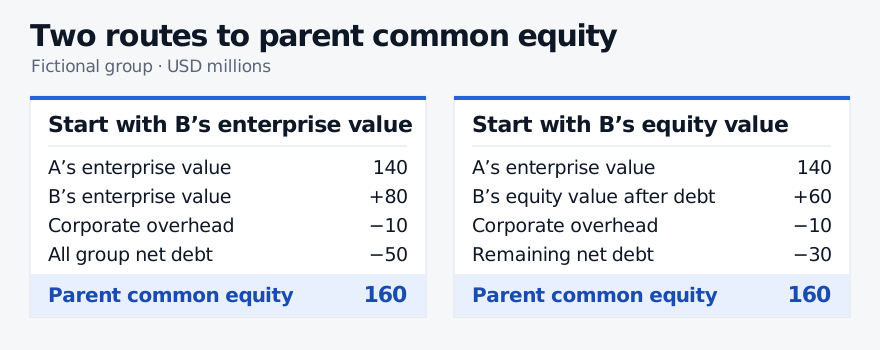
Where you deduct Business B’s net debt depends on the value you carry into the bridge.
Reconcile the rest of the group
- Non-operating assets. Add the value of an equity holding only if its cash flows and assets sit outside the operations you valued. For a quoted stake, the parent’s shares in the investee times the investee’s price gives an equity input. Its debt is already reflected in that price. Treat excess cash separately only to the extent that it is outside the operating values and the net-debt figure.
- Outside owners and other claims. If you include all of a partly owned subsidiary’s operating value and all of its net debt, deduct the estimated value of the outside shareholders’ equity. If you instead include only the parent’s stake in that subsidiary’s equity, keep the subsidiary’s debt, cash and outside equity out of the remaining bridge. Deduct the value of other claims, such as preferred equity, if the bridge has yet to account for them. Damodaran, Holdings in Other Firms · Damodaran, Getting to equity value per share
The resulting equity value is a model estimate. Comparing it with the parent’s market capitalisation gives the separate holding-company or conglomerate discount when the shares trade below the estimate. If the scenario assumes an actual break-up, account for changes such as lost shared purchasing benefits, replacement overhead and taxes triggered by a sale.
Sources
- Aswath Damodaran, NYU Stern equity valuation course notes, 21 April 2024 entry, item 5 on sum-of-the-parts valuation.
- NextEra Energy and Dominion Energy, Joint proxy statement and prospectus, 24 July 2026, Lazard’s NextEra Energy sum-of-the-parts analyses.
- Aswath Damodaran, Holdings in Other Firms and Getting to equity value per share.