Segment reporting is the disclosure of a company’s financial performance by reportable business segment in the notes to its financial statements. It shows which businesses generate sales and profit when the consolidated income statement blends their results. A rising group margin, for example, can come from higher sales in an already high-margin division even when each division’s own margin holds steady.
How management’s view becomes a public disclosure
IFRS 8 and US GAAP Topic 280 start from how management runs the business. Under IFRS 8, an operating segment carries out business activities that can generate revenue and incur expenses, has separate financial information available, and has results that the chief operating decision maker (CODM) reviews regularly to assess performance and allocate resources. The CODM is a function that a person or a group can perform. A company might run its business by product line even if its subsidiaries are organised by country. IFRS 8, paragraphs 5–10 · FASB ASU 2023-07, ASC 280-10-55-15D
An operating segment becomes reportable through a separate assessment. Under IFRS 8, segments with similar economics can be aggregated if the applicable criteria are met, including similarities such as products, customers and distribution. The revenue test uses 10% of the combined internal and external revenue of all operating segments. There are separate 10% tests for profit or loss and assets. Reportable segments must together cover at least 75% of the entity’s external revenue, so a segment below the individual thresholds may still need separate disclosure. IFRS 8, paragraphs 11–16 and 22
Why segment sales add to more than group revenue
In a fictional group, Equipment reports USD 80 million of revenue, including USD 20 million from sales to Services. Services reports USD 60 million, all from outside customers. With no other reconciling items, the segment note reaches consolidated revenue in two ways, in USD millions.
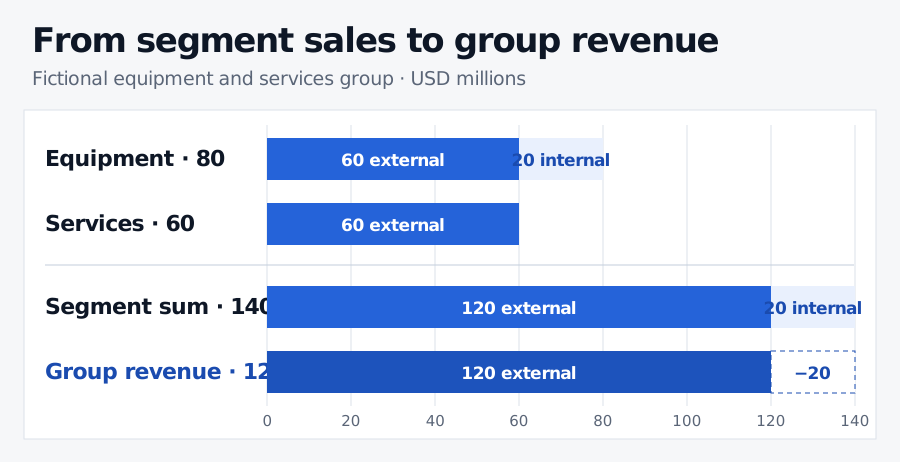
The internal sale belongs in Equipment’s segment revenue here. The group removes it when reporting revenue from outside customers.
Each segment supplies half of group revenue from customers. Use the external sales split to forecast consolidated sales. Keep the internal sales separately if modelling the volume or pricing of transfers between the two businesses. In a filing, the annual segment note reconciles reported segment revenue to the consolidated total. IFRS 8, paragraphs 23 and 28 · FASB ASU 2023-07, ASC 280-10-50-30
What a segment margin includes
Read the profit definition and its own reconciliation. A segment margin based on the CODM’s profit measure can exclude headquarters costs or reflect internal transfer prices. That matters for a sum-of-the-parts valuation, where each segment’s profit must be comparable to the profits used to price its peers. Check whether a reorganisation moved activities between segments before calculating growth, and use prior-period figures recast on the new basis when available. IFRS 8, paragraphs 25–30 · FASB ASU 2023-07, ASC 280-10-50-27 through 50-36
For public entities in scope of Topic 280, ASU 2023-07 adds annual and interim disclosure of significant expenses that enter each reported segment profit measure and that the CODM regularly receives or can readily compute from information provided regularly. The note also identifies other segment items, the residual after deducting disclosed significant expenses and reported segment profit or loss from segment revenue, and describes what it contains. That residual can include unlisted expenses as well as gains and losses that enter the profit measure. The amendments apply to fiscal years beginning after 15 December 2023 and to interim periods within fiscal years beginning after 15 December 2024. FASB ASU 2023-07, ASC 280-10-50-26A through 50-26C, 50-28C and 50-32
In Carpenter Technology’s fiscal 2026 filing, the sales reconciliation removes intersegment sales. The separate profit reconciliation also deducts corporate costs that the company leaves outside the segments. Carpenter Technology, fiscal 2026 Form 10-K, Note 20