A holding-company or conglomerate discount is the percentage by which a parent’s traded common equity is below the equity value implied by valuing its businesses or holdings separately. For a holding company, the benchmark starts with the stakes it actually owns. For a conglomerate, it can start with estimates of what its operating businesses are worth separately. Analysts use sum-of-the-parts valuation to build the benchmark and the discount to measure the gap to the market. Berger and Ofek, Diversification’s effect on firm value · Damodaran, Holdings in other companies
Compare the same claim
Compare the parent’s market capitalisation with a model estimate of the same common equity on the same date. A quoted subsidiary stake can start from the shares the parent holds times their quoted price. The subsidiary’s debt is already reflected in that equity price. When starting instead from the full enterprise value of each business, adjust for net debt and any other claims ahead of or outside the parent’s common equity. Account for parent liabilities and shared costs once, on the same ownership and valuation basis as the parts. Damodaran, Holdings in other companies · Macquarie Capital, Project Lexington valuation exhibit
Consider a fictional parent with two wholly owned businesses worth 200 million and 100 million USD on an enterprise basis. The present value of shared corporate functions the businesses would still need on a standalone basis is 20 million USD. This cost is incremental to the segment estimates. Group net debt is 50 million USD. Assume no other claims, non-operating assets beyond cash included in net debt, or separation adjustments in this benchmark.
The parent’s traded common equity is 184 million USD. For a positive parts estimate, use this sign convention.
A positive result means the shares trade at a discount to the estimate. A negative result means they trade at a premium. The percentage uses estimated common equity as its base.
How much of the gap could shareholders realise?
Start with the uncertainty in the benchmark. Sparse segment disclosures can obscure costs or make the right peer valuation multiple hard to choose. Hold the share price, debt, corporate costs and Business A’s estimate fixed in the example. If Business B is worth 40 million USD in a lower case or 130 million USD in an upper case, the same market value implies an 8.2% premium or a 29.2% discount. The scenarios change the estimate while the market quote stays put.
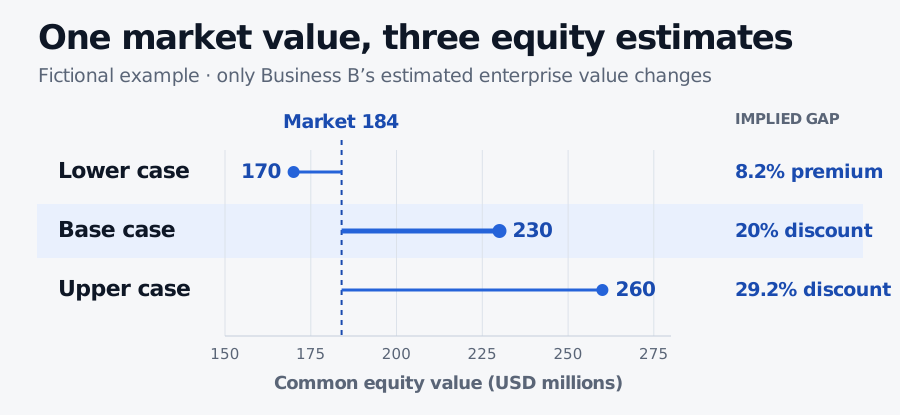
Changing the estimate for one business can flip the sign of the gap while the share price stays fixed.
Then model the path from owning the parent to receiving the value of the parts. A sale can trigger taxes and fees. A spin-off can require duplicated systems or sacrifice shared purchasing power. Include the value of any lost synergies only to the extent that the segment forecasts still assume them. In its 2025 spin-off information statement, Qnity estimated recurring costs of operating independently and one-time costs such as building stand-alone IT systems. Its statement also set out the tax consequences if the distribution failed to qualify for tax-free treatment. Qnity Electronics, spin-off information statement
The parent’s shareholders generally depend on its board to sell assets or distribute subsidiary shares. Even where a subsidiary already trades, shorting it against the parent can introduce borrow and funding risk, and the relationship can end before prices converge. An arbitrage would require a way to lock in the payoff. The 20% here is the gap to a conditional equity estimate. Mitchell, Pulvino and Stafford, Limited Arbitrage in Equity Markets
Sources
- Philip G. Berger and Eli Ofek, Diversification’s effect on firm value, Journal of Financial Economics, 1995. The study uses a log ratio on total capital as its excess-value measure.
- Aswath Damodaran, Holdings in other companies, Damodaran on Valuation, chapter 11, section 4.2.
- Macquarie Capital, Project Lexington valuation exhibit, slides 15–16, 2010.
- Qnity Electronics, Spin-off information statement, 2025.
- Mark Mitchell, Todd Pulvino and Erik Stafford, Limited Arbitrage in Equity Markets, Journal of Finance, 2002.