Corporate bankruptcy is a court-supervised process for administering a company's property and resolving claims against it. Reorganisation changes the company's obligations, ownership or operations under a plan, often so the business can continue. For a credit analyst, the filing changes the recovery question. What can the company realise from a sale or continued operation, and how much of that value reaches this particular claim? The discussion here uses U.S. federal bankruptcy law. U.S. Courts, Chapter 7, Chapter 11
What the filing changes
A U.S. bankruptcy petition creates an estate that generally includes the debtor's interests in property. Filing also generally triggers the automatic stay, which pauses many actions to collect pre-filing debts or enforce liens. Section 362 lists exceptions, including certain government regulatory actions. The court can also lift or modify the stay, for example when a creditor's interest in property lacks adequate protection. 11 U.S.C. § 541(a), § 362(a), (b)(4), (d)
- Chapter 7. A trustee administers and liquidates estate assets. Chapter 7's distribution rules generally put statutory priority claims ahead of general unsecured claims, with collateral rights handled separately. A court can authorise temporary operation of the business when that helps the liquidation. U.S. Courts, Chapter 7, “Role of the Case Trustee”, 11 U.S.C. § 726
- Chapter 11. The debtor typically stays in control as the debtor in possession. A court-confirmed plan can modify debt terms, issue new debt or equity, or sell the assets and distribute the proceeds in liquidation. During the case, debtor-in-possession financing can fund continued operations and a Section 363 sale can sell assets outside the ordinary course before a plan is confirmed. U.S. Courts, Chapter 11, 11 U.S.C. § 1123
Even in Chapter 11, liquidation value can matter. The best-interests test generally gives a nonaccepting holder in an impaired class a recovery floor based on what that holder would receive in a hypothetical Chapter 7 liquidation on the plan's effective date. Absolute priority and cramdown address different protections when a court is asked to confirm a plan over an impaired class's nonacceptance. 11 U.S.C. § 1129(a)(7), (b)
One estate, two sources of payment
Take a fictional debtor with 100 million in distributable cash before charges. Of that, 50 million comes from eligible collateral that fully covers the only secured claim. The other 50 million is unencumbered. Assume 10 million in process charges comes from that unencumbered pool, and the only remaining creditor class has 90 million of allowed unsecured claims, all principal. The example assumes immediate cash payments and no other claims.
After the process charges and secured payment, the unsecured class shares the remaining 40 million pro rata. Its recovery is of allowed principal. Old equity receives zero because the unsecured class uses all the remaining cash.
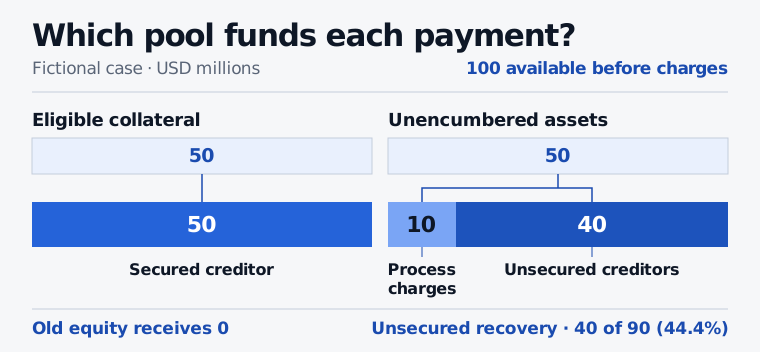
The pool that bears the charges is also the pool that funds the unsecured recovery.
This waterfall stipulates where the charges are paid. In an actual case, the estate, the allowed claims, lien rights and the applicable distribution rules or confirmed plan determine the payments. Administrative priority does not automatically put fees ahead of a secured creditor's rights to its collateral. For example, § 506(c) permits the trustee to recover reasonable and necessary costs of preserving or disposing of collateral from that property to the extent the secured creditor benefits. 11 U.S.C. § 506(a), (c), § 507(a)(2), § 726
Which date belongs in a recovery model?
The petition date starts the case. How much it tells the market depends on what has already happened. In a prepackaged Chapter 11, formal plan votes are solicited before filing and can count if the statutory conditions are met. In a prearranged case, the debtor negotiates terms with key creditors before filing and formally solicits votes afterwards. Both still require court confirmation. 11 U.S.C. § 1126(b), U.S. Trustee Program, Chapter 11 Case Administration, § 3-13
Confirmation is the court's approval of the plan. The plan's effective date and its distribution dates can differ from the confirmation date. A recovery model values the cash, new debt or equity the particular claim is expected to receive and accounts for when it can be delivered. In a filing-event backtest, timestamp when the filing became public and use only the terms and estimates available by that time. Later orders and distributions are subsequent observations. The SelfMadeQuant lesson on distressed convertible hedges shows how differing rank or guarantees can leave two claims on the same issuer exposed to different recoveries. 11 U.S.C. § 1123(a)(5), § 1129(a)(7), (11), Capital Structure and Distressed Convertible Hedges (public preview, full lesson for members)
Sources
- U.S. Courts, Chapter 7 Bankruptcy Basics
- U.S. Courts, Chapter 11 Bankruptcy Basics
- 11 U.S.C. § 362, Automatic stay
- 11 U.S.C. § 506, Determination of secured status
- 11 U.S.C. § 507, Priorities
- 11 U.S.C. § 541, Property of the estate
- 11 U.S.C. § 726, Distribution of property of the estate
- 11 U.S.C. § 1123, Contents of plan
- 11 U.S.C. § 1126, Acceptance of plan
- 11 U.S.C. § 1129, Confirmation of plan
- U.S. Trustee Program, Chapter 11 Case Administration, § 3-13