Cramdown is court confirmation of a U.S. Chapter 11 plan over the nonacceptance of an impaired class. In ordinary Chapter 11, the absolute priority rule is part of the protection for such a class of unsecured claims. If the plan gives its holders less than the full value of their allowed claims, holders of junior claims or interests generally cannot receive or keep property under the plan because of those junior positions. For a credit analyst, the distinction matters when valuing a proposed recovery. The amount available for distribution and the plan's ability to win confirmation are separate inputs. 11 U.S.C. § 1129(a)–(b)
Who has to accept?
A plan generally groups substantially similar claims or interests into classes, specifies how it treats each impaired class and gives claims or interests in the same class equal treatment unless a holder agrees to less favourable treatment. Impairment generally means the plan changes the rights attached to a claim or interest. The Code allows certain defaults to be cured and maturities reinstated without impairment if its conditions are met. 11 U.S.C. §§ 1122, 1123(a)(1)–(4) and 1124
For a voting class of claims, acceptance ordinarily requires at least two-thirds by dollar amount and more than half by number of allowed claims actually voted, excluding votes the court designates under § 1126(e). A voting class of equity interests has the two-thirds amount threshold alone. Unimpaired classes are presumed to accept. A class whose holders receive or retain no property under the plan on account of their claims or interests is deemed to reject it. 11 U.S.C. § 1126(c)–(g)
Section 1129(a)(8) requires each class to accept or be unimpaired. If that condition fails, the plan proponent can ask the court to confirm under § 1129(b). The other applicable requirements of § 1129(a) still apply. For example, if any class of claims is impaired, at least one impaired class of claims must accept, with insider acceptances excluded. The court also considers feasibility and the best-interests test, which generally gives each nonaccepting holder in an impaired class a floor based on its own hypothetical Chapter 7 recovery. Each impaired class that fails to accept must also receive fair and equitable treatment and be free from unfair discrimination under the plan. Unfair discrimination compares treatment across similarly situated classes, such as two unsecured classes of equal rank. Absolute priority asks what a junior holder receives. A consensual deal in which the affected senior class accepts is assessed under the applicable confirmation requirements without using that class's cramdown protection. 11 U.S.C. § 1129(a)(7)–(11), (b)(1), In re Tribune Co., Third Circuit, 2020, opinion pp. 4 and 24–27
What does fair and equitable require?
For an impaired class of unsecured claims that fails to accept, § 1129(b)(2)(B) provides two routes. The plan can give every holder in the class property worth the allowed amount of its claim as of the plan's effective date. Otherwise, the plan must give junior holders no property on account of their junior claims or interests, subject to the statute's exception for individual debtors' § 1115 estate property, which is subject to § 1129(a)(14). Property can include new shares. Even a right to buy shares can matter. In 203 North LaSalle, the U.S. Supreme Court rejected a plan that let old equity buy the new equity exclusively, without competition, while a dissenting senior unsecured class went unpaid in full. The Court left open the broader question of when a contribution of fresh capital can support an old shareholder's participation. 11 U.S.C. § 1129(b)(2)(B), Bank of America v. 203 North LaSalle, 526 U.S. 434, 454–58 (1999)
An impaired secured class that fails to accept has its own test under § 1129(b)(2)(A). The plan can preserve liens and provide deferred cash payments meeting both an allowed-claim total and a collateral-based present-value floor. Other routes include a qualifying collateral sale with liens attaching to proceeds and statutory credit-bidding protections, or treatment that provides the indubitable equivalent of the claims. Nonaccepting impaired equity classes also have a separate test under § 1129(b)(2)(C). Small-business debtors proceeding under Subchapter V have their own confirmation framework under § 1191. 11 U.S.C. §§ 1129(b)(2)(A), (C), 1181 and 1191
Follow 80 million through a waterfall
Suppose a fictional debtor has 80 million of distributable value, including enough eligible collateral to cover a single allowed secured claim of 50 million. Assume the secured claim is paid first from that collateral, the only other creditor class has 60 million of allowed unsecured claims, and old equity takes any remainder. All figures are in USD millions, with immediate cash distributions and no other claims or costs.
The secured creditor receives 50, leaving 30 for unsecured creditors and zero for old equity. The unsecured class recovers and has a shortfall of million.
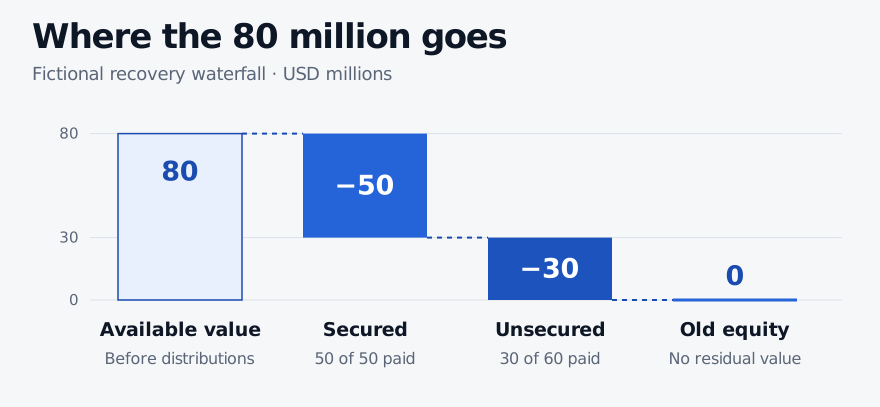
The collateral payment uses 50 of the 80 available. The remaining 30 covers half of the unsecured claims.
If the unsecured class is impaired and does not accept the plan, diverting any of its 30 to old shareholders because they held the old shares would fail the unsecured absolute priority test in this setup. Paying zero to old equity clears that particular obstacle. Confirmation still depends on class acceptance, the other confirmation requirements and the treatment of any other impaired nonaccepting class. 11 U.S.C. § 1129(a)–(b)
For a real recovery estimate, start with the allowed claims and collateral rights at the relevant debtor. Under § 506(a), a creditor can have both a secured portion and an unsecured deficiency. Collateral value depends on how the property will be used or disposed of, and an eligible § 1111(b) election can change the claim's treatment. Then value the actual package of cash, new debt or equity and test recoveries across scenarios. The SelfMadeQuant lesson on distressed convertible hedges shows how rank and guarantees can change recovery exposure across claims on the same issuer. 11 U.S.C. §§ 506(a) and 1111(b), Capital Structure and Distressed Convertible Hedges (public preview, full lesson for members)
Sources
- 11 U.S.C. § 506, Determination of secured status
- 11 U.S.C. § 1111, Claims and interests
- 11 U.S.C. § 1122, Classification of claims or interests
- 11 U.S.C. § 1123, Contents of plan
- 11 U.S.C. § 1124, Impairment of claims or interests
- 11 U.S.C. § 1126, Acceptance of plan
- 11 U.S.C. § 1129, Confirmation of plan
- 11 U.S.C. § 1181, Inapplicability of other sections
- 11 U.S.C. § 1191, Confirmation of plan in Subchapter V
- Bank of America v. 203 North LaSalle, 526 U.S. 434 (1999)
- In re Tribune Co., 972 F.3d 228 (3d Cir. 2020)