Debtor-in-possession financing, or DIP financing, is credit obtained after a U.S. Chapter 11 bankruptcy filing by the debtor that remains in control of the business. It can cover payroll, supplier bills and case costs while the debtor pursues a reorganisation or sale. For a credit analyst, the financing changes two questions. How long can the company meet its bills, and what claim will the lender have on the value that remains? U.S. Courts, Chapter 11 Bankruptcy Basics
An approved facility and a funded draw
A fictional debtor starts with USD 10 million in cash and has a court-approved USD 75 million new-money facility. It satisfies the draw conditions and receives USD 50 million. At funding, cash rises to USD 60 million and DIP principal rises from zero to USD 50 million, before fees and interest. The remaining USD 25 million is an undrawn commitment subject to the terms for a later draw.
Suppose the debtor then pays USD 20 million in payroll and supplier bills under the approved budget, with no other receipts, payments or principal repayments. Cash falls to USD 40 million and DIP principal stays at USD 50 million. A real cash forecast tests when each draw can fund and which disbursements the budget permits. For example, Marin Software’s 2025 DIP note required borrowing notices, variance reporting and satisfaction of draw conditions. Marin Software DIP note, §1
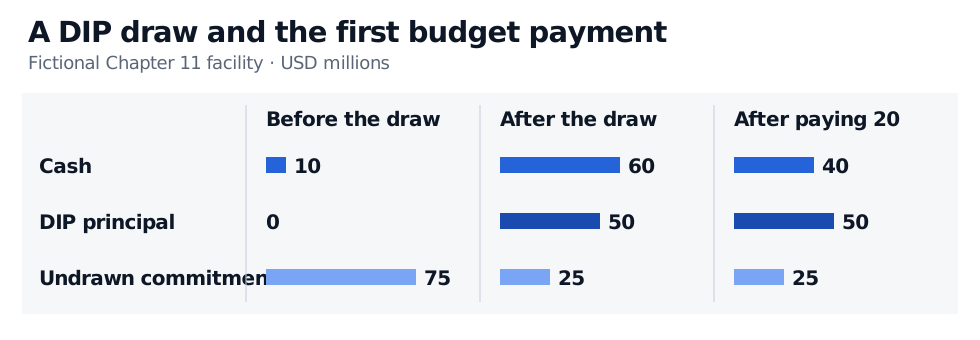
The draw converts part of the commitment into cash and debt. Spending the proceeds reduces cash while the funded principal remains outstanding.
The draw improves funding liquidity. Any change in enterprise value depends on what the financing enables. Keeping the business open through a sale may preserve operating value. The funded amount itself is a balance-sheet movement.
What the court can grant under §364
A DIP lender’s rights depend on the type of credit and the terms the court authorises. 11 U.S.C. §364(a)–(d)
| Provision | Treatment under Chapter 11 |
|---|---|
| §364(a) | A debtor authorised to operate may take ordinary-course unsecured credit as an administrative expense, unless the court orders otherwise. |
| §364(b) | After notice and a hearing, the court may authorise unsecured credit outside §364(a), also as an administrative expense. |
| §364(c) | If unsecured administrative-expense credit is unavailable, after notice and a hearing the court may grant priority over specified administrative expenses under §503(b) or §507(b), a lien on unencumbered estate property, or a junior lien on already encumbered estate property. |
| §364(d) | After notice and a hearing, the court may authorise a senior or equal lien on already encumbered estate property only if credit is otherwise unavailable and the affected lienholder’s interest is adequately protected. The debtor bears the burden of showing adequate protection. |
Superpriority under §364(c)(1) ranks the lender’s claim against administrative expenses specified in the order. A priming lien under §364(d) changes the ranking on particular collateral. The same facility can have both. Adequate protection can include payments or a replacement lien to cover a decline in the value of the affected property interest. Compare the financing order with any intercreditor agreement when estimating recoveries from shared collateral. 11 U.S.C. §364(c)–(d), 11 U.S.C. §361
Borrowing cash and spending cash collateral
A debtor may already hold cash collateral, such as cash proceeds of pledged receivables in which both the estate and a lender have an interest. To use cash collateral in the ordinary course under §363(c), the debtor needs the consent of every entity with an interest in it or court authorisation after notice and a hearing. Under §363(e), an interested party can ask the court to prohibit or condition use as necessary to protect its interest. Track cash the debtor has authority to spend and new cash it can still draw as separate inputs. 11 U.S.C. §363(a), (c) and (e)
In Silver Airways, interim cash-collateral authority proved insufficient to sustain operations. The court’s May 2025 order recounts an interim DIP approval with both priming liens and administrative superpriority. It also recounts the limit on spending proceeds to approved budget items. The financing helped bridge operations to a proposed Section 363 asset sale, and the May order granted the financing and bidding procedures motions. In re Silver Airways LLC, order of 19 May 2025, pp. 6–7 and 20
The SelfMadeQuant lesson on distressed convertible hedges applies collateral ranking and recovery scenarios when comparing claims on the same issuer. The preview is public and the full lesson requires membership. Capital Structure and Distressed Convertible Hedges