An intercreditor agreement is a contract that sets the relative rights of different creditor groups, often through their agents. When two groups have liens on the same assets, lien priority determines which group has the first claim on those assets and their proceeds. The agreement can also govern who may enforce the liens and who must hand over proceeds they receive. For a recovery estimate, that means tracing both the distribution of cash and when it can reach each creditor.
The second lien gets paid above 100
Suppose a fictional borrower has USD 100 million of first-lien debt and USD 80 million of second-lien debt, both secured on the same collateral. Both liens are enforceable. Assume no costs, accrued interest or other claims. The agreement applies net proceeds to the first-lien claim up to its face amount, then to the second-lien claim up to its face amount. With non-negative net proceeds , all amounts in USD millions are
| Net proceeds (USD millions) | First-lien recovery | Second-lien recovery |
|---|---|---|
| 90 | 90 (90% of face) | 0 (0% of face) |
| 130 | 100 (100% of face) | 30 (37.5% of face) |
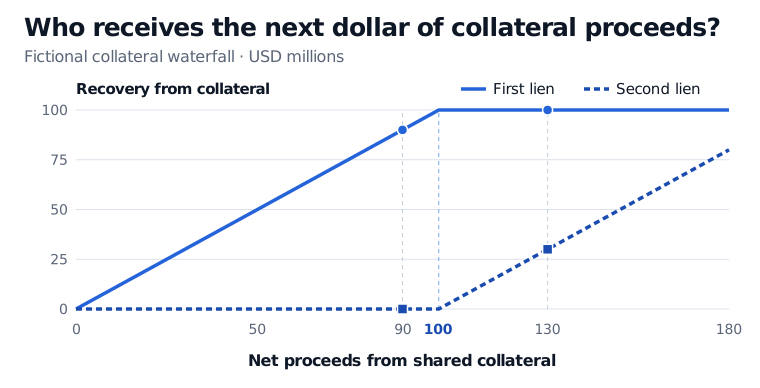
The first lien takes each additional dollar until it reaches 100. The second lien takes the next 80.
Of the extra 40, the first 10 fills the senior shortfall and the remaining 30 goes to the junior. These are recoveries from the shared collateral. Any unsecured deficiency or guarantee recovery requires a separate claim analysis. In an actual agreement, discharge of the first-lien obligations can require payment of accrued interest and fees, plus separate arrangements for outstanding letters of credit. 11 U.S.C. §506(a)(1), Crimson Exploration agreement, §1.02
Who can act and who keeps the proceeds
Crimson Exploration’s New York-law agreement dated 27 December 2010 gave the first lien priority and generally gave the first-lien agent control of collateral enforcement. The second-lien agent’s enforcement standstill ran for 180 days after the junior agent gave the senior agent written notice that the second-lien debt had been accelerated. The clock paused during specified stays, and the agreement could still block junior enforcement after expiry if the senior side was diligently pursuing remedies. Crimson Exploration agreement, §§2.01, 3.01, 3.02 and 10.07
The turnover clause required the junior side to pass specified collateral receipts to the senior agent before discharge of the first-lien obligations. The senior agent applied covered proceeds to the senior obligations, then sent any remainder it held to the junior agent. Section 3.03 separately allowed the junior lenders to receive required debt payments that did not result from the junior side exercising secured-creditor remedies or enforcing a junior lien contrary to the agreement. Crimson Exploration agreement, §§3.03 and 4.01–4.02
Which kind of priority applies?
Payment subordination governs specified payments or distributions on the junior debt itself. Evergy’s August 2026 prospectus describes unsecured junior notes whose payments can be diverted to holders of defined senior indebtedness on specified default or insolvency triggers. Structural subordination comes from which entity owes the debt. Evergy’s notes were obligations of the parent alone. In a subsidiary liquidation, its creditors have claims on the subsidiary’s assets ahead of any residual value flowing to the parent as shareholder. A release or transfer of collateral can also change which asset pool a creditor can reach. Evergy prospectus supplement, “Ranking” and “Subordination”
The law supplies the starting rules and limits. For collateral governed by New York’s Article 9, §9-322 generally ranks conflicting perfected interests by time of filing or perfection, subject to exceptions. Section 9-339 allows a party entitled to priority to subordinate it by agreement. In U.S. bankruptcy, §510(a) recognises contractual subordination to the extent enforceable under applicable nonbankruptcy law. Section 362 separately imposes an automatic stay that generally bars lien enforcement against estate property, subject to statutory exceptions and court relief. The agreement’s own enforcement clock operates alongside those rules. New York UCC §9-322, New York UCC §9-339, 11 U.S.C. §510(a), 11 U.S.C. §362(a), (b) and (d)
The SelfMadeQuant lesson on capital structure and distressed convertible hedges applies rank, guarantees and recovery scenarios when comparing claims on the same issuer. The preview is public and the full lesson requires membership. Capital Structure and Distressed Convertible Hedges