Collateral leakage occurs when assets or their value move beyond the reach of existing secured lenders. A covenant trapdoor is a provision, or combination of provisions, that can allow that move despite broader restrictions in the loan documents. The face amount owed can stay the same while the pool supporting it shrinks, changing what lenders can expect to collect in a downside scenario.
Read the transfer and the release separately
| Question | What to look for in the documents |
|---|---|
| Can value move? | A basket is an exception to a covenant, often with a dollar or formula-based limit. Trace each step against the relevant investment, disposition or restricted-payment provisions. Check how much capacity remains after prior use and how the agreement values the transfer. |
| Where does the asset land? | An unrestricted subsidiary is outside the scope of specified covenants under that agreement. It can still belong to the corporate group. Check the conditions for designation and whether the agreement treats the subsidiary’s existing assets as an investment that uses basket capacity. |
| Which creditor rights change? | A lien release removes a right over particular property. A guarantee release removes a particular entity’s promise to pay. Check the separate release triggers, any replacement collateral or required prepayment, and the lender consent threshold. |
The Acuren credit agreement as signed on 30 July 2024 illustrates those distinctions. It set a dedicated basket for investments in unrestricted subsidiaries and barred those subsidiaries from owning intellectual property used in and material to a loan party’s business. Section 10.09 set separate conditions for releasing a lien on assets disposed of in a permitted transaction and releasing a subsidiary guarantee. Acuren credit agreement, §1.01 and §10.09
If the receiving subsidiary later borrows against the transferred asset and the original lenders have neither a surviving lien on it nor a direct claim against that subsidiary, the new subsidiary lenders can be paid from its assets before residual value reaches the parent as equity. This is structural subordination. A change in who can claim which assets is distinct from a change in lien priority among creditors sharing collateral.
The loan stays at USD 200 million
Assume a fictional credit agreement permits the transfer and lien release of an asset valued at USD 70 million. The original lenders receive no paydown, substitute collateral or proceeds retained for their benefit. At the same valuation date, the pledged pool drops from USD 300 million to USD 230 million and the original secured principal remains USD 200 million.
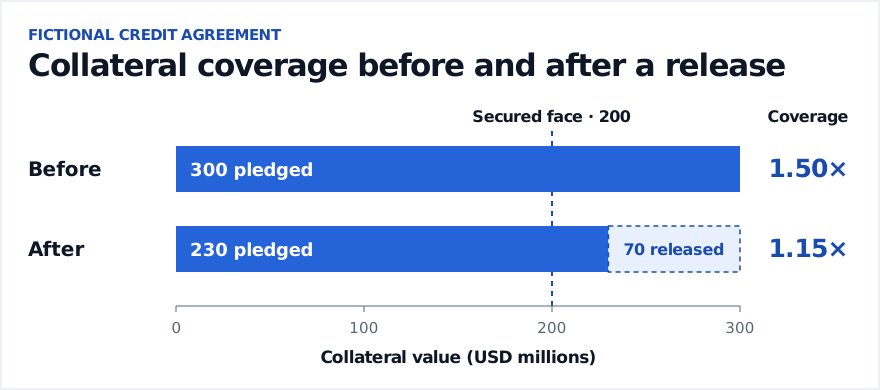
The dashed segment shows the value removed from the lenders’ collateral pool. The vertical reference marks unchanged secured principal.
At 1.15×, the estimated collateral value still exceeds principal. A recovery estimate needs the amount the collateral could realise under stress, net of enforcement costs and subject to competing claims, plus any distributions available through surviving borrower or guarantee claims. Model those distributions by legal entity and use consolidated figures to reconcile the model.
What the J.Crew dispute turned on
J.Crew reported that it moved US brand intellectual property to an indirect subsidiary in two stages in December 2016 and July 2017. The transferred rights then backed new secured notes with different lien priorities on the two portions. The company’s filing also reports a term-loan repayment as part of the 2017 refinancing. J.Crew Form 10-Q, “Debt Exchange and Refinancing”
In April 2019, New York’s Appellate Division affirmed the dismissal of the fraud claims and the claims against the loan agent. Under that agreement’s no-action clause, the contract claims alleging a transfer of all or substantially all of the collateral without unanimous approval fell within a specific exception to limits on individual lender suits. The appeal addressed which claims could proceed. Whether the transfers met the consent threshold was a separate question. In a similar analysis, distinguish a covenant’s permission for the transfer, any consent needed to release the security, and who can challenge the transaction. Eaton Vance Management v Wilmington Savings Fund Society