A Section 363 asset sale is a sale of property of a U.S. bankruptcy estate under § 363 of the Bankruptcy Code. In Chapter 11, the debtor in possession generally has the trustee’s power to sell assets outside the ordinary course under § 363(b), subject to the statutory notice and hearing requirements. A sale can cover a single asset or an operating business, even before a plan is confirmed. For a credit analyst, the sale price is a starting point. Cash at closing depends on the form of the bid, and recovery depends on which claims can reach the proceeds. 11 U.S.C. § 363(b), § 102(1), § 1107(a)
From opening bid to closing
A stalking horse is an initial bidder whose agreed offer sets a baseline for competing bids. A bidding procedures order can set bidder qualifications, deadlines and any protections for that initial bidder. If an auction is held, selecting a successful bidder is one step. The sale order authorises the transaction on specified terms, and closing still depends on the agreement’s conditions. In the FAT Brands case, the court’s May 2026 sale order records a separate procedures order and auction, and expressly makes closing subject to the purchase agreement’s conditions. E.D.N.Y. Bankruptcy Court, Sale Guidelines, § 1, In re FAT Brands Inc., preamble and ¶ 68
Under § 363(k), at a § 363(b) sale the holder of an allowed claim secured by a lien on the property being sold may bid and, if it buys that property, offset the claim against the purchase price. The court can limit or disallow that right for cause. The portion of a price satisfied by this credit bid brings in no cash. For a good-faith purchaser, § 363(m) generally preserves the validity of a completed sale despite reversal or modification of the authorisation on appeal, unless the authorisation and sale were stayed pending appeal. 11 U.S.C. § 363(k), (m)
What transfers free and clear?
For each outside interest to be removed under § 363(f), one of five bases must apply. Nonbankruptcy law allows a sale free of the interest, its holder consents, the interest is a lien and the price exceeds the aggregate value of all liens on the property, the interest is genuinely disputed, or its holder could be compelled in a legal or equitable proceeding to accept money in satisfaction of it. On request by an interest holder, § 363(e) requires the court to prohibit or condition the sale as needed to protect that interest adequately. 11 U.S.C. § 363(e), (f)
The purchase agreement identifies what the buyer assumes and what it excludes. An unpaid supplier claim that the buyer excludes can still be asserted against the estate, subject to the case’s claim rules. Selected contracts and leases may transfer under § 365, which can require curing defaults and showing that the buyer can perform. The FAT Brands order excepted assumed liabilities and permitted liens from its free-and-clear relief and provided for covered liens, claims and interests to attach to any qualifying cash proceeds. Check the order and agreement together to see what follows the assets, what attaches to proceeds and what remains with the estate. 11 U.S.C. § 365(a), (b), (f), In re FAT Brands Inc., finding W and ¶¶ 15, 22
From USD 100 million at closing to USD 90 million before distributions
A fictional manufacturer closes a court-approved sale for USD 100 million in cash. Assume that the estate pays USD 10 million in stipulated transaction costs from the proceeds and that these are the only cash flows in the sale calculation. Net sale cash before distributions is million USD.
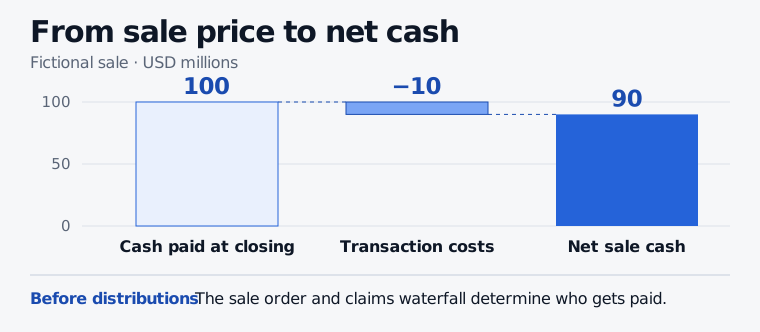
The closing cash bridge stops before any allocation to creditors.
To estimate what a creditor receives, identify any liens on the proceeds, the treatment of debtor-in-possession financing and the allowed claims with access to the remaining cash under the applicable distribution rules or plan. Track separate potential inflows, such as a fraudulent-transfer recovery, on their own timing. The SelfMadeQuant lesson on distressed convertible hedges applies that ranking question to two securities of the same issuer. 11 U.S.C. § 550(a), Capital Structure and Distressed Convertible Hedges (public preview, full lesson for members)
Sources
- 11 U.S.C. § 363, Use, sale, or lease of property
- 11 U.S.C. § 102, Rules of construction
- 11 U.S.C. § 1107, Rights, powers, and duties of debtor in possession
- 11 U.S.C. § 365, Executory contracts and unexpired leases
- 11 U.S.C. § 550, Liability of transferee of avoided transfer
- U.S. Bankruptcy Court for the Eastern District of New York, Sale Guidelines
- In re FAT Brands Inc., sale order, 19 May 2026