In U.S. corporate bankruptcy, a fraudulent conveyance, or fraudulent transfer, is a transfer of an interest in the debtor's property that can be set aside on grounds such as intent to hinder creditors or inadequate value under specified conditions. Clawback risk is the recipient's exposure to returning the property or paying its court-ordered value. For a credit analyst, the prospect of recovery can change how much the estate has available to distribute and when creditors may receive it. 11 U.S.C. § 548, § 550
What makes a transfer avoidable?
Section 548(a)(1) gives the trustee two grounds for avoiding certain transfers or obligations in the two-year window ending with the petition date. A Chapter 11 debtor in possession generally has the trustee's avoidance powers. 11 U.S.C. § 548(a)(1), (d)(1), § 1107(a)
- Actual intent. The issue is whether the debtor intended to hinder, delay or defraud a current or future creditor. 11 U.S.C. § 548(a)(1)(A)
- Constructive fraudulent transfer. The debtor must have received less than reasonably equivalent value and meet at least one additional condition. The debtor was already insolvent or the transaction made it insolvent. It had too little capital left for its business or a transaction it was undertaking or about to undertake. It intended or expected to take on debts beyond what it could pay as they fell due. Or the transfer or obligation went to or benefited an insider under an employment contract outside the ordinary course. This route can apply without proof of actual intent. Value to the debtor can include satisfaction or securing of its debt as well as property received. 11 U.S.C. § 548(a)(1)(B), (d)(2)(A)
Section 544(b)(1) is another route. It generally lets the trustee use applicable law, often state law, if an actual unsecured creditor with a qualifying claim could have challenged the transaction under that law. The applicable law supplies its own elements, defenses and timing rules. The lookback for the transaction is a separate question from the deadline to bring the avoidance action under § 546(a). 11 U.S.C. § 544(b), § 546(a)
An asset worth 100 sold for 20
Suppose a fictional manufacturer sells equipment to a buyer before filing. Assume the equipment was worth USD 100 million at the time of sale and that USD 20 million in cash was the only consideration the debtor received. The stipulated value gap is million. That gap flags the transaction for review. Whether the estate has a case depends on the applicable law, the timing and evidence such as the debtor's finances and intent at the time. The cash gap alone establishes neither avoidability nor an amount recoverable. 11 U.S.C. § 544(b), § 548(a), (d)
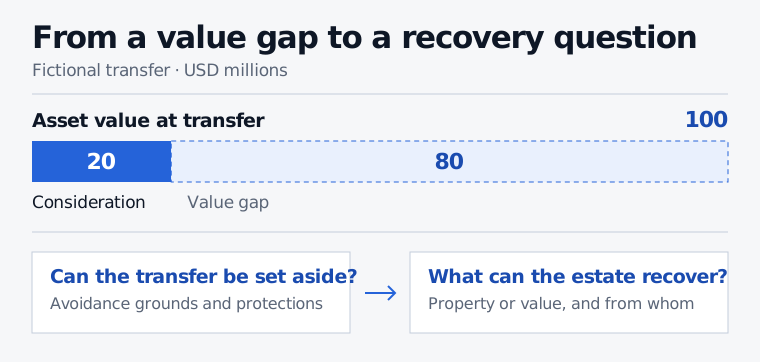
The gap measures the exchange at the time of transfer. The two legal questions determine whether any value comes back to the estate.
Avoidance sets aside the transfer to the extent permitted by law. Under § 548(c), a transferee that took for value and in good faith may have a lien or keep an interest to the extent of the value it gave the debtor, subject to the statute's limits. Recovery under § 550 brings the property, or its value if the court orders it, back for the benefit of the estate to the extent the transfer was avoided. Potential targets include the initial transferee, an entity for whose benefit the transfer was made and certain downstream transferees. A downstream buyer can have a defense if it took for value in good faith and lacked knowledge that the transfer could be avoided. The estate can obtain only one satisfaction. 11 U.S.C. § 548(c), § 550(a), (b), (d)
A preference under § 547 addresses a different problem. Even paying a valid old invoice can be avoidable if the payment was made while insolvent, fell within the relevant window, gave the creditor more than it would have received in a hypothetical Chapter 7 liquidation without the payment, and met the other statutory conditions. Ordinary-course and new-value defenses can matter. 11 U.S.C. § 547(b), (c)
How a recovery reaches a debt claim
In a distressed-debt valuation, treat a disputed transfer as a contingent source of estate value. Model a negotiated settlement, a collectible judgment and a failed action separately, with their own litigation costs and any proceeds and receipt dates. Then apply the distribution rules to estimate the effect on the specific claim. A claim arising from a § 550 recovery is itself assessed for allowance as though it arose before filing under § 502(h), so a recovery can change both the estate's assets and the claims it must address. Track a post-filing Section 363 asset sale separately as a disposition of estate property, with its own sale proceeds and timing. 11 U.S.C. § 502(h), § 550(a), § 363(b)
Sources
- 11 U.S.C. § 548, Fraudulent transfers and obligations
- 11 U.S.C. § 544, Trustee as lien creditor and as successor to certain creditors and purchasers
- 11 U.S.C. § 546, Limitations on avoiding powers
- 11 U.S.C. § 550, Liability of transferee of avoided transfer
- 11 U.S.C. § 547, Preferences
- 11 U.S.C. § 1107, Rights, powers, and duties of debtor in possession
- 11 U.S.C. § 502, Allowance of claims or interests
- 11 U.S.C. § 363, Use, sale, or lease of property