A provision is a liability recorded on the balance sheet whose settlement date or amount is uncertain. Under IAS 37, a contingent liability is a possible obligation from a past event whose existence depends on uncertain events outside the company’s full control, or an existing obligation that falls short of the recognition criteria because payment is insufficiently likely or the amount cannot be estimated reliably. A legal reserve is an informal name for a liability the company has recorded for losses from litigation or other legal claims. Cash earmarked for settlement would be a separate asset. For an equity or credit analyst, the distinction matters because the balance sheet can omit a meaningful exposure that appears in the notes. IAS 37, paragraphs 10–14 and 27–28
What qualifies for recognition?
IAS 37 requires a provision when all three conditions hold at the reporting date.
- There is a present obligation from a past event. It may be legally enforceable or constructive. A constructive obligation can arise when a company’s established conduct or specific commitment creates a valid expectation that it will act.
- An outflow to settle the obligation is probable. IAS 37 uses more likely than not, meaning a probability above 50%. If the existence of the obligation is in doubt, IAS 37 separately assesses whether an obligation is more likely than not to exist, using all available evidence.
- The amount can be estimated reliably. An estimate can be reliable even when the settlement amount remains uncertain. IAS 37 expects a sufficiently reliable estimate in all but extremely rare cases.
A contingent liability stays off the balance sheet and generally goes in the notes unless the chance of outflow is remote. The notes describe the obligation and, where practicable, its financial effect, uncertainties about amount or timing, and possible reimbursement. For example, a lawsuit can start as a note disclosure and become a provision if new evidence shows a present obligation, probable payment and a reliably estimable amount. IAS 37, paragraphs 14–16, 23–30 and 86–92
Why a 10% warranty claim rate can still lead to a provision
A fictional manufacturer has sold 1,000 units with identical warranties that cover manufacturing defects. Customers cannot buy this warranty separately and it provides only assurance that the product works to specification. The sales create present obligations, the estimates are reliable and discounting is immaterial. Each warranty has a 10% chance of costing USD 1,000 and a 90% chance of costing zero. IFRS 15, paragraphs B28–B32
IAS 37 assesses the chance of an outflow for similar obligations as a class. In this example the claims are independent, so the chance of zero payments is . At least one claim is therefore more than 99.99% likely to be paid. Once recognition is established, IAS 37 measures a large population using expected value. The provision aggregates the USD 100 expected cost per contract.
If instead a shared defect causes all 1,000 warranties to pay together with 10% probability and otherwise none pays, the expected total is still USD 100,000. The probability of any outflow then drops to 10%, so the class fails the probable-outflow test in that hypothetical. Adding the expected costs requires only the individual probabilities. Assessing whether anything will be paid also requires knowing how claims occur together. IAS 37, paragraphs 23–24 and 36–39
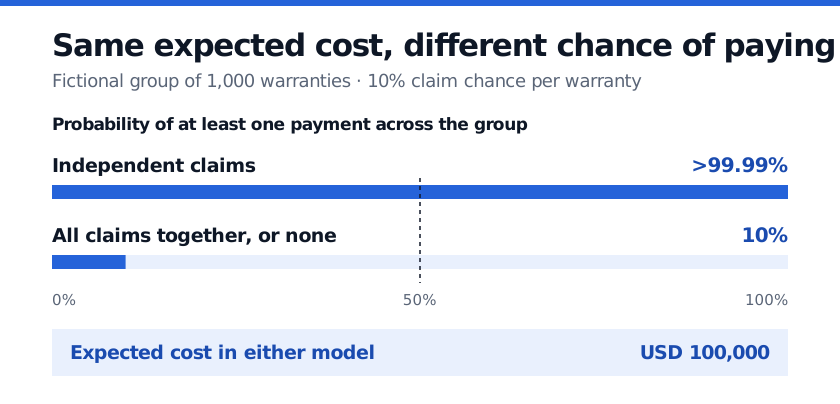
The dashed line marks 50%. IAS 37’s probable-outflow test requires the class probability to exceed that line.
A single recognised obligation, such as one lawsuit, calls for a different judgment. Its most likely outcome may be the best estimate, but a material chance of paying much more or much less can move the estimate. When the time value of money is material, IAS 37 measures the provision at present value. IAS 37, paragraphs 36–47
The SelfMadeQuant primer works through probability-weighted averages and how dependence changes the distribution of a total. The full lesson is free with an account. Expectation, Variance and Covariance
Comparing filings across accounting frameworks
For a legal loss contingency in scope of U.S. GAAP’s ASC 450-20, the company accrues a loss when available information indicates it probably incurred the liability by the reporting date and can reasonably estimate the loss. In ASC 450, probable means the confirming event is likely to occur, a qualitative threshold. For an asserted claim, the company generally discloses the nature of a material loss contingency if an unaccrued loss, or a loss beyond the amount accrued, is at least reasonably possible. The note gives an estimate or range, or states that an estimate cannot be made. ASC 450 calls for a descriptive label such as estimated liability for an accrual. ASC 450-20-25-2, reproduced in FASB EITF Issue 09-4, ASC 450-20-50-1 and 50-3 to 50-4, reproduced in FASB ASU 2010-20, SEC Staff Accounting Bulletin, Topic 5.Y
For a recorded IAS 37 provision, the movement table separates new charges, amounts used in settling the obligation and reversals of amounts no longer needed. In the warranty example, initially recording the provision increases liabilities and reduces profit on the income statement before any claims are paid. Later payments reduce the liability and appear as outflows on the cash flow statement. A valuation model that already forecasts the warranty payments captures that settlement cost in its operating cash flows. For legal exposures, read the contingency notes alongside that table. A model built only from recognised liabilities misses cases disclosed solely in the notes. IAS 37, paragraphs 59–62 and 84–88
As of 8 November 2026, the IASB listed final amendments to IAS 37 as the next milestone in its targeted improvements project. The recognition and measurement above follow the issued standard. IASB, Provisions—Targeted Improvements
Sources
- IFRS Foundation, IAS 37 Provisions, Contingent Liabilities and Contingent Assets
- IFRS Foundation, IFRS 15 Revenue from Contracts with Customers, warranty guidance
- IASB, Provisions—Targeted Improvements project
- FASB, EITF Issue 09-4 staff paper reproducing ASC 450-20-25-2
- FASB ASU 2010-20, which reproduces ASC 450-20-50-1 and 50-3 to 50-6
- SEC Staff Accounting Bulletin, Topic 5.Y, Accounting and Disclosures Relating to Loss Contingencies