Precedent transaction analysis estimates what a buyer might pay for a business from the prices agreed in earlier acquisitions of similar businesses. It expresses each deal price as a valuation multiple of a financial measure such as revenue or EBITDA, earnings before interest, taxes, depreciation and amortisation, then applies a benchmark from those deals to the target’s matching measure. Comparable company analysis uses quoted share prices. A negotiated acquisition price can reflect control rights, bidder competition and how much of the expected gains the seller captured. Arcosa, definitive merger proxy, Evercore’s trading and transaction analyses
From the headline price to 8×
Start by identifying what the headline price measures. If it gives the amount paid for the common shares, bridge it to enterprise value (EV) before dividing by operating earnings. Add debt and other claims included in your EV convention, such as preferred equity or outside ownership in consolidated subsidiaries. Deduct cash and other non-operating assets excluded from operating value. If the release already quotes EV, reconcile its components before making any adjustment. Arcosa, definitive merger proxy, Selected Transactions Analysis
For deals paid in shares, record the price date used to value the stock. Identify earnouts and their valuation basis separately from fixed consideration. An advertised maximum payout can produce a very different multiple from a present value that accounts for the chance of payment.
In a fictional acquisition of all the common shares, the price is 100 million USD, debt is 25 million and surplus cash is 5 million. The acquired business had 15 million of comparable trailing EBITDA available at announcement. A new target has 12 million of EBITDA on the same accounting and trailing-period basis at its own valuation date. With no other claims or non-operating assets, the calculation in millions of USD is
The 96 million values the target’s operations. To estimate common equity, use the target’s bridge. If it has 18 million of debt, 3 million of surplus cash and no other adjustments, implied common equity is 81 million.
Rebuild each deal as it looked at announcement
Record both the period measured and the date the information became available. A quarter can have ended by announcement while its results are still private. In the fictional deal, suppose the next earnings release includes that quarter and shows trailing EBITDA of 20 million. Substituting that later figure produces 6× and an implied target EV of 72 million. Using a later earnings release against the same announcement price introduces look-ahead bias and reduces the estimate by 24 million. The SelfMadeQuant lesson works through a similar timing issue with an earnings release and a later revision. Its preview is public and the full lesson requires membership. Point-in-Time Data
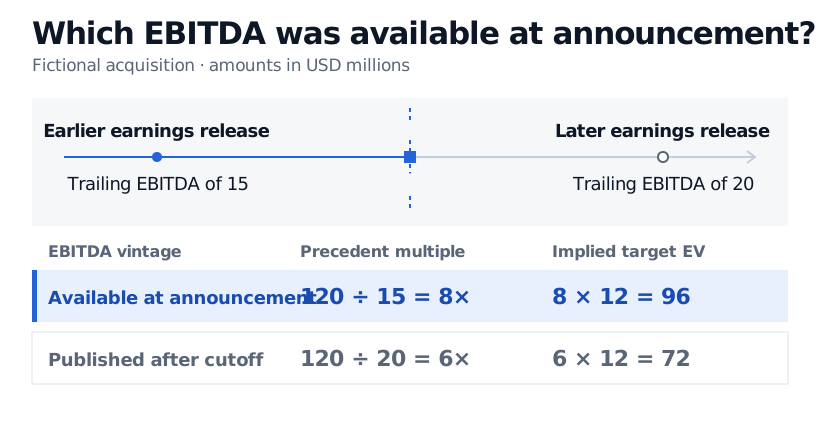
Both paths use the same deal price and target EBITDA. Only the information available at announcement can reconstruct the historical multiple.
Evercore’s analysis in the Arcosa merger proxy generally used trailing adjusted EBITDA available at each deal’s announcement, with disclosed exceptions where trailing data was unavailable. In the Boston Scientific–Penumbra filing, Perella Weinberg separately looked at deal EV relative to trailing revenue, forecast revenue and forecast EBITDA. If you use forecasts, keep the estimates from the relevant date and align the forecast horizons. Flag missing inputs and exclude a deal from the benchmark when you cannot construct a comparable multiple. Arcosa, definitive merger proxy, Boston Scientific–Penumbra, Selected Precedent Transaction Analysis
Reconcile EBITDA adjustments across deals and the target. A company that repeatedly incurs an expense may call it exceptional, but removing it every year can overstate ongoing operating earnings. Apply the same lease accounting treatment on both sides of the ratio. For leases treated as financing, include the corresponding liabilities in EV and measure EBITDA before those lease costs. For an after-rent comparison, keep the corresponding rental expense in EBITDA and exclude those liabilities from EV. Mixing the conventions changes both the price and the earnings being compared. IASB, IFRS 16 Effects Analysis, section 6.5
Decide which prices travel
An agreed price for control may reflect the value of changing how the business is run and part of the synergies available to that buyer. The observed takeover premium alone cannot separate those effects. Synergies can also appear in the denominator. CRH’s Arcosa announcement quoted a multiple of forecast adjusted EBITDA that included expected cost synergies. That headline ratio and Evercore’s trailing EBITDA benchmarks answer different questions. Adding a separate control premium or capitalising expected synergies on top of a deal benchmark can count value already embedded in the price. CRH and Arcosa, merger announcement, Arcosa, definitive merger proxy
Compare business mix, growth and reinvestment needs as well as deal terms, buyer type and the financing market at announcement. Keep minority-stake and carve-out deals separate unless the price and earnings cover comparable operations and ownership rights. A distressed sale and a competitive auction in a period of easy credit may say very different things about the same industry. A median can summarise the observed multiples. Explain separately which deals anchor the range you apply to the target. Check how the range shifts when an unusual deal is removed. A narrow range from a few disclosed deals reflects that sample and the judgement used to select it. Lazard, U.S. Concrete valuation analysis, Precedent Transactions Analysis
Sources
- Arcosa, Definitive merger proxy, Opinion of Evercore and Selected Transactions Analysis.
- Boston Scientific and Penumbra, Proxy statement/prospectus, Perella Weinberg’s Selected Precedent Transaction Analysis.
- CRH and Arcosa, Merger announcement filed as additional proxy material.
- IASB, IFRS 16 Effects Analysis, section 6.5.
- U.S. Concrete, Disclosure statement, Lazard’s Precedent Transactions Analysis.