Lease accounting determines how a contract to control the use of an identified asset for a period in exchange for payment is recorded in the financial statements. From the renter’s side, most leases put two amounts on the balance sheet. The right-of-use asset represents the right to use the property or equipment, and the lease liability represents the obligation to make lease payments. IFRS 16 and U.S. GAAP’s ASC 842 generally recognise both, but their presentation rules can produce different profit and operating cash flow for the same payment schedule. IFRS 16, paragraphs 5–9 and 22, ASC 842-20-25 and 45
Three payments create a 272.32 USD liability
A company leases equipment for three years and pays 100 USD at each year-end. Assume a recognised lease, a 5% effective annual discount rate, no purchase or renewal option, and no upfront payments, incentives, initial direct costs or restoration obligations. The opening liability is the present value of the three payments.
The opening right-of-use asset is also 272.32 USD in this example. An upfront lease payment, for example, would increase the asset’s cost while only unpaid amounts enter the opening liability. Both frameworks use the rate implicit in the lease when it is readily determinable and otherwise generally use the lessee’s incremental borrowing rate. ASC 842 also permits lessees that are not public business entities to elect a risk-free rate in place of the borrowing rate by class of underlying asset. IFRS 16, paragraphs 23–28, ASC 842-20-30, FASB’s risk-free rate amendment
During year one, the liability accrues interest at 5% of the opening balance, or 13.62 USD. The 100 USD payment covers that amount and reduces principal by 86.38 USD, leaving 185.94 USD outstanding. Carrying the unrounded balance into each period, the liability reaches zero just after the third payment. This same roll-forward applies to the example under IFRS 16 and under either ASC 842 classification. IFRS 16, paragraphs 36–37, ASC 842-20-35
The same payment can show up in different places
For the illustration, assume straight-line depreciation or amortisation over three years where the model separates that charge from interest. Assume no impairment, remeasurement or lease costs capitalised into another asset. Amounts below are in USD.
| Lessee treatment | Year-one income statement | Year-one cash payment of 100 |
|---|---|---|
| IFRS 16 | 90.77 depreciation plus 13.62 interest, for 104.39 total | 86.38 principal in financing. Classify the 13.62 interest under IAS 7. |
| ASC 842 finance lease | 90.77 amortisation plus 13.62 interest, for 104.39 total | 86.38 principal in financing and 13.62 interest in operating. |
| ASC 842 operating lease | A single lease cost of 100 | All 100 in operating for this example. |
In the ASC 842 operating-lease case, the single lease cost of 100 USD includes the 13.62 USD that accrues on the liability. The difference, 86.38 USD, reduces the right-of-use asset in year one. Under ASC 842, a lease can qualify as a finance lease if it transfers ownership or if its term covers a major part of the asset’s remaining economic life, among other criteria. A lease that meets none of the finance criteria is operating. Both frameworks permit an election for qualifying short-term leases, and IFRS 16 also permits an election for leases of low-value assets. Under ASC 842, operating lease payments that are costs of preparing another asset for its intended use go to investing instead. IFRS 16, paragraphs 5–8, 29–32 and 49–50, ASC 842-10-25 and 842-20-25 and 45, FASB’s Topic 842 post-implementation review, p. A-6
Before an entity applies IFRS 18, IAS 7 allows it to classify interest paid as operating or financing, consistently from period to period. When IFRS 18 applies, an ordinary manufacturer classifies interest paid in financing, so the full 100 USD in this example goes to financing. Entities that invest in assets or provide financing to customers as a main business activity apply the specific IAS 7 classification rules for those entities. IFRS 18 applies to annual reporting periods beginning on or after 1 January 2027, with earlier application permitted. IAS 7 before the amendments, paragraphs 31–33, IAS 7 as amended, paragraphs 34A–34D, IFRS 18, Appendix C and Appendix D
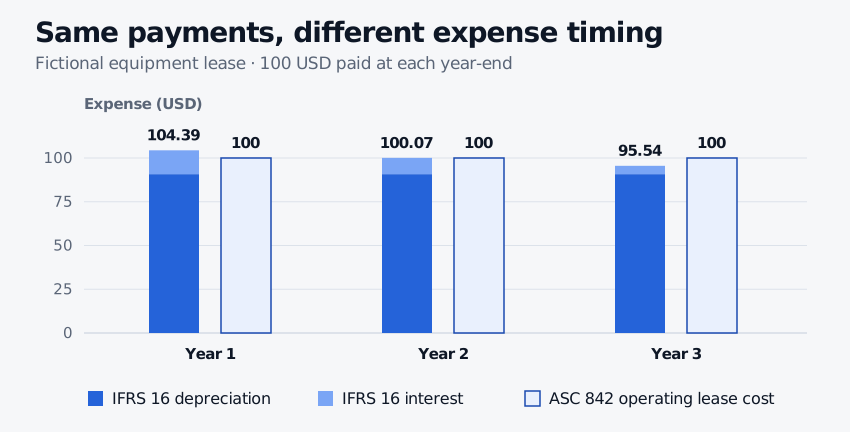
As the liability falls, so does the interest charge. Both treatments recognise 300 USD of total expense across the three years in this example.
Compare peers on a common lease basis
The difference matters when comparing EBITDA or reading the cash flow statement. An ASC 842 operating lease’s single cost generally reduces EBITDA. In the IFRS 16 example, the same contract’s interest and depreciation both sit outside an EBITDA calculation. Operating cash flow also looks higher under IFRS 16 because at least the principal goes through financing. Compare the lease notes and their payment schedules before interpreting those differences as stronger margins or cash generation.
For discounted cash flow valuation, align the projected cash flows with the enterprise-to-equity value bridge. If the model treats an existing lease liability as debt, its contractual payments belong on the financing side of the model and the liability belongs in the debt deduction. Deducting the liability from a value already based on cash flows after those same contractual payments counts the commitment twice. Aswath Damodaran, NYU Stern, debt in the equity value bridge
To practise discounting several dated payments, see Time Value of Money in the Finance Primer. The preview is public and the full lesson requires membership.
Sources
- IFRS Foundation, IFRS 16 Leases
- IFRS Foundation, IAS 7 Statement of Cash Flows before the IFRS 18 amendments
- IFRS Foundation, IAS 7 Statement of Cash Flows as amended
- IFRS Foundation, IFRS 18 Presentation and Disclosure in Financial Statements
- FASB, ASU 2016-02, Leases (Topic 842), Section A
- FASB, ASU 2021-09, Discount Rate for Lessees That Are Not Public Business Entities
- FASB, Post-Implementation Review of Topic 842, Leases
- Aswath Damodaran, NYU Stern, Debt to Subtract in Estimating Equity Value