An earnout is part of an acquisition price that the buyer pays to the seller after closing if the acquired business meets agreed targets. It lets the parties agree on an upfront price when they disagree on what the business will earn. Earnouts are a form of contingent consideration, which ties part of the deal price to a future outcome. A contingent value right can do this by giving eligible shareholders a claim tied to a milestone. For a deal model, the first question is how much the buyer owes in each scenario.
The contract sets the payout
A fictional deal provides for one possible cash payment, based on the first post-closing year’s adjusted EBITDA as defined in the agreement. Let be that EBITDA in USD millions. The seller receives 20% of the amount above USD 100 million, with a zero floor and a USD 15 million cap. The payment in USD millions is
At EBITDA of 90, 120 and 200 million, the seller receives 0, 4 and 15 million, respectively. The cap first binds at million. A higher EBITDA leaves the payment at 15 million.
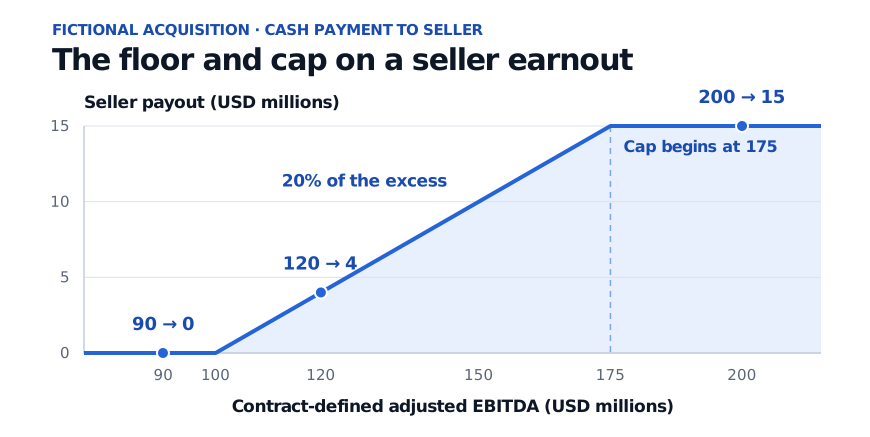
The seller receives USD 0.20 per additional dollar of adjusted EBITDA between the threshold and the cap. The payout stays flat on either side.
In the 2020 agreement for NN, Inc. to sell Precision Engineered Products to ASP Navigate, the earnout jumped from zero below the minimum EBITDA target to a positive payment at the target. The agreement specified the adjustments to audited earnings, required the buyer to share its calculation with the seller and provided for unresolved disputes to go to an independent accountant. The threshold formula and the definition of earnings both matter, particularly if integration changes which costs the acquired business bears. Stock Purchase Agreement, §1.7
Average the payments across scenarios
Give the three fictional EBITDA scenarios probabilities of 25%, 50% and 25%, respectively. The expected value of the cash payment before discounting is USD 5.75 million.
Average EBITDA is USD 132.5 million. Feeding that single number into the formula gives USD 6.50 million because it misses the effect of the floor and cap across the distribution. The SelfMadeQuant lesson Functions of Random Variables derives the expected-payoff calculation and works through another payoff with a threshold. The full lesson requires membership.
The USD 5.75 million is an undiscounted forecast under the assumed probabilities. Under IFRS 13, fair value of an earnout liability is the price to transfer the liability in an orderly transaction between market participants at the measurement date. A present-value model reflects the payment timing and the risks market participants would price, including the buyer’s risk of failing to pay. Scenario weighting and discounting need consistent assumptions so that the same risk enters the model only once. IFRS 13, paragraphs 9, 42–43, B13–B14 and B23–B26
What the buyer records under IFRS
For a business combination under IFRS 3, the acquisition-date fair value of contingent consideration enters the purchase price allocation as part of consideration transferred. The fictional obligation to pay cash when adjusted EBITDA exceeds the threshold is a financial liability. The buyer remeasures such a liability at each reporting date and recognises changes from post-close developments in profit or loss. A better earnings outlook can therefore create an accounting loss before cash changes hands. Qualifying new information about facts that existed at acquisition can instead adjust provisional acquisition accounting during the measurement period. The buyer accounts for subsequent settlement of an equity-classified earnout within equity, without remeasurement. IFRS 3, paragraphs 39–40, 45–49 and 58, IAS 32, paragraphs 11 and 25
If a seller forfeits the payment automatically on leaving employment and the service condition is substantive, IFRS treats the payment as compensation for post-combination services, outside the acquisition price. The IFRS Interpretations Committee reached the same conclusion for a handover arrangement with specified exceptions such as death or disability. If payment survives departure, assess the remaining terms, including whether selling shareholders who become employees get a higher payment per share than those who do not. IFRS 3, paragraphs 51–52 and B54–B55, April 2024 IFRS Interpretations Committee agenda decision
Sources
- NN, Inc., Precision Engineered Products Holdings and ASP Navigate, Stock Purchase Agreement (2020)
- IFRS Foundation, IFRS 13 Fair Value Measurement
- IFRS Foundation, IFRS 3 Business Combinations
- IFRS Foundation, IAS 32 Financial Instruments: Presentation
- IFRS Interpretations Committee, Payments Contingent on Continued Employment during Handover Periods (April 2024)