A contingent value right (CVR) is a contractual claim to an additional payment if a specified future condition is met. In a merger, an acquirer can give CVRs to eligible target shareholders alongside cash or shares at closing. This lets the parties close the deal while leaving part of the purchase price tied to an unresolved event. Like an earnout, a CVR is a form of contingent consideration. To value it, separate the amount promised on success from the value today of the right to receive it.
The agreement defines success
When Bristol Myers Squibb acquired Mirati in 2024, each eligible common share converted into USD 58 in cash and one CVR. The right offered a one-time USD 12 payment if the specified application for MRTX1719 was submitted and the FDA accepted it for filing by January 23, 2031, subject to the agreement’s termination provisions. Acceptance for filing was the trigger. A later decision to approve the drug was a separate event. Mirati CVR agreement, recitals and §§1.1, 4.2 and 6.8.
Transfer and payment had separate rules. The Mirati agreement barred exchange trading and generally barred transfers, with exceptions such as inheritance. If the milestone qualified, the acquirer had up to 15 business days to notify and fund the rights agent, which had up to another 15 business days after receiving the funds and any required instructions to pay registered holders other than equity-award holders. Other deals can allow trading. Bristol Myers Squibb’s 2019 Form 10-K reported that the CVR issued in the Celgene acquisition was listed on the NYSE. Mirati CVR agreement, §§2.2–2.4, Bristol Myers Squibb 2019 Form 10-K.
Value the right separately from the closing payment
In a fictional merger, each right pays USD 5 in one year if the defined milestone is met by then and zero otherwise. Its all-or-nothing payoff resembles a cash digital option. The merger agreement and the CVR agreement govern the claim, including who can hold it and how it settles. Those terms can differ from standardised exchange-traded option terms.
Take the risk-neutral probability of success as 40%, assume a 5% effective annual risk-free rate and assume the obligor pays in full if the milestone is met. The present value in this one-period model is
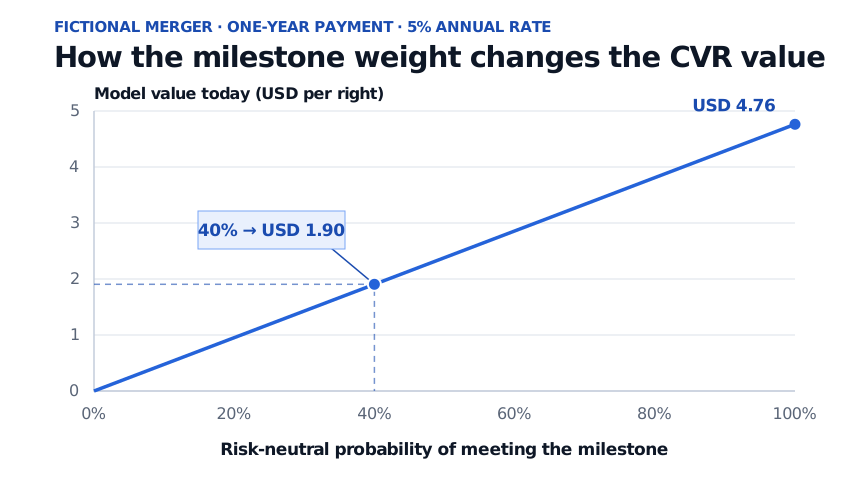
The upper endpoint is the value today of a certain USD 5 payment in one year. Each point on the line changes the assumed risk-neutral probability while holding the payment and discount rate fixed.
The 40% is a pricing input. If traded assets cannot replicate the milestone payoff, no-arbitrage alone may leave that input undetermined. In an actual deal, the buyer’s obligations to pursue the milestone can affect the chance it is met, the obligor’s credit affects whether holders are paid, and transfer restrictions or thin trading affect what a holder can realise from a sale. Even a traded CVR’s quote can therefore reflect more than the chance of success. MIT OpenCourseWare, One-Period Financial Models, §§2.3–2.4, Mirati CVR agreement, §§2.2 and 4.2–4.3.
The SelfMadeQuant lesson Market Model and Risk-Neutral Valuation derives the link between a one-period event claim’s price and its risk-neutral probability. The full lesson requires membership. Its replication argument applies when traded assets can reproduce the payoff in every state.