A digital option, also called a binary option, has a payment that switches on or off when a specified condition is met. The common cash version pays a fixed sum when the condition holds and zero otherwise. For a quant, the key feature is the jump: a small move across the trigger can change the entire payment, making approximation and numerical risk estimation sensitive to what happens near that boundary.
First specify what the trigger releases
For a European digital, the condition is tested at maturity . Let be the observed underlying price and the strike price. Two important variants share the same call trigger but release different payments:
| Variant | Call payment at maturity | What changes after activation? |
|---|---|---|
| Cash-or-nothing option | Nothing: the cash amount stays fixed. | |
| Asset-or-nothing option | for one underlying unit | The payment rises with the terminal asset value. |
Here is an indicator function: one if the event occurs, zero otherwise. The asset variant can deliver the asset or settle its value in cash, according to the contract. “Digital” therefore does not by itself identify the currency, quantity, settlement method or triggered payment. Hull treats both cash and asset binaries in §26.10; CQG's asset-binary specification also makes the distinct asset payment explicit.
The trigger needs equal care. A European cash call with and one with differ exactly at the strike. A put commonly reverses the direction of the price condition. A barrier option may instead depend on observations during the contract's life. The terminal formulas here do not describe that monitoring rule.
Why a tight call spread is only an approximation
Consider a synthetic cash-settled digital paying USD 10 at maturity if , and zero otherwise. The underlying is quoted in USD per unit. Equality produces zero; there are no intermediate observations. These are payments before premiums and funding costs, rather than profits.
Compare it with a call spread built from European calls on the same underlying, maturity and settlement basis: buy five calls struck at USD 99 and sell five struck at USD 101. Each synthetic call covers one underlying unit. Using , its terminal payment is
| Terminal underlying price | Digital payment | Call-spread payment |
|---|---|---|
| USD 98 | USD 0 | USD 0 |
| USD 100 | USD 0 | USD 5 |
| USD 102 | USD 10 | USD 10 |
Both structures pay zero at or below USD 99 and USD 10 at or above USD 101. Between those two strikes, the spread ramps continuously through intermediate payments, while the digital jumps. In particular, at USD 100 the lower call contributes USD 1 per unit and the upper call contributes zero, giving five times USD 1: USD 5, although the strict digital pays zero.
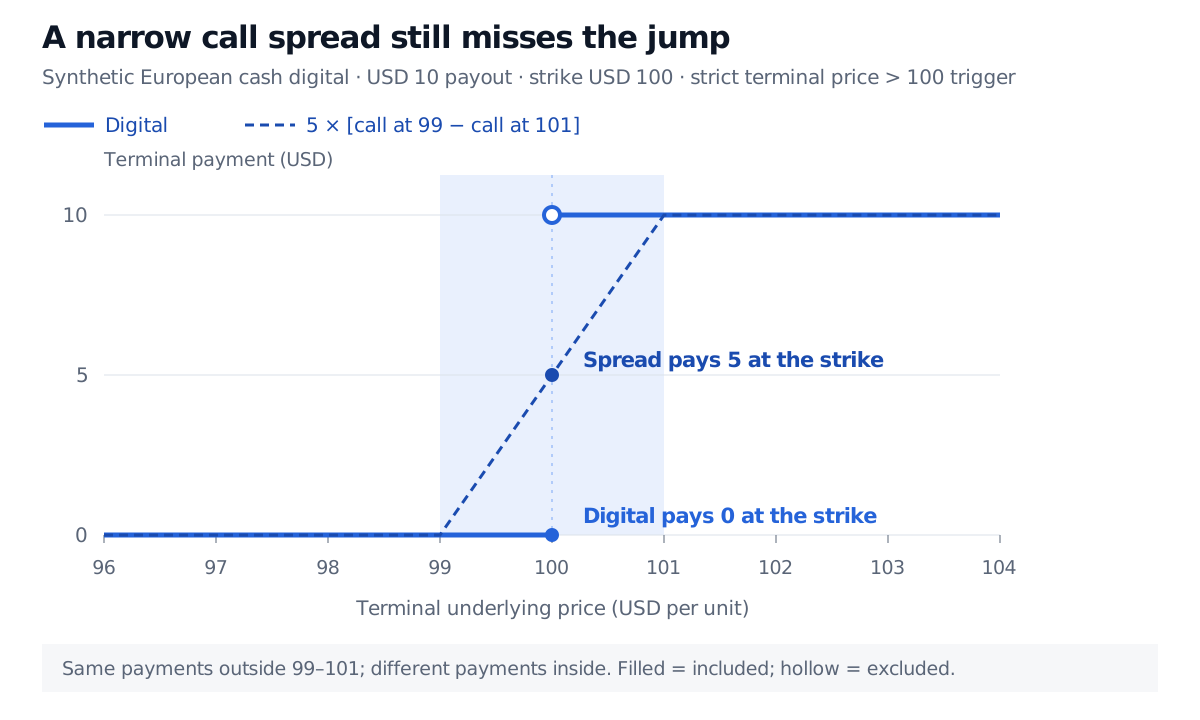
Original synthetic terminal-payoff comparison. Filled points include a value; the hollow point excludes it. The shaded band is the interval between the spread's two strikes. No price or hedge performance is inferred.
More generally, a symmetric spread with strikes and , scaled to a cash payment , has payoff
At each fixed terminal price away from , making sufficiently small eventually gives exactly the digital's payment. At , however, the symmetric spread always pays . Narrowing it cannot remove that boundary mismatch. The convergence away from the strike is not uniform over terminal prices: for every width there are still states near the strike with a material payment difference. A finite spread is consequently not an exact replication of the digital.
The numerical consequence of the jump
A terminal cash digital is flat on either side of its strike. Differentiating a simulated payment along a fixed path therefore gives zero away from the crossing, but the option's value can change as the probability of crossing changes. A zero pathwise payoff derivative does not establish a zero delta. Smoothing the payoff can help a numerical method, but it changes the contract being computed and introduces an approximation to control.
Greeks and Numerical Sensitivities develops this digital counterexample and discusses common random numbers, likelihood-ratio estimators and payoff smoothing. Its preview is public; the full lesson requires membership.
The digital's fixed triggered amount also does not make its premium a direct forecast of a real-world success probability. Valuation requires a model or market pricing framework, payment timing and discounting. The cash-or-nothing and asset-or-nothing entries develop those payment-specific distinctions.
Sources
- John C. Hull, Options, Futures, and Other Derivatives, 9th Global Edition, Pearson, 2018, §26.10, pp. 628–629: binary payoff definitions and the distinction between cash and asset payments.
- MathWorks, Cash-or-Nothing Digital Option: European cash digital definition and model-based valuation context.
- CQG, Asset-or-Nothing Binary: asset call and put payments with explicit strict inequalities.