A barrier option activates or cancels a payoff when the underlying reaches a specified level. Monitoring dates, equality rules and rebates determine which paths pay.
Barrier option
A barrier option is an option whose payoff eligibility changes when the underlying reaches a specified price level during the contract’s monitoring period. A knock-in activates the payoff; a knock-out cancels it. Two contracts can therefore finish with the same underlying price and still pay different amounts because their observed histories differ.
The barrier is separate from the strike price. The strike determines the ordinary option payoff; the barrier determines whether that payoff is eligible. Reaching a barrier does not by itself guarantee a positive payment.
Read the direction and the switch
For a standard single-barrier contract, “down” places the barrier below the initial underlying level and “up” places it above. Combine that direction with the activation rule:
Contract
Effect of a qualifying barrier hit
Down-and-in
A hit at the lower barrier activates the payoff
Down-and-out
A hit at the lower barrier cancels the payoff
Up-and-in
A hit at the upper barrier activates the payoff
Up-and-out
A hit at the upper barrier cancels the payoff
Each can be attached to a call or a put. A knock-in option still needs the ordinary payoff condition to be satisfied after activation. A knock-out option can lose its eligibility even if the underlying subsequently recovers.
Contracts may also specify a rebate, a separate payment associated with the barrier condition. Its amount and payment date must be read explicitly. The examples below have no rebate.
Same finish, different history
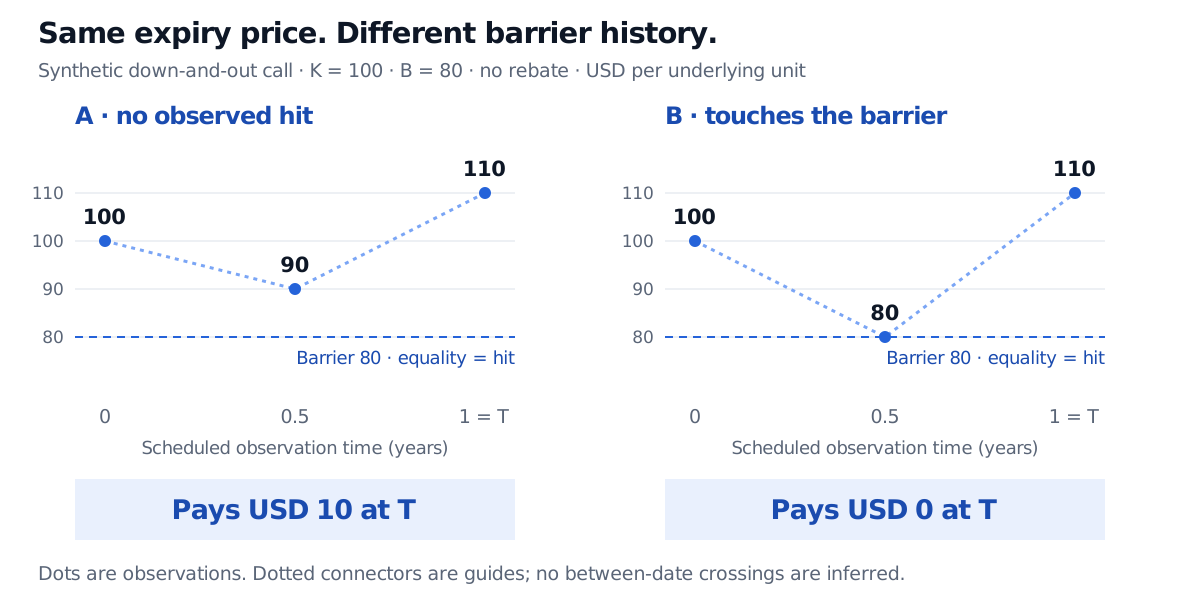
Take a synthetic cash-settled European call with strike K=100 and a down-and-out barrier B=80. Prices and cash payoffs are in USD per underlying unit. Monitoring occurs only at t=0,0.5,1 year, including both endpoints; equality with the barrier counts as a hit. Any eligible call payoff is paid at T=1 year.
Observation time (years)
Path A
Path B
0
100
100
0.5
90
80
1
110
110
Lowest observed price
90
80
Barrier hit?
No
Yes
Down-and-out payoff at T
10
0
Both terminal call payoffs before applying the barrier are max(110−100,0)=10. Path A retains that payoff. Path B touches 80 at the middle observation, so its payoff is cancelled permanently despite recovering to 110. Nothing is paid when it touches the barrier.
Two synthetic down-and-out call paths observed at 0, 0.5 and 1 year. Path A is 100, 90, 110 and pays USD 10. Path B is 100, 80, 110, touches the inclusive lower barrier 80 and pays zero. Both have strike 100 and settle at one year, with no rebate.
Original synthetic observations, in USD per underlying unit. Strike 100; lower barrier 80; equality counts as a hit; no rebate; cash payoff at T = 1 year. Dotted connectors are visual guides, not continuously observed paths.
Writing M for the monitoring dates, this contract pays
max(ST−K,0)1{mint∈MSt>B}.
The strict > in the survival condition implements the inclusive hit rule: a single observed value equal to B eliminates the payoff. This is a payoff calculation, excluding the option premium, funding and costs; it is not a price or investment profit.
Monitoring is part of what you bought
A discrete contract tests only its specified observations. These three prices cannot establish whether the underlying crossed the barrier between them. A continuously monitored contract tests the intervening path too. The distinction can materially affect valuation, as Broadie, Glasserman and Kou show.
For a zero-rebate knock-out with a nonnegative terminal payoff, adding monitoring times can only preserve or remove eligibility on a given path. It cannot create a larger payoff. Turning that statement into a price comparison requires the same underlying model, payoff and other terms. It gives no price for the synthetic paths above.
Also check the observation window, source of the observed price and whether touching or strictly crossing triggers the event. European exercise means the payoff is exercised at expiry; it does not mean the barrier is checked only at expiry.
The two switches partition one vanilla payoff
Match a knock-in and a knock-out on the same underlying, strike, expiry, barrier, observations and equality rule. Give both the same European terminal payoff and zero rebates. Then, on every path,
knock-in payoff+knock-out payoff=vanilla payoff.
On Path A the two payments are 0+10=10; on Path B they are 10+0=10. The knock-in in Path B pays at expiry, not at the barrier hit. This in–out parity follows because hit and no-hit are complementary events; Carr, Ellis and Gupta use the corresponding pricing relation for European barriers. Rebates or mismatched monitoring terms change the cash-flow comparison.
The Barrier Options lesson develops this pathwise partition and distinguishes contractual monitoring from numerical path discretisation. A public preview is available; the full lesson requires membership.
Sources
John C. Hull, Options, Futures, and Other Derivatives, 9th Global Edition (Pearson, 2018), §26.9, pp. 626–628: barrier types and monitoring conventions.
Peter Carr, Katrina Ellis and Vishal Gupta, Static Hedging of Exotic Options, Journal of Finance 53(3), 1998, §II: single barriers and European in–out parity.