Skip to content

Knock-in option

A knock-in option becomes eligible for its ordinary payoff after a qualifying barrier hit. Activation is remembered, but it neither guarantees a profit nor pays cash at the touch.

A knock-in option is a barrier option that becomes eligible for its ordinary option payoff only after a qualifying barrier hit. A buyer therefore purchases exposure conditional on the underlying reaching a specified level: finishing in the money is insufficient if the barrier condition was never met.
An up-and-in activates at an upper barrier; a down-and-in activates at a lower barrier. Either can govern a call or a put. The barrier controls eligibility; the strike price controls the size of the ordinary payoff. Their roles are separate.

The hit is remembered

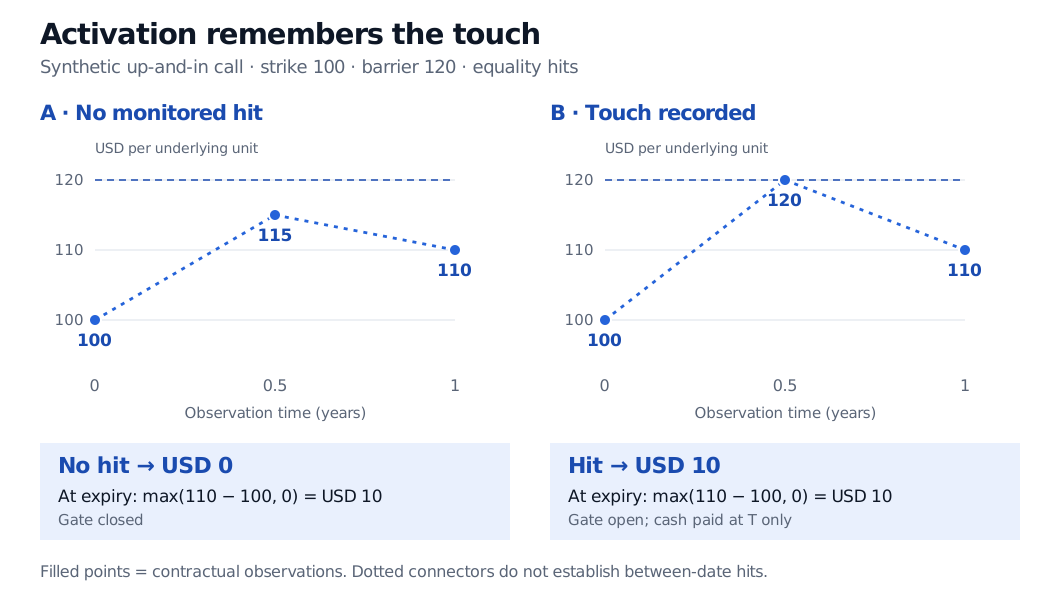
Consider a synthetic cash-settled European up-and-in call with strike K=100K=100 and upper barrier B=120B=120. Monitor only at t=0, 0.5, 1t=0,\ 0.5,\ 1 year, including start and expiry. Equality counts as a hit. Prices are USD per underlying unit; the contract pays cash for exactly one underlying unit at T=1T=1 year and has no rebate.
Contract observationPath APath B
Start: t=0t=0100100
Middle: t=0.5t=0.5115120
Expiry: t=1t=1110110
Barrier hit?NoYes, at the middle observation
Ordinary call payoff at expiryUSD 10USD 10
Knock-in cash payoff at expiryUSD 0USD 10

Path A never qualifies, even though its terminal price exceeds the strike. Path B qualifies when it touches 120. Its subsequent fall to 110 does not reverse activation: the call still pays max⁡(110−100,0)=10\max(110-100,0)=10 at expiry.

Two synthetic up-and-in call paths with strike 100 and inclusive upper barrier 120, observed at 0, 0.5 and 1 year. Path A is 100, 115, 110 and pays USD 0. Path B is 100, 120, 110 and pays USD 10 at expiry even though its final price is below the barrier.
Original synthetic observations, in USD per underlying unit. Both endpoints are monitored; equality counts as a hit; zero rebate. Cash payoffs at T = 1 year are for one underlying unit, undiscounted and before premium. Dotted connectors are visual guides only.

Writing M\mathcal{M} for the monitoring dates, the up-and-in call payoff is

max⁡(ST−K,0) 1{max⁡t∈MSt≥B}.\max(S_T-K,0)\,\mathbf{1}_{\{\max_{t\in\mathcal{M}}S_t\ge B\}}.

For a down-and-in, replace the hit condition with min⁡t∈MSt≤B\min_{t\in\mathcal{M}}S_t\le B. For a put, replace the ordinary call payoff with max⁡(K−ST,0)\max(K-S_T,0).

Activation is eligibility, not a cash payment

For this contract, touching the barrier neither exercises the option nor pays cash immediately. It removes one condition from the eventual settlement calculation. If the activated call subsequently ends at 95 with the same strike 100, its payoff is zero. A hit guarantees neither a positive payout nor a profit after the premium.

Nor does “inactive” mean valueless before the hit. Before expiry, a knock-in can have a positive market value because a future hit followed by a positive terminal payoff remains possible. The table calculates realised terminal cash flows; it does not calculate a premium or a return.

Once activation has occurred, the remaining payoff condition is the ordinary European option payoff under the same terms. This differs from a knock-out option, where a qualifying hit removes eligibility.

Which observations count?

A discrete contract checks the specified dates and observed price source. It does not infer a hit from a line connecting observations. The two paths above contain no information about between-date crossings. Continuous monitoring would inspect the intervening path as well; Broadie, Glasserman and Kou distinguish these monitoring conventions in their barrier-pricing analysis.

For the same realised path and nonnegative terminal payoff, adding contractual observations can only preserve or increase a zero-rebate knock-in payoff: a new observation may establish a hit, but it cannot erase an existing one. A price comparison also needs a common pricing model and all other contract terms held fixed. It gives no price for these two synthetic paths.

Check whether equality triggers, whether the start and expiry are included, the monitoring window, and any rebate amount and payment date. The inclusive rule used here is an explicit example convention. European exercise alone does not specify the barrier schedule.

Pairing the two barrier legs

Match the underlying, call or put payoff, strike, expiry, barrier, monitoring schedule, equality rule and settlement terms. If both legs have zero rebates and the same European terminal payoff, in–out parity gives

knock-in payoff+knock-out payoff=vanilla payoff.\text{knock-in payoff}+\text{knock-out payoff} =\text{vanilla payoff}.

Here, Path A splits the USD 10 vanilla payment as 0+100+10; Path B splits it as 10+010+0. The hit and no-hit events exhaust the possibilities. With matching terms, the corresponding prices also add by no-arbitrage. A different observation rule or an added rebate changes that cash-flow comparison.

For the partition argument and its monitoring implications, continue with Barrier Options. The public preview outlines the lesson; full access requires membership.

Sources

  • John C. Hull, Options, Futures, and Other Derivatives, 9th Global Edition (Pearson, 2018), §26.9, pp. 626–628: barrier classification, vanilla decomposition and monitoring frequency.
  • Mark Broadie, Paul Glasserman and Steven Kou, A Continuity Correction for Discrete Barrier Options, Mathematical Finance 7(4), 1997, pp. 326–327: terminal knock-in payoffs and separate continuous/discrete monitoring definitions. The inclusive equality rule and synthetic observations above are stated contract assumptions.
Last updated
  • barrier options
  • knock in
  • path dependence
  • monitoring
  • payoff
← Back to the glossaryBack to top ↑