A knock-out option loses its remaining option payoff when a specified barrier is hit. A recovery cannot undo a recorded hit; monitoring and rebate terms matter.
Knock-out option
A knock-out option is a barrier option whose remaining option payoff is cancelled if a specified barrier is hit during its monitoring period. A buyer can obtain selected option exposure for a lower premium than a matched vanilla option, but gives up the paths that trigger cancellation. A later price recovery does not restore the cancelled right.
The barrier is separate from the strike price. The strike determines the ordinary call or put payoff; the barrier decides whether that payoff remains available. A down-and-out contract knocks out at a lower barrier, while an up-and-out contract knocks out at an upper barrier. Either can be a call or a put.
The recovery does not revive it
Consider a synthetic European down-and-out call on one underlying unit, with strike USD 100 and lower barrier USD 85 per unit. Observe only at 0, 0.5 and 1 year, including both endpoints. Equality counts as a hit. There is no rebate, and any surviving cash payoff is paid at T=1 year.
Contract observation
Path A
Path B
Start: 0 years
100
100
Middle: 0.5 years
90
85
Expiry: 1 year
110
110
Barrier hit?
No
Yes, at 0.5 years
Cash payoff at expiry (USD)
10
0
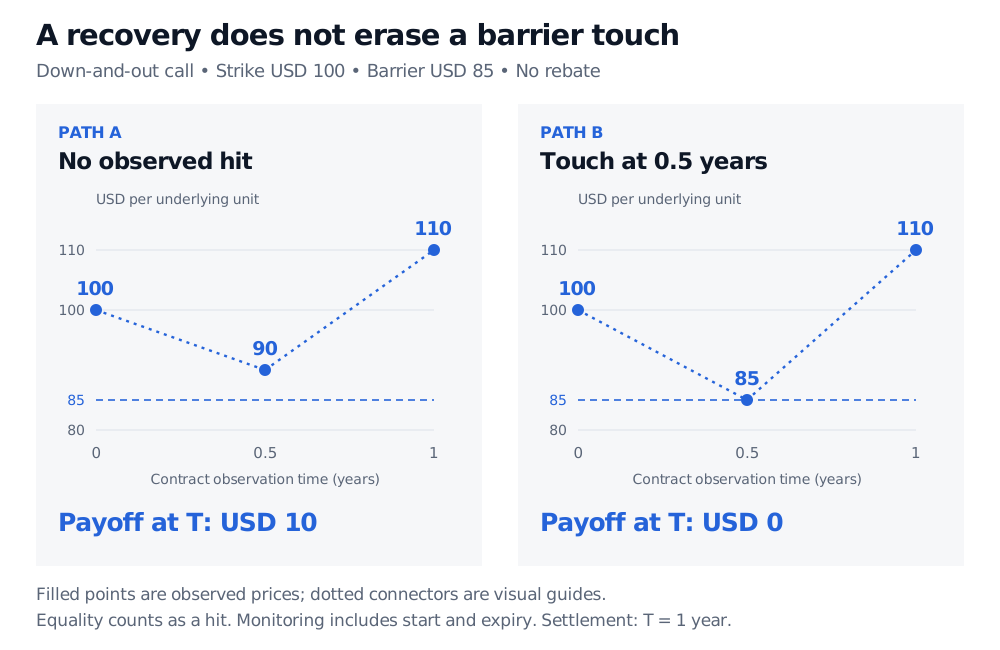
Both paths finish USD 10 above the strike. Only Path A still owns the right to that payoff. On Path B, touching 85 cancels the call; finishing at 110 cannot reverse the earlier hit. Knock-out is a lasting contract state, rather than a test applied only to the final spot.
Two down-and-out call paths end at 110. Path A has observations 100, 90, 110, avoids barrier 85 and pays USD 10. Path B has observations 100, 85, 110, touches the inclusive barrier and pays zero despite recovering.
Original synthetic discrete observations in USD per underlying unit. Strike 100; down barrier 85; monitoring at 0, 0.5 and 1 year includes both endpoints; equality is a hit; no rebate; settlement at T = 1 year. Dotted connectors are visual guides only.
Survival does not guarantee a positive payoff: the call must also finish above its strike. Nor is a positive payoff necessarily a profit. The premium and the timing and cost of funding it matter to the buyer's result.
Write the monitoring rule into the payoff
Let M be the specified observation dates, B the lower barrier and K the strike. For the inclusive-touch, zero-rebate down-and-out call above, the terminal cash payoff is
Xout=(ST−K)+1{mint∈MSt>B},(x)+=max(x,0).
For an up-and-out call with the same inclusive-touch convention, replace the survival condition by maxt∈MSt<B. For a put, replace the call payoff by (K−ST)+. The strict inequalities describe survival because equality triggers a hit.
Discrete monitoring and continuous monitoring are different contracts. A dip between the stated observation dates does not knock out this example. For a continuously monitored contract it could. Connecting the plotted observations supplies no evidence about what happened between them. Under otherwise matched zero-rebate terms, adding monitoring times can only remove surviving paths, so it cannot increase the knock-out payoff or its model value.
A real term sheet must also identify the observed price, observation window, endpoint and equality treatment, and any rebate. A rebate may leave a separate cash payment after cancellation; its amount and payment date are contract terms. The zero payoff on Path B relies on this example's explicit no-rebate convention.
When the barrier reduces the premium
A zero-rebate knock-out pays no more than the matched vanilla option on every path. The matched knock-in option supplies exactly the payoff that the knock-out discards:
Xout+Xin=Xvanilla.
This identity requires the same underlying, call or put, strike, expiry, settlement and barrier monitoring rules, with complementary hit events and no rebates. Under a common arbitrage-free valuation framework it gives the corresponding value identity. The knock-out value is no greater than vanilla; a strict discount requires positive value in the excluded payoff scenarios. Hitting the barrier on paths where vanilla would already pay zero need not create a discount.
Any discount buys narrower protection or participation. A down-and-out put used as downside insurance can disappear during the fall it was meant to protect against. An up-and-out call can lose its upside payoff when the underlying rallies into the upper barrier.
For a fuller treatment, Barrier Options develops in–out parity and the distinction between contractual monitoring and a numerical grid. The public page is a preview; the full lesson requires membership.
Sources
John C. Hull, Options, Futures, and Other Derivatives, 9th Global Edition (Pearson, 2018), §26.9, pp. 626–628: knock-out types, in–out decomposition and monitoring conventions.